


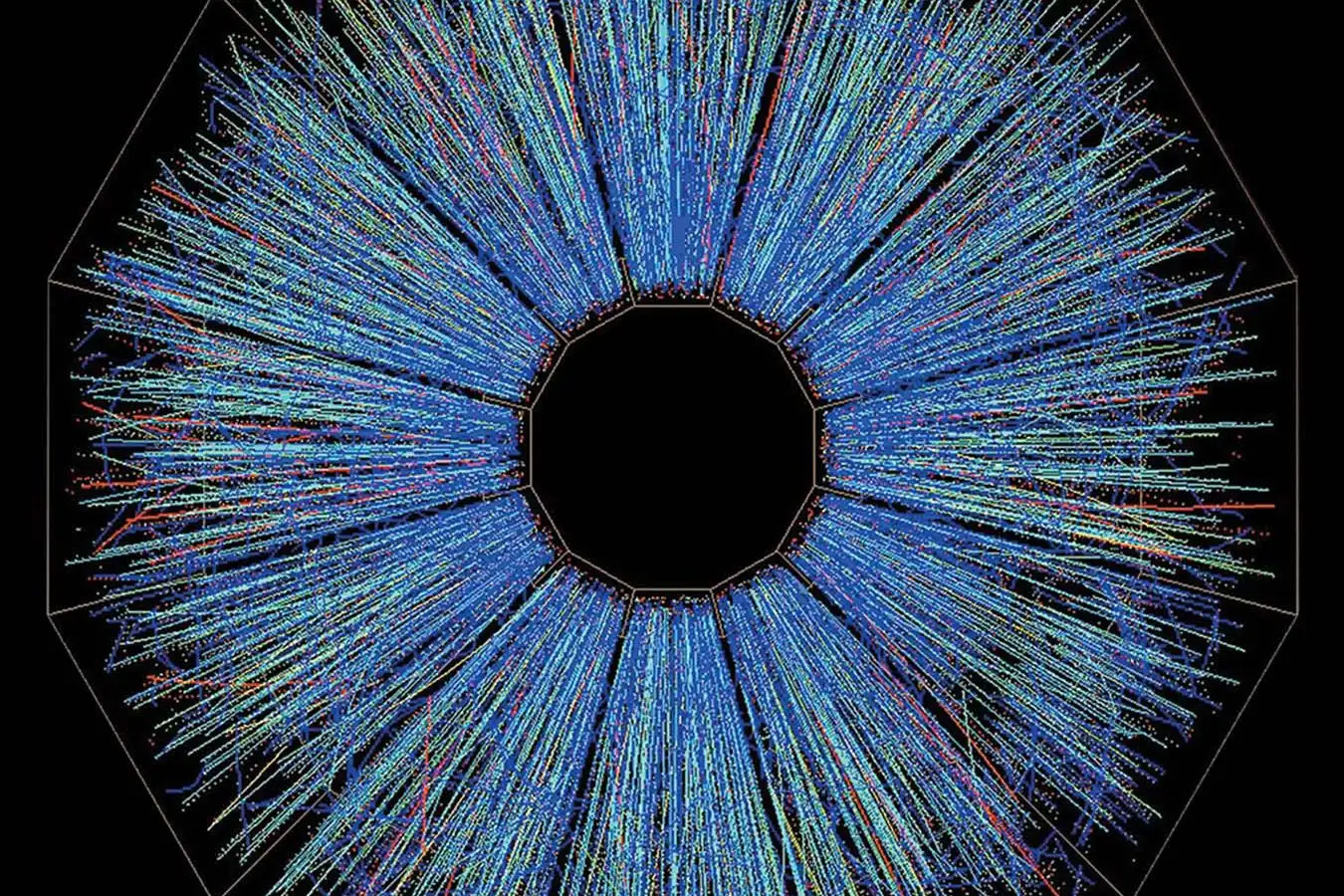
Particle collisions inside the STAR detector at the Solenoidal Tracker at RHIC, known as STAR
Brookhaven National Laboratory
A pair of rare particles produced in high-energy proton collisions may be the clearest evidence yet that mass can emerge from empty space. The finding could shed light on one of the biggest puzzles in physics: how particles acquire their mass.
According to quantum chromodynamics (QCD) – widely considered to be our best theory for describing the strong force, which binds quarks inside protons and neutrons – even a perfect vacuum isn’t truly empty. Instead, it is filled with short-lived disturbances in the underlying energy of space that flicker in and out of existence, known as virtual particles. Among them are quark-antiquark pairs.
Under normal conditions, these fleeting pairs vanish almost as soon as they appear. But if enough energy is injected into a vacuum, QCD predicts they can be promoted into real, detectable particles with measurable mass.
Now, the STAR collaboration – an international team of physicists working at the Relativistic Heavy Ion Collider in Brookhaven National Laboratory in New York state – has observed this process for the first time.
The team smashed together high-energy protons in a vacuum, producing a spray of particles. Some of these particles should be quark-antiquark pairs pulled directly from the vacuum itself, but quarks can never exist alone and immediately combine into composite particles.
Luckily for the team, these particular particles hold a clue as to their origins. Quarks and antiquarks are born with their spins correlated — a shared quantum alignment inherited from the vacuum.
The researchers found that this link persists even after the quarks and antiquarks become part of larger particles called hyperons, which decay in less than a tenth of a billionth of a second. Spotting these spin-aligned hyperons in the aftermath of the proton collisions allowed the researchers to confirm that the quarks within them came from the vacuum.
“This is the first time we’ve seen the entire process,” says Zhoudunming Tu, a member of the STAR collaboration.
“I’m very happy to see this measurement,” says Daniel Boer at the University of Groningen in the Netherlands, who wasn’t involved with the work. He says there are still many mysteries about quarks, such as why they can’t exist alone. “This is what makes this experiment especially interesting.”
Tu thinks that the work opens a new way to examine the properties of the vacuum directly, hopefully allowing scientists to study how particles acquire mass. The theory of QCD predicts that quarks gain more of their heft by interacting with the vacuum itself, but how they do so is unclear.
Alessandro Bacchetta at the University of Pavia in Italy says the result isn’t yet definitive, as reconstructing events from particle collisions can be complex. Researchers must first exhaustively exclude other possibilities that could have led to the same signal, he says.
Topics:
Source link : https://www.newscientist.com/article/2522324-particles-seen-emerging-from-empty-space-for-first-time/?utm_campaign=RSS%7CNSNS&utm_source=NSNS&utm_medium=RSS&utm_content=home
Author :
Publish date : 2026-04-08 12:00:00
Copyright for syndicated content belongs to the linked Source.