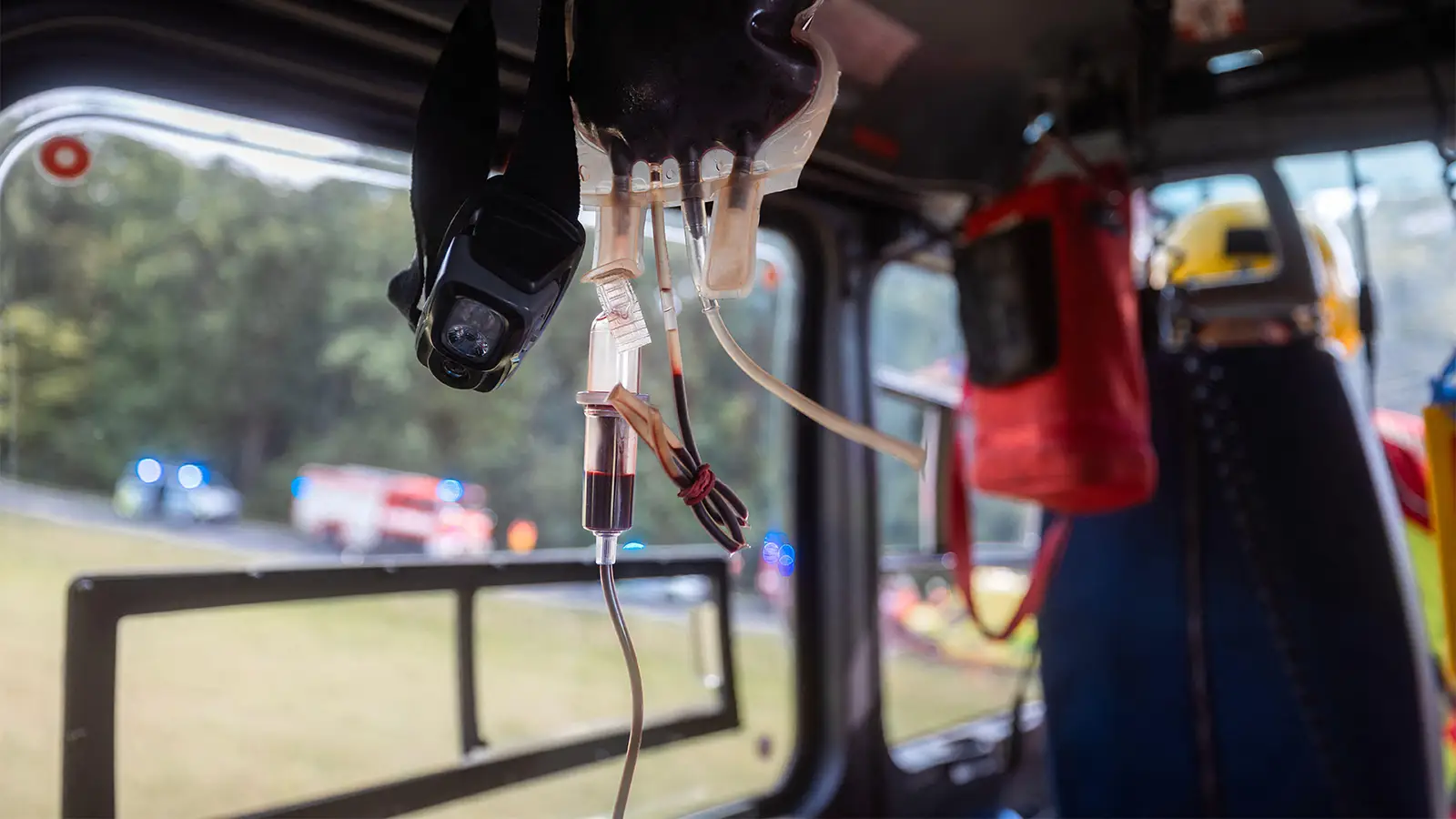
- A trial from England tested whether prehospital transfusion of 2 units of whole blood would be superior versus separated blood components for major traumatic hemorrhage.
- There was no difference between groups in the composite outcome of all-cause death or massive transfusion within 24 hours.
- However, there were logistical advantages with whole-blood transfusion, as well as a favorable safety profile.
Logistical advantages and safety aside, whole-blood transfusion offered no clinical improvement for the treatment of life-threatening hemorrhage in the prehospital setting, the randomized SWiFT trial found.
Among patients transported by air ambulances in England, the composite outcome of all-cause death or massive transfusion within 24 hours was about equally likely whether they’d gotten whole-blood transfusion or standard care such as blood components (48.7% vs 47.7%; relative risk 1.02, 95% CI 0.80-1.31), reported Laura Green, MD, of the NHS Blood and Transplant Clinical Trials Unit in Cambridge, England, and colleagues.
The incidence of death from any cause, massive transfusion (defined as ≥10 units of blood components or products), and other secondary outcomes were also individually similar between the groups. However, the standard-care group did log numerically more serious adverse events (37 vs 31) — leaving no safety concerns associated with whole-blood transfusion.
The study was published in the New England Journal of Medicine and simultaneously presented at this year’s International Symposium on Intensive Care and Emergency Medicine.
Green and colleagues suggested that the use of up to 2 units of whole blood may not have been enough to show clinical benefit. This approach may have more benefit in some groups over others, they added.
In any case, it can be argued that whole-blood transfusion still has a role absent a clinical reason to use it over separated parts such as red blood cells, platelets, and plasma.
“In the United Kingdom, prehospital transfusion by air ambulance teams usually involves the administration of red cells alone, or red cells and plasma as separate components,” Green and colleagues wrote. “Recently, leukocyte-depleted platelet-rich whole blood, containing red cells, plasma, and platelets, has become available and can be stored at 4°C [39.2°F] for up to 21 days. The use of a single bag streamlines logistics, shortens administration time, aids limited circulatory access, and decreases the risk of transfusion errors.”
One of the problems with platelet transfusion, for example, is the impracticality of the requirement for continuous agitation of platelets.
“This trial provides key evidence to inform the use of whole blood within civilian prehospital trauma systems,” the authors noted. “Decisions about adopting the use of whole blood must balance logistic advantages against supply constraints, cost, and the overall availability of blood.”
SWiFT was a phase III open-label superiority trial conducted by 10 air ambulance services in England. The researchers randomized 942 patients to whole-blood transfusion (up to 2 units) or standard care with blood components (up to 2 units each of red cells and plasma) before arrival at the hospital. Exclusion of patients with nontraumatic hemorrhage or traumatic cardiac arrest left 616 patients with major traumatic hemorrhage for the present analysis.
The incidence of thrombotic events appeared to be similar in the two groups.
With whole-blood transfusion, prothrombin times more frequently went above the normal range (40.7% vs 30.5%), Green and colleagues noted, although this did not translate into any difference in clinical outcomes.
“A plausible explanation for this finding could be the age of the plasma in the two groups — plasma within the whole-blood units was up to 21 days old, as compared with plasma that was typically less than 5 days old in the standard-care group,” they wrote, pointing to potential differences in clotting factor levels.
Limitations to the trial included variable adherence to the protocol, and the potential inclusion of some patients without life-threatening hemorrhage due to a reliance on clinical judgment to initiate transfusion. In addition, a cyberattack on a national trauma research database in 2023 resulted in some lost data.
Source link : https://www.medpagetoday.com/emergencymedicine/emergencymedicine/120349
Author :
Publish date : 2026-03-17 20:34:00
Copyright for syndicated content belongs to the linked Source.