
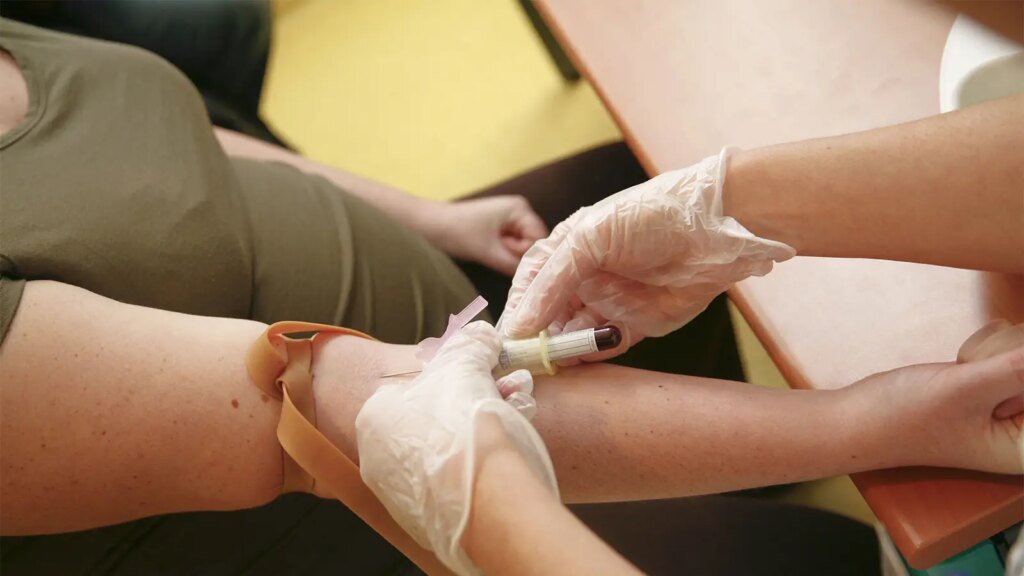
- Four states — Arizona, Georgia, Louisiana, and Michigan — enacted mandates for prenatal syphilis screening in the third-trimester of pregnancy and at delivery.
- These mandates were associated with a short-term increase in maternal syphilis case detection that was no longer significant at 1 year.
- Complementary supports are needed for clinicians and patients to generate sustained impact, according to the researchers.
Four U.S. states that mandated more frequent syphilis screening during pregnancy and at delivery had increased case detection rates, but the effect waned in the year after those laws took effect, according to an observational study of more than 16 million live births.
In the first quarter after enacting expanded prenatal syphilis screening mandates, Arizona, Georgia, Louisiana, and Michigan together saw the incidence of maternal syphilis case detection increase by 26% (P=0.02), reported Jessica Cohen, PhD, of the Harvard T.H. Chan School of Public Health in Boston, and colleagues.
This translated to an overall difference-in-difference estimate of 19.5% more cases detected per quarter — or 32.2 additional cases per 100,000 live births — with the mandate than without it (P=0.04), the research team detailed in JAMA Health Forum.
That positive detection bump faded in the year after the mandates’ enactment, however. After the first quarter’s significant increase, the next three quarters trended toward an 11% increase without reaching statistical significance (P=0.48).
“Our study suggests that mandates can generate a meaningful boost in case detection after they are enacted, but that it may be short-lived,” co-author Sara Baum, also of Harvard T.H. Chan School of Public Health, told MedPage Today. “Mandates alone may not come with the complementary supports needed for clinicians and patients to generate sustained impact.”
Congenital syphilis transmitted during pregnancy from mothers to babies can increase the risk of stillbirth, neonatal death, and low birth weight. After reaching historic lows in the early 2000s, U.S. congenital syphilis rates have spiked — climbing from 8.7 cases per 100,000 live births in 2013 to 105.8 cases per 100,000 in 2023.
Routine prenatal screening and treatment prior to delivery make congenital syphilis mostly preventable, and clinicians in many states have been required since the 1970s to offer first-trimester screening. Many clinical guidelines go further, backing multiple screens during pregnancy. The American College of Obstetricians and Gynecologists, for example, calls for universal screening three times during pregnancy, including at the first prenatal care visit, during the third trimester, and at birth.
Screening coverage across states is highly variable, however, and several factors may slow screening momentum over the longer term, Baum noted. It might not be clear whether insurance covers mandated screening, and physicians may find navigating the complicated testing algorithm for syphilis challenging.
The researchers analyzed how a state’s passage of a mandate expanding prenatal syphilis screening from the first trimester alone to the third trimester and delivery affected that state’s quarterly maternal syphilis rate per 100,000 live births. They studied all live births in 50 states and the District of Columbia between 2012 and 2022 using data from the National Center for Health Statistics.
Four states passed mandates during the period and had at least 2 years of post-treatment data, while 29 states without expanded mandates served as controls. The analysis excluded 16 states that had already had an expanded-screening mandate. The investigators compared the eight quarters before a mandate’s passage with the four quarters after.
From 2012 to 2022, there were 20,961 reported syphilis cases among the 16.3 million live births in the four mandate states and 29 control states. A total of 62% of pregnant women were white, 14% were Black, and 14% were Hispanic. Just over half (52%) of the pregnant women in the mandate states were on Medicaid, compared with 39% of those in control states.
At baseline in 2012 to 2014, mean quarterly syphilis case detection rates were higher in the mandate states than the control states, at 151 cases versus 49 cases per 100,000 live births, respectively. National maternal syphilis detection rates from 2012 to 2022 rose 445%, from 58 to 316 cases per 100,000 live births. Mandate states had case detection rise 252% in that period, from 126 to 443 cases per 100,000, while control states showed a 524% increase, from 49 to 306 cases.
While screening mandates can provide a meaningful boost in the short-term, testing is “just one piece of the puzzle,” Baum cautioned. “Testing itself requires having access to prenatal care in the first place, which for many is not guaranteed. People who do test positive still need to be able to access and complete treatment.”
Study limitations include an inability to assess which mechanisms led to case detection changes, or to distinguish the effects of expanding screening itself from screening implemented because of legal mandates. The researchers didn’t assess how case detection increases affected later maternal and infant outcomes.
Please enable JavaScript to view the comments powered by Disqus.
Source link : https://www.medpagetoday.com/obgyn/stds/120411
Author :
Publish date : 2026-03-20 16:50:00
Copyright for syndicated content belongs to the linked Source.