
[ad_1]
- While putting a patient face down has been shown effective in restrictive lung diseases, there’s been less rigorous evidence for primarily obstructive pathophysiology or for use in children.
- In this large randomized trial, prone positioning of infants on high-flow nasal cannula oxygen support for bronchiolitis didn’t significantly reduce risk of progression to needing positive pressure ventilation.
- While the study didn’t support universal use in this setting, further studies are needed to determine whether certain subgroups would benefit.
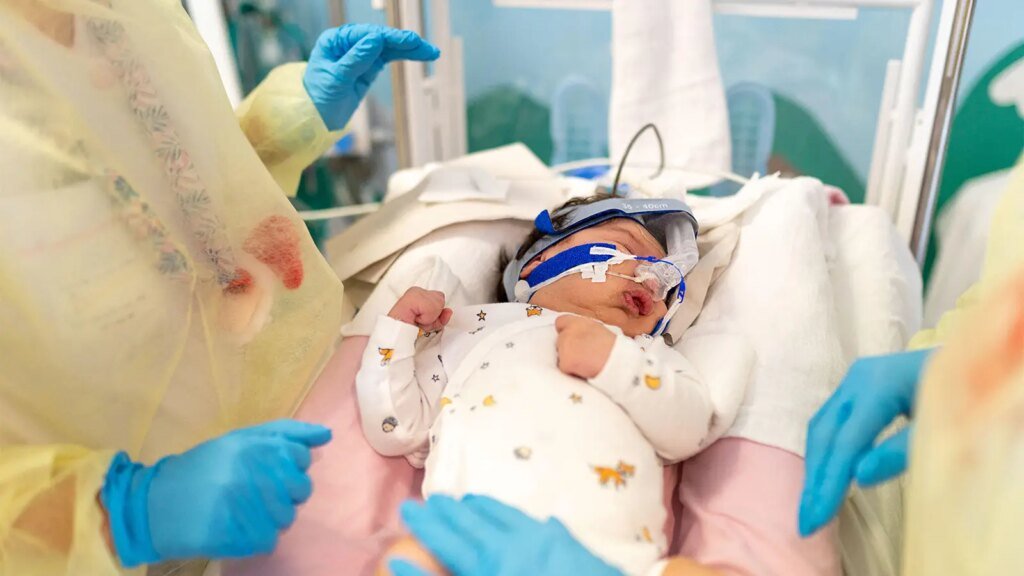
Prone positioning of infants on high-flow nasal cannula oxygen support for bronchiolitis didn’t significantly reduce risk of progression to needing positive pressure ventilation, a large randomized trial showed.
Escalation of care occurred in 15.0% of infants placed in the prone position and 20.8% in the supine position, a difference that did not reach statistical significance (adjusted OR 0.66, 95% CI 0.40-1.07, P=0.09), reported Florent Baudin, MD, PhD, of Hôpital Femme Mère Enfant in Bron, France, and colleagues.
“However, the wide 95% confidence interval around the observed odds ratio suggests that this study was not definitive and further research is warranted,” the research group concluded in JAMA.
Their findings from the PROPOSITIS trial were also presented at the International Congress of the European Society of Paediatric and Neonatal Intensive Care in Valletta, Malta.
“Mechanistically, prone positioning is a plausible way to improve lung mechanics with limited safety risk, as evidenced in PROPOSITIS with similar comfort measures, feeding tolerance, and serious adverse event rates between groups,” according to an accompanying editorial by Joseph G. Kohne, MD, MSc, of Rainbow Babies and Children’s Hospital in Cleveland, and colleagues.
While putting a patient face down has been shown effective in restrictive lung diseases like severe acute respiratory distress syndrome and COVID-19, there’s been less rigorous evidence for primarily obstructive pathophysiology or for use in children.
While the PROPOSITIS findings were negative on first glance, there was heterogeneity suggesting benefit in a subset of responders, the editorialists pointed out. Children able to tolerate 8 hours of prone positioning had fewer escalations than the supine positioning group (9% vs 20%, OR 0.35, 95% CI 0.18-0.67), but the escalation rate was high among those for whom prone positioning was abandoned before the target duration of 24 hours (30% overall and 50% for those who spent 2-18 hours prone).
“Prone positioning was not universally beneficial in this trial, nor is it among any form of respiratory failure treated with prone positioning,” Kohne’s group noted. Any number of patient-level factors might drive response in critical bronchiolitis, they wrote, although no obvious characteristics stood out in the trial other than time in the prone position.
“We now have one more strategy to consider for preventing escalation of respiratory support in young infants, provided a child tolerates it,” the editorialists concluded. They agreed with the researchers on the need for further investigation with a population better targeted than by considering level of respiratory support required.
“Until then, while prone positioning likely improves clinical outcomes in many children with severe bronchiolitis, clinicians are back to not knowing exactly when and how to use it safely and effectively,” Kohne and colleagues concluded.
The trial included 446 infants age 6 months and younger who were admitted to 15 pediatric intermediate or intensive care units in France. All had a diagnosis of acute bronchiolitis with moderate to severe respiratory distress requiring high-flow nasal cannula respiratory support. They were randomly assigned to standard prone positioning or to supine positioning for 24 hours or longer during the first 48 hours and then followed up until hospital discharge.
The primary outcome was the need for escalation of care to noninvasive or invasive ventilation within the first 72 hours under prespecified criteria. No differences were seen between groups in the secondary outcomes of treatment failure, tolerance of prone positioning, length of hospital stay, duration of respiratory support, infant comfort, and adverse events.
The safety analysis showed similar risk of serious adverse events between prone and supine positioning (1.1% vs 0.8%).
Limitations included that the study finished enrolling in November 2023, before the introduction of monoclonal antibodies against respiratory syncytial virus (one of the most common causes of bronchiolitis in this age group) that lower risk of severe outcomes and might change the distribution of viruses in bronchiolitis, the researchers said.
Also, “even with prespecified criteria, the choice of initial respiratory support as well as the escalation depend on many factors, such as experience, phenotype, and comfort, that could not be fully controlled for in the present study,” the group noted. Observer bias was also possible, “as it was not feasible to blind the position of infants,” they added. And, a per-protocol population was defined post hoc for the primary analysis to exclude patients who did not achieve the required duration of prone positioning, rather than reassigning them between groups as initially planned.
Please enable JavaScript to view the comments powered by Disqus.
[ad_2]
Source link : https://www.medpagetoday.com/pulmonology/generalpulmonary/121806
Author :
Publish date : 2026-06-17 15:27:00
Copyright for syndicated content belongs to the linked Source.