
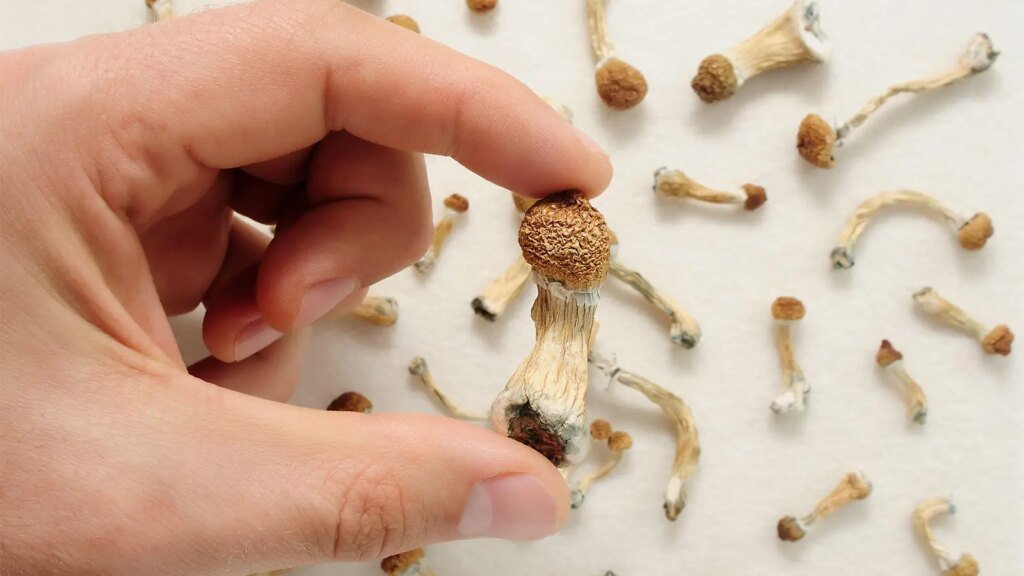
- Psilocybin plus therapy missed the primary endpoint in a trial of treatment-resistant depression, but met some secondary endpoints.
- The results may have been due to expectancy bias, a known issue with psychedelic trials.
- In a systematic review and meta-analysis, psychedelic-assisted therapy was no more effective than open-label treatment with traditional antidepressants.
Psilocybin plus psychotherapy showed limited efficacy for easing depressive symptoms in individuals with treatment-resistant depression, the phase IIb EPISODE randomized clinical trial found.
After withdrawal from antidepressants, 17% and 12.5% of patients who received one dose of 25 mg and 5 mg psilocybin, respectively, achieved at least a 50% reduction in Hamilton Rating Scale for Depression-17 (HAMD17) at week 6 compared with 10.6% of controls who received placebo in the form of nicotinamide, according to Gerhard Gründer, MD, of Heidelberg University in Mannheim, Germany, and colleagues.
For 25 mg psilocybin vs nicotinamide, the adjusted was OR 1.73 (95% CI 0.53-6.23, P=0.19). Because the first hierarchical comparison was nonsignificant, no further formal testing was performed.
The 25 mg psilocybin dose showed clinically meaningful effects on a few key secondary endpoints compared with placebo, including significantly lower week 6 scores on the HAMD17 scale (estimated difference -4.60, 95% CI -7.01 to -2.18, P<0.001) and the Beck Depression Inventory-II scale (-7.21, 95% CI -11.86 to -2.56, P<0.001).
“Although results suggest potential efficacy, the divergence between primary and secondary outcomes renders the findings inconclusive and calls for cautious interpretation and replication,” the team wrote in JAMA Psychiatry.
The findings contrast with several prior trials that have reported significant psychiatric benefits with psilocybin, including in treatment-resistant depression.
While the secondary outcome effects likely aren’t due to chance, they could be due to expectation, argued James Hudson, MD, ScD, and Harrison Pope Jr., MD, MPH, both of McLean Hospital in Belmont, Massachusetts, in an accompanying editorial.
“There is no clear upper bound for this effect in psychiatric disorders such as depression,” they pointed out. “Thus, it might fully account for the effects reported in trials of psilocybin to date, especially because in psychedelic trials, as compared with ordinary drug trials, additional factors conspire to inflate expectation.”
These factors include the novelty and intensity of the psychedelic experience itself, the effects of concomitant psychotherapy administered by guides invested in the success of the trial, selection factors favoring participants with high baseline levels of expectation, and the “potentiation of suggestibility by psychedelic drugs,” Hudson and Pope wrote. Ultimately, they noted that a blinded psychedelic experience is “a contradiction in terms.”
To further examine this issue, a systematic review and meta-analysis, also published in JAMA Psychiatry, tested the effectiveness of psychedelic-assisted therapy with open-label traditional antidepressants such as selective serotonin reuptake inhibitors (SSRIs) or serotonin norepinephrine reuptake inhibitors (SNRIs), comparing them under equal, unblinded conditions as depression treatment.
A 24-trial analysis found psychedelic-assisted therapy was no more effective than open-label treatment with traditional antidepressants (estimated mean difference 0.3, 95% CI -1.39 to 1.98, P=0.73), reported Balázs Szigeti, PhD, of the University of California San Francisco, and colleagues. There was also no difference between psychedelic-assisted therapy compared with open-label SSRI treatment (citalopram, escitalopram, fluoxetine, and sertraline) or with open-label SNRI treatment (duloxetine and venlafaxine).
Open-label administration was associated with better outcomes than blinded treatment for traditional antidepressants, but not psychedelic-assisted therapy. Szigeti’s group said this confirms that psychedelic trials “are effectively always open label.”
“Unblinding is the defining methodological problem of psychedelic trials. What I wanted to show is that even if you compare psychedelics to open-label antidepressants, psychedelics are still much better,” Szigeti said in a statement. “Unfortunately, what we got is the opposite result — that they are the same, which is very surprising given the enthusiasm around psychedelics and mental health.”
“Psychedelics may still be a valuable treatment option,” Szigeti noted. “But if we want to understand their true benefits, we have to compare them fairly — and when we do that, the advantage over standard antidepressants is much smaller than many people, including myself, expected.”
EPISODE Trial Details
The triple-blind, four-arm EPISODE trial was conducted at two German university hospitals from June 2021 to February 2024. Gründer’s team recruited adults ages 25 to 65 with moderate-to-severe treatment-resistant depression (HAMD17 score ≥17).
Treatment-resistant depression was defined as nonresponse to at least two adequate antidepressant treatments from different pharmacological classes in the current episode. Average age was about 43 years, 59% were male, and 98% were white.
After assessment of the primary endpoint at week 6, participants received a second therapeutic dose. A total of 144 participants were randomized 2:2:1:1 to the following four groups:
- Nicotinamide 100 mg, followed by psilocybin 25 mg
- Psilocybin 5 mg, followed by 25 mg
- Psilocybin 25 mg, followed by 5 mg
- Two doses of psilocybin 25 mg
Nicotinamide was selected as an active placebo due to acute physiological effects. Both dosing sessions (6-8 hours plus overnight stay) were embedded in a structured psychotherapeutic program consisting of 14 total hours of preparatory and integration sessions. Participants completed eight in-person visits and eight weekly therapist safety calls.
No group differences were observed in HAMD17 or BDI-II response rates at week 12.
All psilocybin-treated participants experienced adverse events — mostly on dosing days — versus 71% of the nicotinamide group. Severe adverse events occurred in 28% after 25 mg psilocybin, 4% after 5 mg psilocybin, and 8% after nicotinamide. Most events related to altered reality perception included pseudohallucination (21%), paresthesias/dysesthesias (14%), synesthesia (13%), and paranoia (3.8%); all were transient and participants recovered the same day.
Seven participants on psilocybin and one on nicotinamide reported suicidal ideation after the first dose.
Please enable JavaScript to view the comments powered by Disqus.
Source link : https://www.medpagetoday.com/psychiatry/depression/120375
Author :
Publish date : 2026-03-18 21:18:00
Copyright for syndicated content belongs to the linked Source.