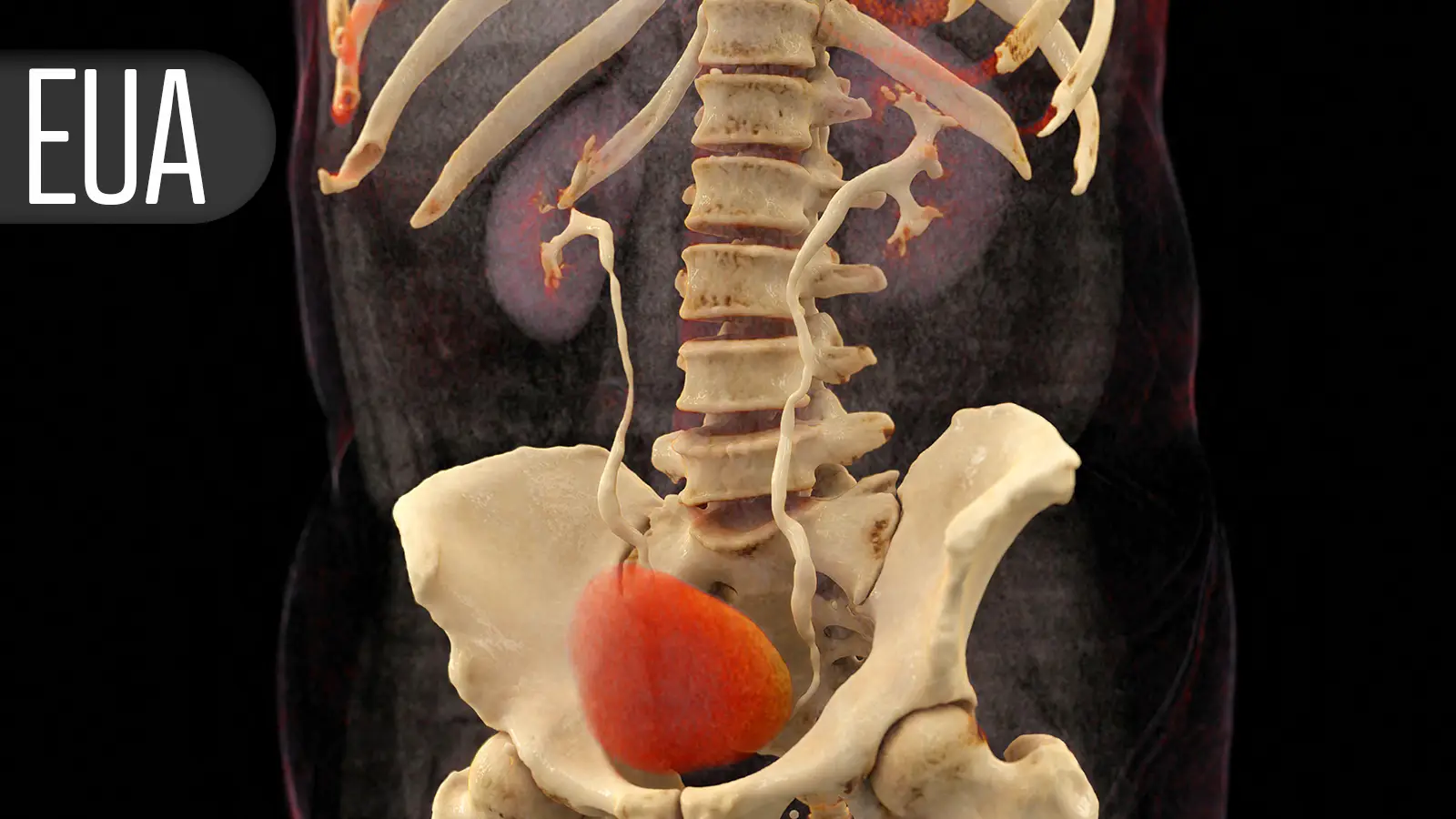
When MRI offered no clear answer in suspected prostate cancer, the use of prostate-specific membrane antigen (PSMA)-PET/CT showed promise for reducing the number of biopsies without compromising the diagnosis of significant malignancies, a phase III trial from Australia showed.
Among biopsy-naive men with a clinical suspicion of significant prostate cancer but equivocal MRI, biopsy was avoided in 49% (95% CI 44-55) of those randomly assigned to undergo PSMA-PET while a control arm received standard-of-care transperineal systematic biopsy, reported James Buteau, MD, of the Peter MacCallum Cancer Centre in Melbourne, Australia.
Clinically significant prostate cancer was detected in 12% of patients who underwent PSMA-PET compared with 16% of controls, a difference that fell within the noninferiority margin for this co-primary endpoint (P=0.0093).
And insignificant prostate cancer was detected in 14% of men in the PSMA-PET arm versus 32% of men in the control arm (P<0.0001), according to findings presented at the European Association of Urology meeting in London.
Implications
To enroll in the study, PRIMARY2, patients were required to have a Prostate Imaging Reporting and Data System (PI-RADS) score of 3 on multiparametric MRI or a PI-RADS score of 2 plus at least one clinical risk factor.
This “is really the first randomized controlled trial using PSMA-PET for the intraprostatic diagnosis of prostate cancer before biopsy,” Buteau said. “The addition of PSMA-PET to high clinical risk PI-RADS 2 0r 3 MRI halved the number of men requiring biopsy, and this led to a reduction in the diagnosis of insignificant malignancy without compromising the diagnosis of clinically significant prostate cancer.”
Study discussant Jochen Walz, MD, of Institut Paoli-Calmettes in Marseille, France, noted that the outcomes in PRIMARY2 “are exactly the same trends we saw when we switched from the systemic biopsy to MRI pathways in the diagnosis of prostate cancer.”
“We are diagnosing the same amount of significant prostate cancers, we are reducing the amount of biopsies that are necessary, and at the same time reducing the amount of insignificant prostate cancers diagnosed,” he said. “So, I think this is a strong argument to implement this sort of technology in the management of our patients.”
However, he noted, PSMA-PET is expensive. For example, while the cost of PSMA-PET is less than $1,000 in Australia where the trial was done, it is more expensive in Europe and significantly more expensive in the U.S. ($4,500 and up).
“We need a thoroughly done cost-effectiveness analysis in order to really judge how we can implement it and if this really helps us improve outcomes of our patients and at the same time not explode the budget we might have for the management of our patients,” Walz said.
Study Rationale and Design
MRI is a firmly established modality for the early detection of prostate cancer, Buteau explained, and prostate biopsy is recommended for patients with normal or equivocal MRI and clinical concerns — such as high prostate-specific antigen (PSA) density.
However, said Buteau, the majority of cases “will either have no cancer or clinically insignificant prostate cancer on biopsy — and we could potentially avoid biopsy altogether on these patients.”
The multicenter, investigator-initiated PRIMARY2 trial was conducted at seven sites across Australia and included 660 biopsy-naive men who had no prior history of prostate cancer but either had MRI imaging with a PI-RADS score of 3 or a score of 2 plus at least one clinical risk factor, such as PSA density >0.1 ng/mL2 or a strong family history.
The co-primary endpoints were the proportion of patients with clinically significant prostate cancer — defined as Gleason score 3 + 4 (with ≥10% pattern 4) — with a noninferiority margin of 10% between the arms, as well as the proportion of patients in the PSMA-PET arm who avoided biopsy at 6 months, with at least 20% biopsy avoidance prespecified as clinically significant.
Patients in the control arm had a median age of 60 years and median PSA of 5.1 ng/mL, with 55% PI-RADS 2 and 45% PI-RADS 3. Those in the PSMA PET-CT arm had a median age of 62 years and median PSA of 5.2 ng/mL, with 47% PI-RADS 2 and 53% PI-RADS 3. Both groups had a median PSA density of 0.13 ng/mL2.
Buteau acknowledged the study had some limitations, including the fact that the definition of clinically significant prostate cancer is “contentious.”
He noted that long-term follow-up will look at cost-effectiveness and the impact on patients’ anxiety and cancer worry.
Source link : https://www.medpagetoday.com/meetingcoverage/eau/120329
Author :
Publish date : 2026-03-16 21:16:00
Copyright for syndicated content belongs to the linked Source.