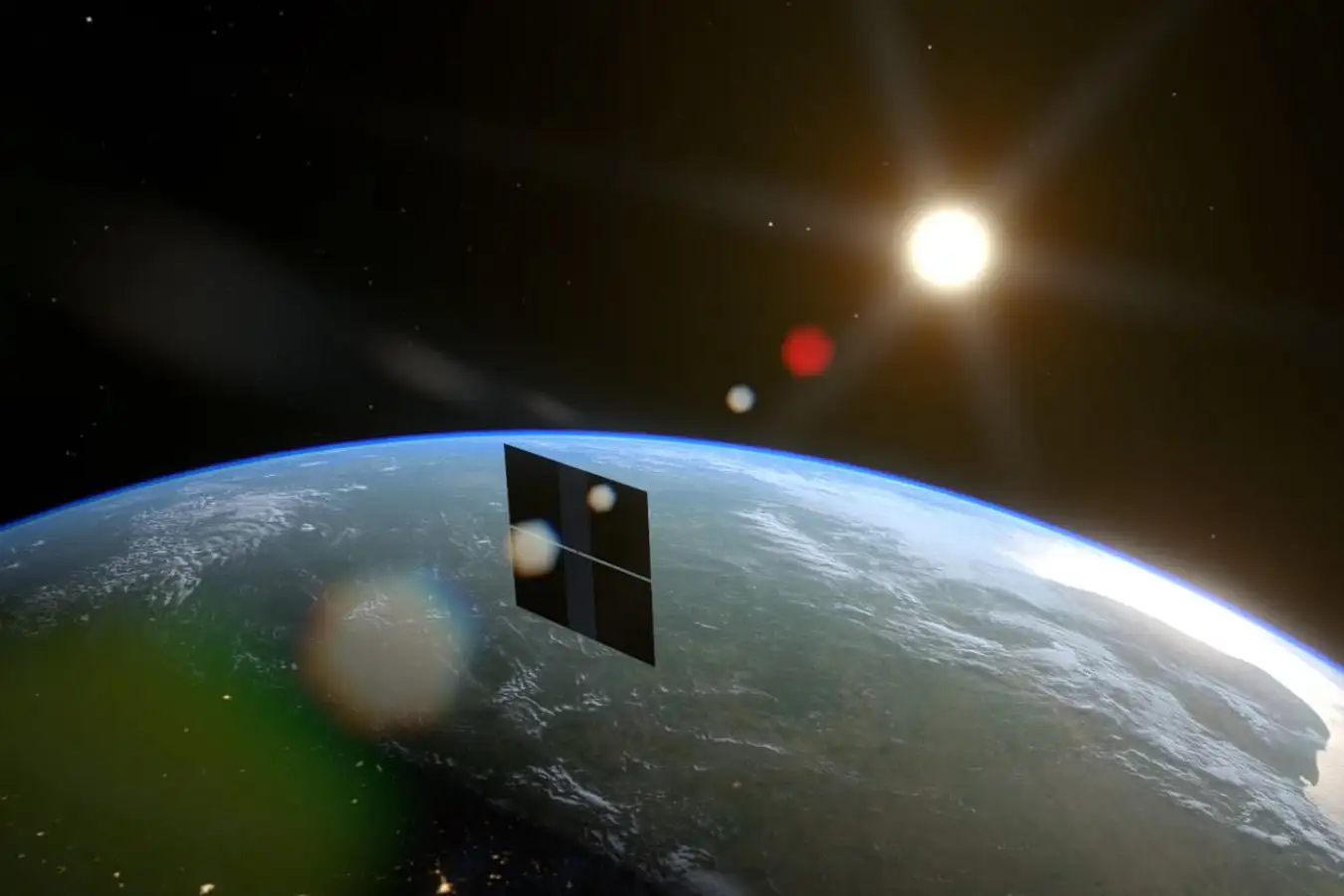
Starcloud wants to build a data centre satellite that is 4 kilometres by 4 kilometres
Starcloud
Could AI’s insatiable thirst for colossal data centres be fixed by launching them into space? Tech companies are eyeing low Earth orbit as a potential solution, but researchers say it’s unlikely in the near future due to a mountain of difficult and unsolved engineering issues.
The huge demand for, and investment in, generative AI products like ChatGPT has created an unprecedented need for computing power, which requires both vast tracts of land and gigawatts of power, equivalent to that used by millions of homes. As a result, data centres are increasingly fuelled by unsustainable sources, like natural gas, with tech companies arguing that renewable power can neither produce the amount of power needed nor the consistency required for reliable use.
To solve this, tech CEOs like Elon Musk and Jeff Bezos have suggested launching data centres into orbit, where they can have constant access to a higher level of sunlight than solar panels on Earth. Earlier this year, Bezos, who alongside founding Amazon also owns space company Blue Origin, said that he envisions gigawatt data centres in space within 10 to 20 years.
Google has more concrete and accelerated plans for data centres in space, with a pilot program called Project Suncatcher, which aims in 2027 to launch two prototype satellites carrying its TPU AI chips to test how they perform in orbit. But so far, perhaps the most advanced experiment in data processing in space was the launch this year of a single H100 graphics processing unit by a Nvidia-backed company called Starcloud. This is nowhere near enough computing power to run modern AI systems – OpenAI, for example, is thought to have a million such chips at its disposal.
Reaching this scale in orbit will require tech firms to tackle a number of unsolved challenges. “From an academic research perspective, [space data centres] are nowhere near production level,” says Benjamin Lee at the University of Pennsylvania, US.
One of the largest problems, with no obvious solution, is the sheer size required to operate at the scale required for AI’s computational demand, says Lee. This is both because of the amount of power that would be needed from solar panels, which would use a vast surface area, and the necessity of radiating away heat produced by the chips, which is the only option for cooling in space, where there is no air. “You’re not able to evaporatively cool them like you are on Earth, blowing cool air over them,” says Lee.
“Square kilometres of area will be used independently for both the energy, but also for the cooling,” says Lee. “These things get pretty big, pretty quickly. When you talk about 1000 megawatts of capacity, that’s a lot of real estate in space.” Indeed, Starcloud says it plans to build a 5000 megawatt data centre that would span 16 square kilometres, or about 400 times the area of the solar panels on the International Space Station.
There are some promising technologies that could reduce this requirement, says Krishna Muralidharan at the University of Arizona, US, such as thermoelectric devices that can convert heat back into electricity and increase the efficiency of chips operating in space. “It’s not a problem, it’s a challenge,” says Muralidharan. “Right now, we can solve it by using these large radiator panels, but ultimately it requires much more sophisticated solutions.”
But space is a very different environment from Earth in other ways, too, including the abundance of high-energy radiation that could hit computer chips and upset calculations by inducing errors. “It’s going to slow everything down,” says Lee. “You’re going to have to restart the computation, you’re going to have to recover and correct those errors, so there is likely a performance discount for the same chip in space than there is deploying on Earth.”
The scale would also require flying thousands of satellites together, says Muralidharan, which would need extremely precise laser systems both to communicate between the data centres, and with Earth, where the light would be partially scrambled by the atmosphere. But Muralidharan is optimistic that these aren’t fundamental problems and could be solved eventually. “It’s a question of when and not if,” he says.
Another uncertainty is whether AI will still require such huge computational resources by the time space data centres are available, especially if the projected advances in AI capability don’t scale with increasing computational firepower, which there are some early signs of. “It’s a distinct possibility that the training requirements will peak or level off, and then demand for massive, larger scale data centres will also peak and level off,” says Lee.
There could, however, still be uses for space-based data centres in this scenario, says Muralidharan, such as for supporting space exploration on the moon or in the solar system, or for making observations of Earth.
Topics:
Source link : https://www.newscientist.com/article/2509368-putting-data-centres-in-space-isnt-going-to-happen-any-time-soon/?utm_campaign=RSS%7CNSNS&utm_source=NSNS&utm_medium=RSS&utm_content=home
Author :
Publish date : 2025-12-19 14:42:00
Copyright for syndicated content belongs to the linked Source.