


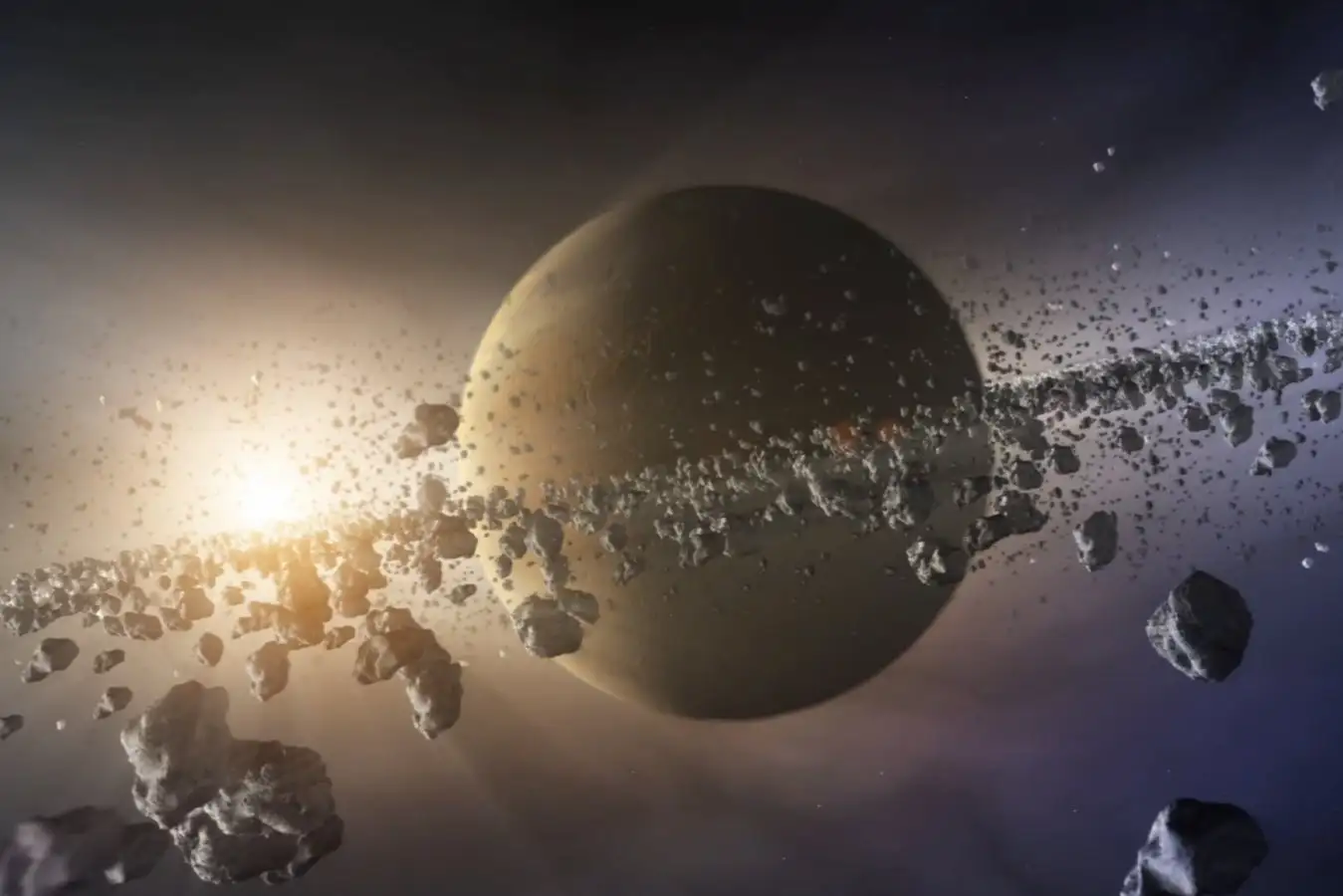
An artist’s impression of an exoplanet
ESA/Hubble (M. Kornmesser)
Quantum computers may help us see more exoplanets – and see them in more detail too.
Astronomers have now found thousands of planets beyond our solar system, but they anticipate that there are actually billions of these exoplanets out there. Identifying and studying them is an integral part of the search for extraterrestrial life, but doing so is technically challenging because they are so distant from Earth.
Johannes Borregaard at Harvard University and his colleagues argue that quantum computers may significantly improve the process.
To image exoplanets, researchers must collect light signals that these planets emanate, but such signals tend to be weak after travelling great distances through space. Moreover, the signals are often made noisy or partially obscured by light from nearby stars.
Borregaard says his colleagues at NASA helped him realise that the problem may be as hard as looking for just one particle of light, or photon, for every second of a telescope’s operation.
Processing such weak signals is difficult with conventional methods, but a quantum computer could store a series of incoming photons’ quantum states, then leverage their quantum properties to extract information about the exoplanet, he says. In this way, an analysis that may normally only result in an image too blurry to tell an exoplanet apart from its star – or that renders it as a single fuzzy dot – could produce sharper depictions of the exoplanet in space. It might even allow researchers to pick out light-based fingerprints of molecules on the exoplanet.
This is the idea at the centre of his team’s scheme, where light from an exoplanet would first hit a quantum computing device made from specially engineered diamonds. Similar devices have already been successfully tested as storage devices for photons’ quantum states. Next, those states would be communicated to another, more sophisticated quantum computer, which would then run an algorithm designed to extract information needed to produce an image of the exoplanet. Borregaard and his colleagues modelled this second device as being made from extremely cold atoms, which is another technology that has recently shown a lot of promise in experiments.
The researchers’ calculations showed that using quantum devices in this way could create images with only hundredths or even thousandths of the number of photons that traditional methods currently require. In other words, the quantum set-up could outperform current techniques when the light is very faint.
“Photons obey the rules of quantum mechanics. Therefore, it is natural and it makes sense to investigate quantum methods to detect and process light coming, for example, from exoplanets,” says Cosmo Lupo at the Polytechnic University of Bari in Italy. However, he says that making the new proposal into reality would be a complex challenge and require both very good control over the performance of each of the two quantum computers and an effective way to connect them.
Borregaard sees the situation similarly. While there is promising experimental work that strengthens the case for using both the diamond-based and the ultracold quantum computer, linking the two is something that several research groups, including his colleagues, are currently working on, he says.
Lupo says that one other scheme for leveraging light’s quantumness has already been used to observe a star in the Canis Minor constellation, so the trend of using quantum devices for observing space is already under way. “I am thrilled to see how quantum computing will impact the field of imaging and astronomy in the future,” he says. “The new work is an important first step in this direction.”

The world capital of astronomy: Chile
Experience the astronomical highlights of Chile. Visit some of the world’s most technologically advanced observatories and stargaze beneath some of the clearest skies on earth.
Topics:
- exoplanets/
- quantum computing
Source link : https://www.newscientist.com/article/2510781-quantum-computers-could-help-sharpen-images-of-exoplanets/?utm_campaign=RSS%7CNSNS&utm_source=NSNS&utm_medium=RSS&utm_content=home
Author :
Publish date : 2026-01-12 18:00:00
Copyright for syndicated content belongs to the linked Source.