Quantum particles can now be made to carry useful information for longer
koto_feja/Getty Images
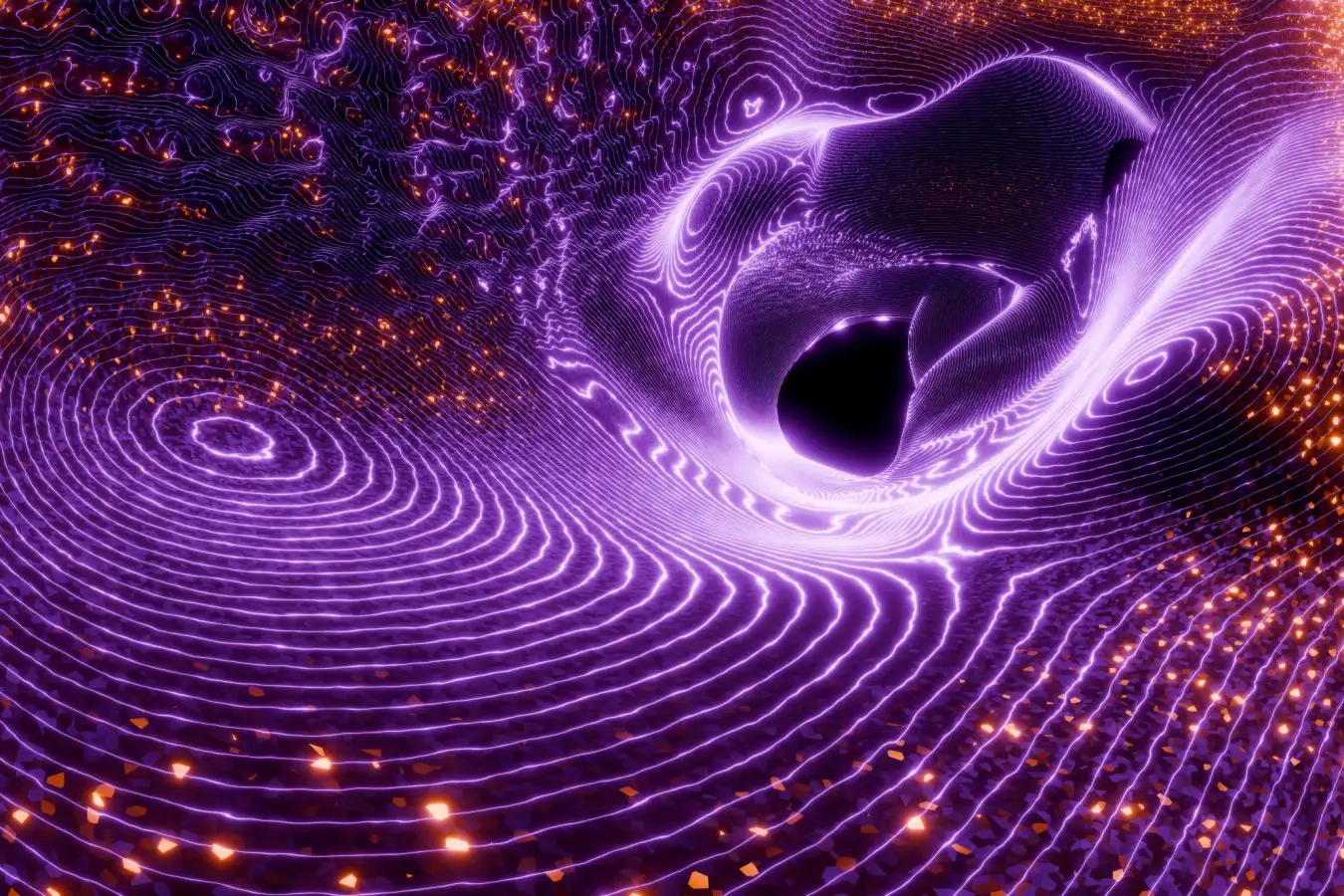
The odd phenomenon of quantum superposition has helped researchers break a fundamental quantum mechanical limit – and given quantum objects properties that make them useful for quantum computing for longer periods of time.
For a century, physicists have been puzzled by exactly where the line between the quantum world of the small and the macroscopic world that we experience should be drawn. In 1985, physicists Anthony Leggett and Anupam Garg devised a mathematical test that could be applied to objects and their behaviour over time to diagnose whether they are big enough to have escaped quantumness. Here, quantum objects are identified by the unusually strong correlations between their properties at different points in time, akin to their behaviour yesterday and tomorrow being unexpectedly related.
Objects that score high enough on this test are deemed to be quantum, but those scores were thought to be limited by a number called the temporal Tsirelson’s bound (TTB). Even definitively quantum objects, theorists thought, couldn’t break this bound. But now, Arijit Chatterjee at the Indian Institute of Science Education and Research in Pune and his colleagues have devised a way to dramatically break the TTB with one of the simplest quantum objects.
They focused on qubits, which are the most basic building blocks of quantum computers and other quantum information processing devices. Qubits can be made in many ways, but the researchers used a carbon-based molecule that contained three qubits. They used the first qubit to control how the second “target” qubit behaved for some amount of time. Then, they used the third qubit to extract the properties of the target.
A three-qubit system is expected to be limited by the TTB, but Chatterjee and his colleagues found a way for the target qubit to break the bound in an extreme manner. In fact, their method produced one of the biggest violations that seems mathematically plausible. Their secret was making the first qubit control the target qubit with a quantum superposition state. Here, an object can effectively embody two states, or behaviours, that seem mutually exclusive. For example, the team’s experiment was similar to the first qubit effectively instructing the target qubit to simultaneously rotate clockwise and counterclockwise.
A qubit normally falls victim to what is known as decoherence as time goes on – meaning its ability to encode quantum information erodes. But when the target qubit had broken the TTB, decoherence came later and it maintained its ability to encode information for five times as long, because its behaviour across time was being controlled by a superposition.
Chatterjee says that this robustness is desirable and useful in any situation where qubits must be precisely controlled, such as for computation. Team member H. S. Karthik at the University of Gdansk in Poland says that there are procedures in quantum metrology – for extremely precise sensing of electromagnetic fields, for instance – that could be enhanced by this kind of qubit control.
Le Luo at Sun Yat-Sen University in China says that, in addition to having clear potential for improving quantum computing protocols, the new study also fundamentally expands our understanding of how quantum objects behave over time. This is because dramatically breaking the TTB means that the qubit’s properties are extremely correlated between two different points in time, in a way that simply cannot happen for non-quantum objects.
The extreme violation of the TTB, then, is a strong testament to just how much quantumness there was in the whole three-qubit system, says Karthik – and an example of how researchers are still pushing the boundaries of the quantum world.
Topics:
- quantum computing/
- quantum physics
Source link : https://www.newscientist.com/article/2507777-qubits-break-quantum-limit-to-encode-information-for-longer/?utm_campaign=RSS%7CNSNS&utm_source=NSNS&utm_medium=RSS&utm_content=home
Author :
Publish date : 2025-12-12 08:00:00
Copyright for syndicated content belongs to the linked Source.