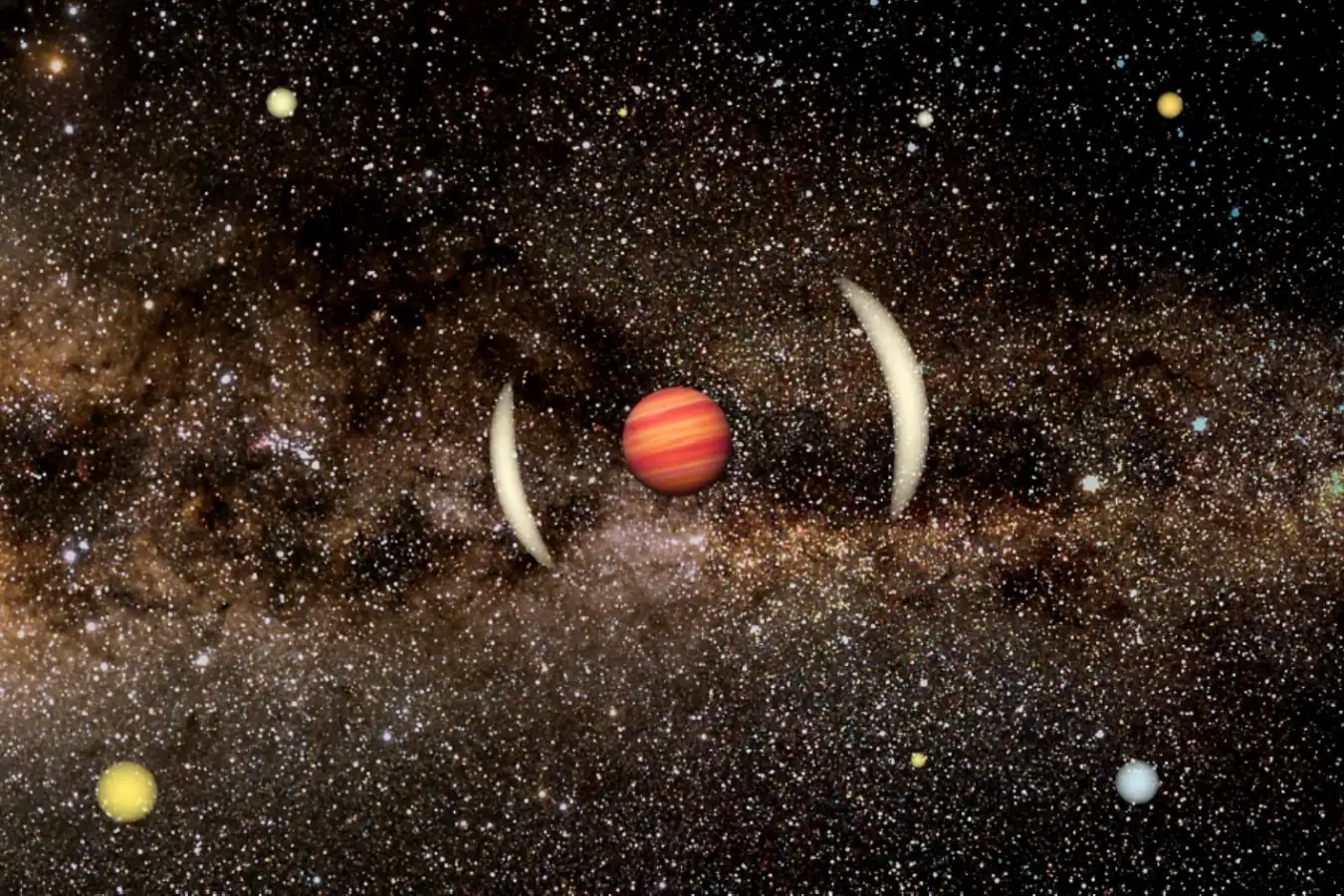
Artist’s impression of the free-floating planet lensing light from a distant source
J. Skowron/OGLE
Nearly 10,000 light years away, a planet the size of Saturn is floating all on its own through empty space. In a stroke of luck, researchers were able to spot this strange, dark world using both ground-based telescopes and the Gaia space telescope, allowing them to measure the mass of a free-floating, or rogue, exoplanet for the first time.
Most rogue worlds that have been found are either more massive than Jupiter or lighter than Neptune, leaving in the middle a gap in size that researchers refer to as the “Einstein desert”. This has generally been attributed to the idea that lighter-than-Neptune worlds are relatively easy to eject from pre-existing orbits around stars, whereas planets more massive than Jupiter don’t have to form inside traditional planetary systems, but can sometimes form similarly to stars in free space.
That makes this newfound planet particularly rare. It has two names – KMT-2024-BLG-0792 and OGLE-2024-BLG-0516 – because Andrzej Udalski at the University of Warsaw in Poland and his colleagues spotted it independently with two different ground-based telescopes. But what’s even more unusual is the fact that they were able to measure its mass at about one-fifth that of Jupiter.
“What’s really great about this one is that it’s the first one that we’ve got that has a mass measurement, and that was only possible because they got Gaia observations as well as Earth-based observations,” says Gavin Coleman at Queen Mary University of London. The researchers found this planet through a method called gravitational microlensing, which occurs when the light from a bright, distant object is bent by a planet’s gravitational pull, creating a sort of halo around the planet. That’s where the researchers got lucky: when the microlensing event was spotted from the ground, the Gaia space telescope happened to be pointed in the right direction, so it captured the event too.
“Mass is the main parameter deciding on the classification as a planet,” says Udalski, so that makes this technically the first confirmed free-floating rogue planet. “This is the moment from which we may be sure that the candidate is a real planet, and free-floating planets indeed exist,” he says. NASA’s Nancy Grace Roman space telescope, planned to launch in 2027, is expected to find many more, though.
“They should be very numerous and they may be crucial for our understanding of the processes during the formation of planetary systems, as the majority of them are ejected from planetary systems at the early formation stages,” says Udalski. That includes our own solar system, which some research hints may have ejected a planet in its early days.
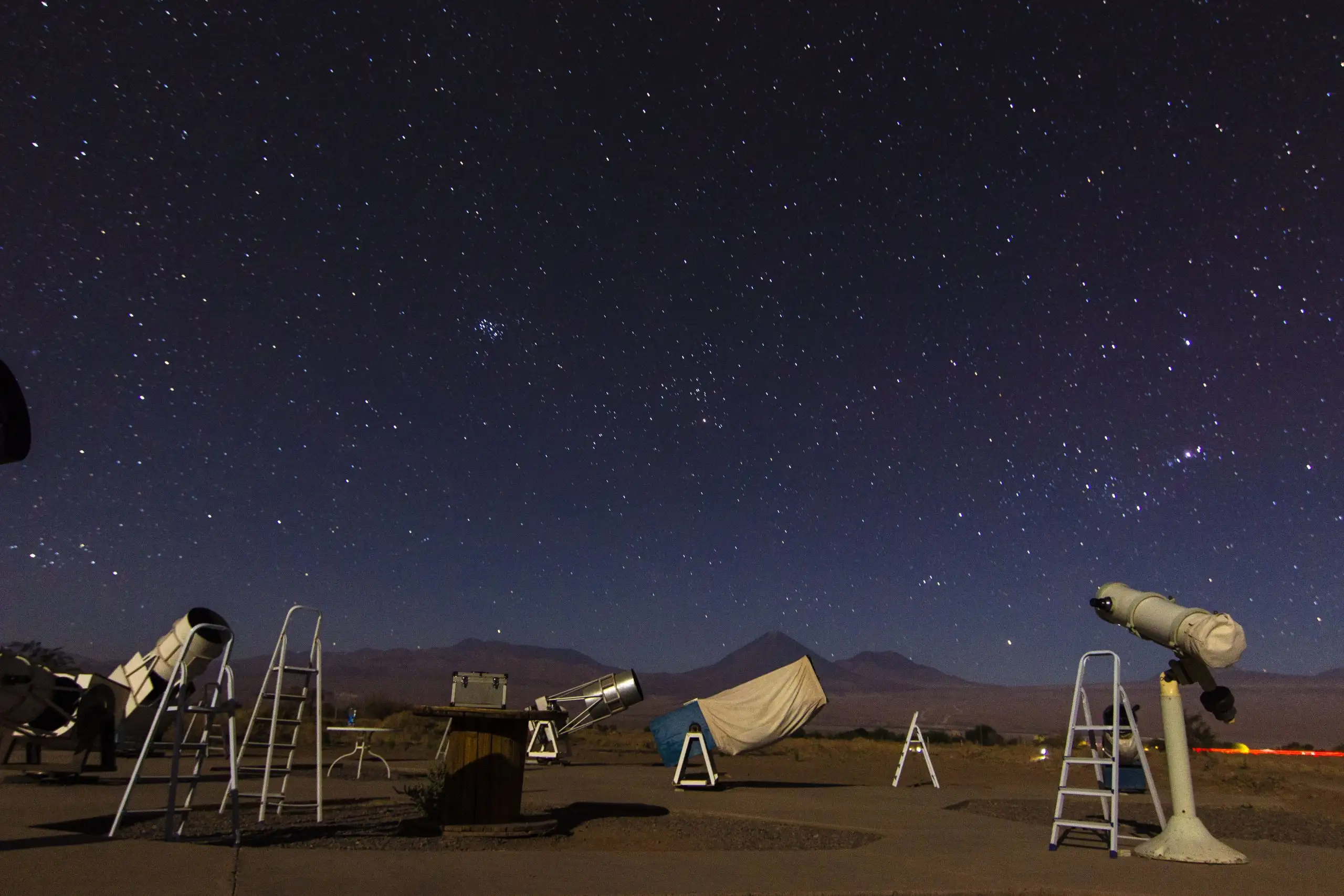
The world capital of astronomy: Chile
Experience the astronomical highlights of Chile. Visit some of the world’s most technologically advanced observatories and stargaze beneath some of the clearest skies on earth.
Topics:
Source link : https://www.newscientist.com/article/2509858-rare-saturn-sized-rogue-planet-is-first-to-have-its-mass-measured/?utm_campaign=RSS%7CNSNS&utm_source=NSNS&utm_medium=RSS&utm_content=home
Author :
Publish date : 2026-01-01 19:00:00
Copyright for syndicated content belongs to the linked Source.