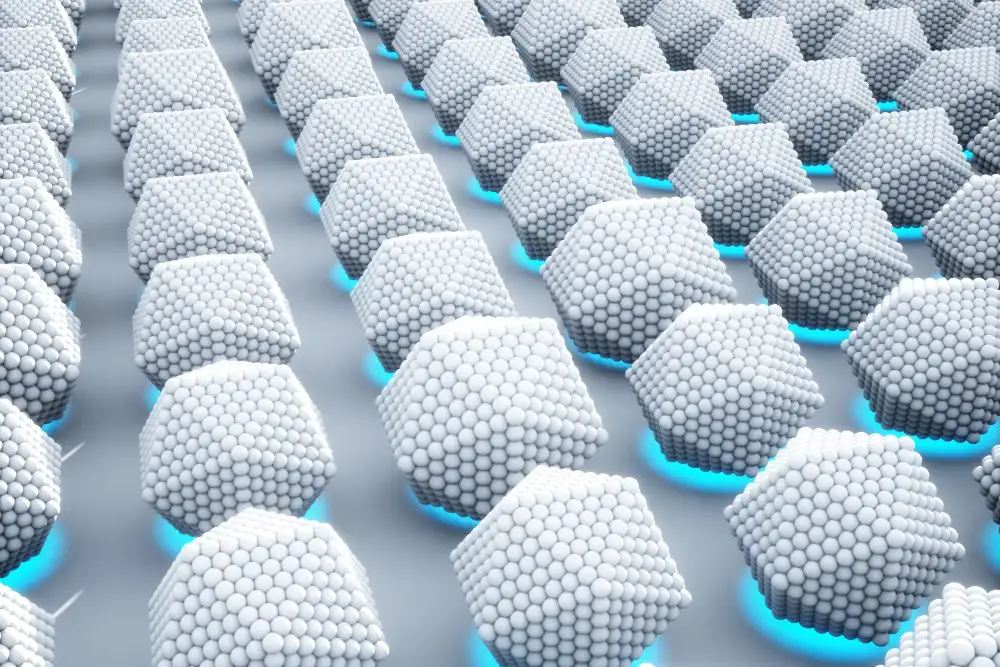
An artist’s representation of qubits in the Quantum Twins simulator
Silicon Quantum Computing
An unprecedently large quantum simulator could shed light on how exotic, potentially useful quantum materials work and help us optimise them in the future.
Quantum computers may eventually harness quantum phenomena to complete calculations that are intractable for the world’s best conventional computers. Similarly, a simulator harnessing quantum phenomena could help researchers to accurately model poorly understood materials or molecules.
This is especially true for materials such as superconductors, which conduct electricity with nearly perfect efficiency, because they derive this property from quantum effects that could be directly implemented on quantum simulators but would require more steps of mathematical translation on conventional devices.
Michelle Simmons at Silicon Quantum Computing in Australia and her colleagues have now created the biggest quantum simulator for quantum materials yet, called Quantum Twins. “The scale and controllability we have achieved with these simulators means we are now poised to tackle some very interesting problems,” she says. “We are designing new materials in previously unthought-of ways by literally building their analogues atom by atom.”
The researchers built several simulators by embedding atoms of phosphorus into silicon chips. Each atom became a quantum bit, or qubit, which is the basic building block of quantum computers and simulators, and the team could precisely arrange the qubits into different grids that emulated atoms’ arrangement in real materials. Each iteration of Quantum Twins was made up of a square grid of 15,000 qubits – more than any previous quantum simulator. Similar qubit arrays have previously been created from, for example, several thousands of extremely cold atoms.
Through this patterning process and by adding electronic components to each chip, the researchers also controlled properties of electrons in the chip. This mimicked controlling electrons in simulated materials, which is crucial for understanding, for instance, the flow of electricity within them. For example, the researchers could tune how difficult it would be to add an electron to any point in the grid or how difficult it would be for an electron to “hop” between two points.
Simmons says conventional computers struggle with simulating large two-dimensional systems, as well as certain combinations of electrons’ properties, but Quantum Twins simulators have shown promise for those cases. She and her team tested their chips by simulating a transition between metallic (or conducting) and insulating behaviour of a famous mathematical model for how “dirt” in a material can affect its ability to support electric currents. They also measured the system’s “Hall coefficient” as a function of temperature, which captures how the simulated material behaves when exposed to magnetic fields.
The size of the devices used in the experiment and the team’s ability to control variables mean Quantum Twins simulators could go on to tackle unconventional superconductors next, says Simmons. How conventional superconductors work at the level of their electrons is relatively well understood, but they must be made extremely cold or put under tremendous pressure to superconduct, which is impractical. Some superconductors can work in milder conditions, but to engineer them to function at room temperature and pressure, researchers need to understand them more microscopically – the kind of understanding that quantum simulators could offer in the future.
Additionally, Quantum Twins could be used to study interfaces between different metals and molecules similar to polyacetylene that could be useful for drug development or artificial photosynthesis devices, says Simmons.
Topics:
Source link : https://www.newscientist.com/article/2514189-record-breaking-quantum-simulator-could-unlock-new-materials/?utm_campaign=RSS%7CNSNS&utm_source=NSNS&utm_medium=RSS&utm_content=home
Author :
Publish date : 2026-02-04 16:00:00
Copyright for syndicated content belongs to the linked Source.