


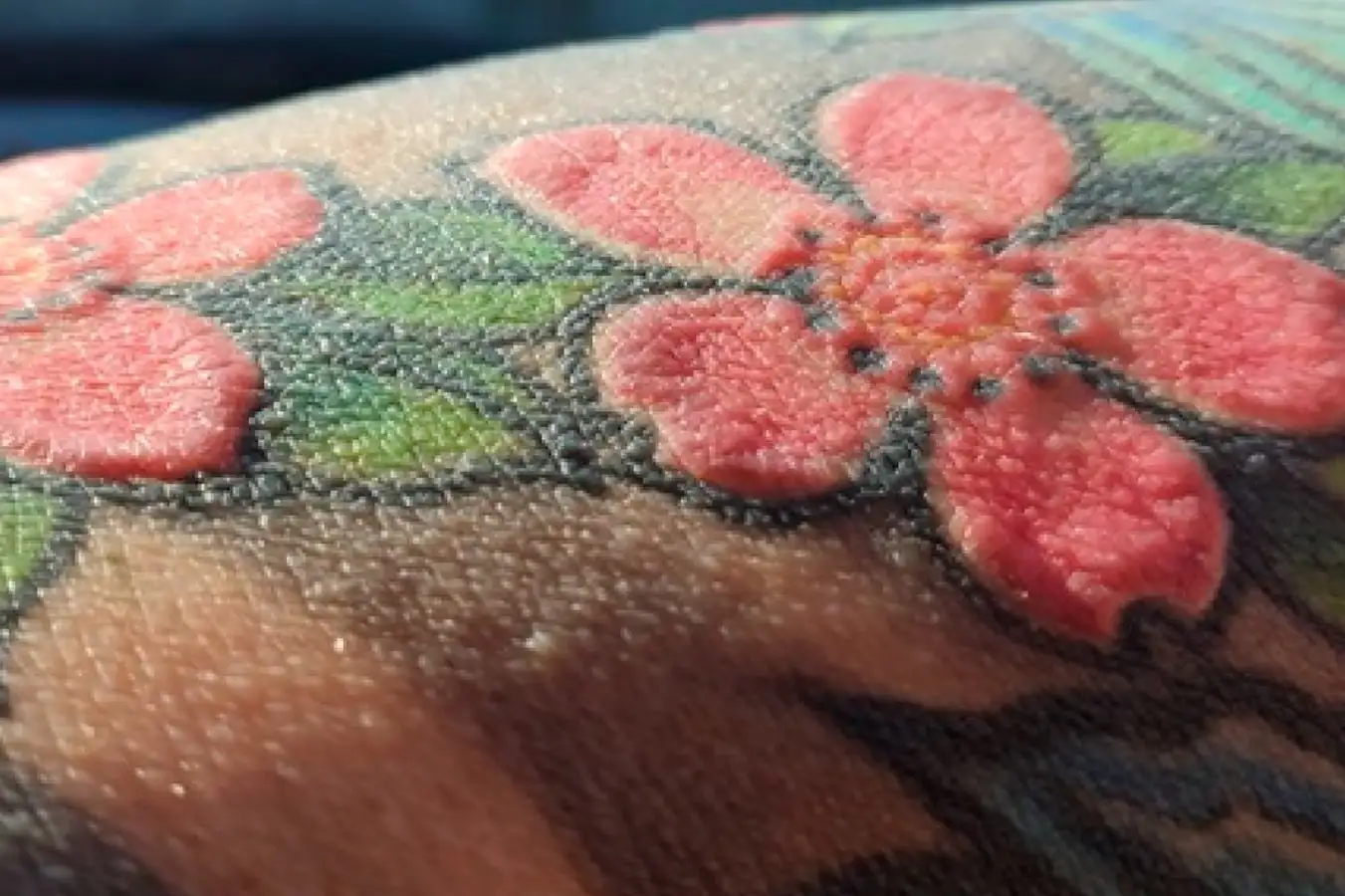
The red parts of the man’s tattoo became inflamed
University Centre of General Dermatology and Oncodermatology, Wroclaw Medical University
A Polish man had an extreme allergic reaction to red ink in a tattoo on his arm, causing all his hair to fall out, his sweat glands to shut down, and his skin to develop vitiligo. The case adds to growing concerns about the effects of some modern tattoo inks on the immune system.
Tattooing is an ancient practice, and for most of its history, it was performed using black soot-based inks that were slowly inserted into the skin using hand techniques. Nowadays, colourful synthetic tattoo inks can be quickly introduced into large areas of skin using electric tattoo machines.
Many of the dyes in coloured tattoo inks were originally developed for printer inks and car paints, rather than the human body. In recent years, there have been increasing reports of allergic reactions to coloured tattoo inks, particularly in people with underlying immune conditions such as eczema, asthma or coeliac disease. One survey found that 6 per cent of people who get a tattoo have a reaction that lasts for more than four months, most commonly if it contains red ink.
The Polish man’s reaction began about four months after he had a large multicoloured tattoo inked on his forearm. He became intensely itchy and developed a red rash over his whole body. He also gradually lost all the hair on his head and body, his nails turned yellow, his lymph nodes became swollen, and he lost the ability to sweat. After two years of these symptoms, he also began to develop large patches of vitiligo, a skin-lightening condition.
The man, who is in his thirties, saw dermatologists, allergy specialists, endocrinologists, neurologists, ophthalmologists and internal medicine specialists, but no one could figure out what was going on. Eventually, a reaction to red ink in his tattoo was suspected, since the red flower and flame motifs in the design looked swollen. A biopsy of a swollen lymph node in his groin also revealed traces of the red ink, which had migrated from his skin.
With limited treatment options available, the man had to have eight surgeries to cut out the red-inked sections of his tattoo and replace them with skin grafts. Since then, his hair has grown back and his vitiligo has stopped progressing. However, he still can’t sweat due to permanent damage to his sweat glands. This puts him at risk of heat stroke, meaning he had to resign from his military job and must regularly spray his body with water.
Dermatologists at Wroclaw Medical University in Poland, who oversaw the man’s treatment, were unable to obtain a sample of the red ink from his tattoo artist for testing. However, in other cases of allergic reactions to red-coloured tattoos, ink testing has identified the presence of synthetic organic dyes called azo dyes.
The reason that tattoo ink sometimes triggers health problems is because it chronically activates the immune system. Most tattoo ink stays in the skin, but some travels to the lymph nodes, which form part of the immune system. There, immune cells called macrophages capture the ink and try to clear it away, but they fail because the ink particles are too big. When one macrophage dies, it passes its captured ink to a new one, setting up a perpetual cycle. ‘The immune system is constantly trying to do something about this ink, so it triggers a chronic immune response,’ says Signe Clemmensen at the University of Southern Denmark.
The Polish man had a pre-existing autoimmune condition called Hashimoto’s disease that may have made his immune system especially sensitive, his dermatologists explain in a report documenting his case. As a result, his immune system may have started wrongfully attacking his skin.
Growing research shows that even people without immune conditions sometimes have adverse effects to tattoos in the long term. Clemmensen’s research, for example, has found that having a tattoo of any colour triples the risk of developing lymphoma, a cancer involving the lymph nodes.
In January 2022, which was after the Polish man received his tattoo, the European Union tried to make tattooing safer by restricting certain chemicals commonly used in tattoo inks, including azo dyes. However, other jurisdictions are yet to follow suit.
Topics:
Source link : https://www.newscientist.com/article/2510374-red-tattoo-ink-causes-man-to-lose-all-his-hair-and-stop-sweating/?utm_campaign=RSS%7CNSNS&utm_source=NSNS&utm_medium=RSS&utm_content=home
Author :
Publish date : 2026-01-08 13:00:00
Copyright for syndicated content belongs to the linked Source.