[ad_1]
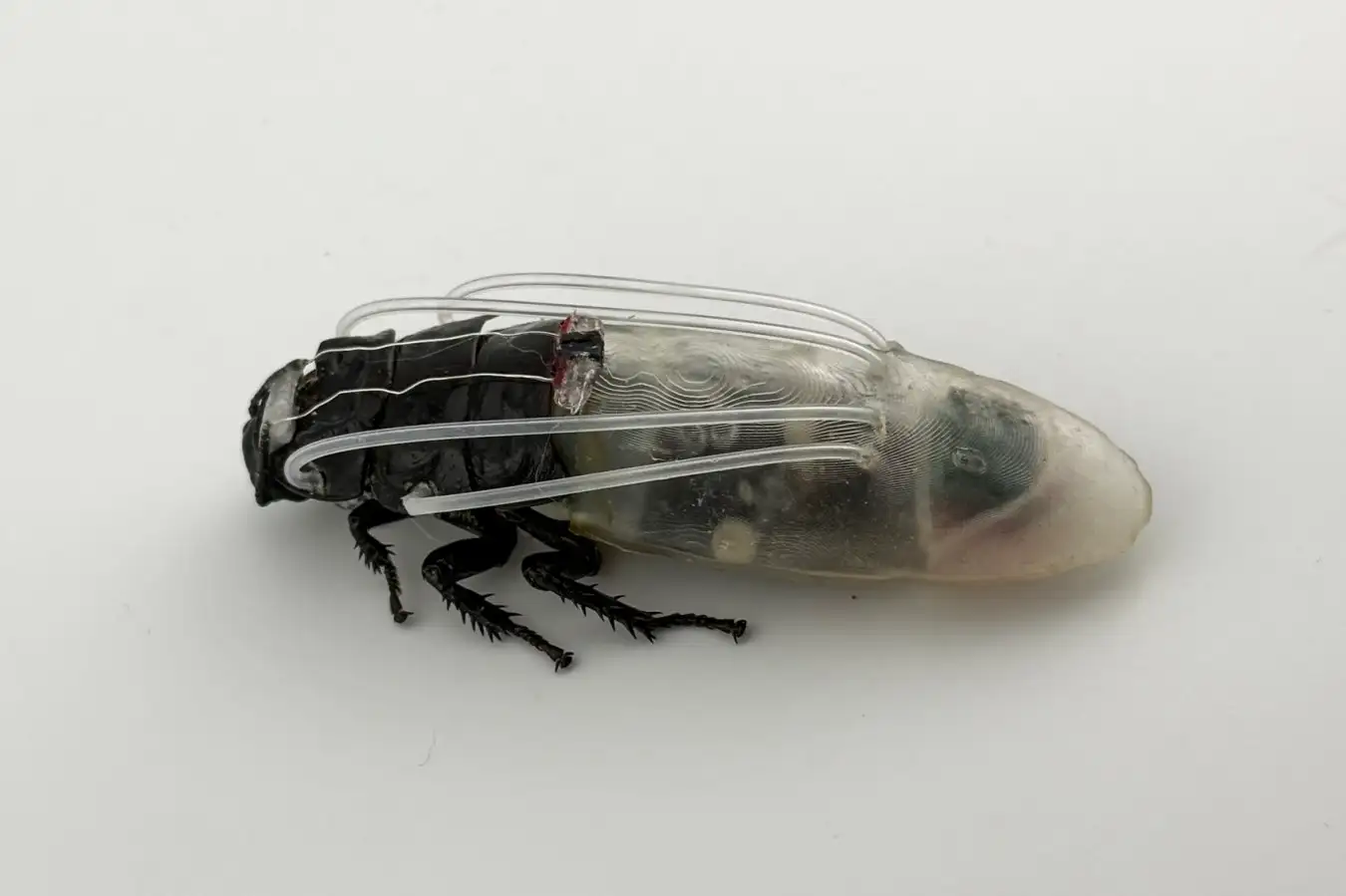
A cyborg cockroach with a suit for breathing underwater
NTU Singapore
Swarms of cyborg insects controlled remotely via electrical implants can now operate underwater, thanks to tiny diving suits supplying them with oxygen – which could one day enable them to explore Mars.
Hirotaka Sato at Nanyang Technological University in Singapore and his colleagues first demonstrated in 2021 that Madagascar hissing cockroaches (Gromphadorhina portentosa) could be remotely controlled with electrodes embedded in sensory organs known as cerci. In 2024, they demonstrated that a swarm of 20 of these cyborg insects could coordinate.
The aim was to develop biological robots equipped with infrared sensors that could be released in large numbers after natural disasters to search for survivors. Cockroaches represent a ready-made platform for such applications with a working fuel source, efficient locomotion and in-built reflexes to dodge obstacles – capabilities that engineers still struggle to replicate mechanically at such a small scale.
But Sato and his team were unhappy with the insects’ inability to search flooded areas, which aren’t uncommon in disaster zones, so they have developed a diving suit to allow them to operate underwater.
Cockroaches breathe through pores called spiracles on their abdomen and thorax. The researchers 3D printed a watertight resin suit, which protects the abdominal spiracles from water. Tiny hoses run forwards from the suit to connect directly to the thorax spiracles; the main part of the suit would interfere with leg movement if it covered the thorax as well.
Rather than supplying the insects with a pressurised tank of oxygen, as scuba suits do, the researchers included a mixture of hydrogen peroxide and manganese dioxide. When these two chemicals react, the hydrogen peroxide decomposes to produce oxygen, which the cockroach can absorb.
While wearing the suit, the cockroaches were able to walk underwater for up to 3 hours at a time, at depths of up to 50 centimetres, with no ill effects: all five insects that were monitored after wearing the suits were still healthy three days later.
The suits also allowed the insects to move underwater surprisingly naturally. On land, the suit-wearing cyborg insects achieved an average forward speed of 87.5 millimetres per second, and this only slowed to 78.4 millimetres per second underwater.
Sato says such suits could make search-and-rescue cyborg insects far more capable, but he also hopes to explore their use in space, another environment lacking in vital oxygen.
“The ultimate goal is to [take this technology to] space,” he says. “It’s kind of one step, one big step, towards space suits for cyborg insects. Exploration over the Mars surface, for example.”
To this end, the research team now intends to test the cockroach suits in the various harsh conditions that they could encounter in orbit or on the surface of a planet like Mars: very low and high temperatures, a vacuum and intense radiation exposure. However, space agencies may not like the idea of sending cockroaches to Mars because it would risk contaminating the planet with microbes from Earth.
Alan Winfield at the University of the West of England says the concept of scuba-diving cockroaches may seem strange, but it has obvious applications, such as environmental monitoring.
“There have been attempts to build very small robots, but the problem is batteries. With a very small robot, you typically don’t get very much battery life,” he says. “People often used to say to me, what are the three big problems in mobile robots? And I’d say: energy, energy and energy.”
Cockroaches are not only vastly more efficient than robots and able to operate for longer without refuelling, they are also capable of foraging for their own food in the wild and operating almost indefinitely.
Topics:
- space exploration/
- robotics
[ad_2]
Source link : https://www.newscientist.com/article/2531894-remote-controlled-cockroach-swarm-can-now-breathe-underwater/?utm_campaign=RSS%7CNSNS&utm_source=NSNS&utm_medium=RSS&utm_content=home
Author :
Publish date : 2026-06-29 10:00:00
Copyright for syndicated content belongs to the linked Source.