
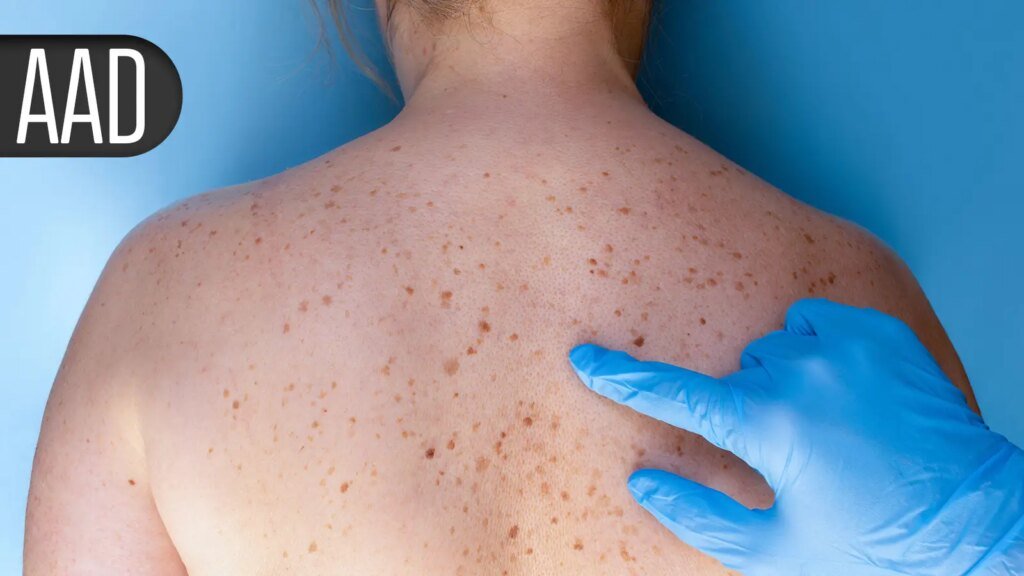
DENVER — Treatment-resistant dermatomyositis improved significantly with the investigational TYK2/JAK1 inhibitor brepocitinib, according to a randomized trial.
The higher of two doses of brepocitinib improved the total dermatomyositis score by almost 50% at 1 year as compared with placebo. The novel therapy demonstrated superiority over placebo across all nine secondary endpoints, including skin disease, glucocorticoid tapering, and functional disability. Noticeable improvement occurred as early as 4 weeks.
Adverse events (AEs) occurred in a similar proportion of patients treated with brepocitinib or placebo, reported Ruth Ann Vleugels, MD, of Brigham and Women’s Hospital in Boston, at the American Academy of Dermatology annual meeting. The study was published simultaneously in the New England Journal of Medicine.
“The 30-mg dose achieved statistical significance that was robust on all 10 primary ranked endpoints,” said Vleugels. “This is important because these ranked endpoints represent improvement not only in skin but also in muscle, global disease activity, rapidity of onset, and our ability to taper corticosteroids — extremely impressive data.”
“For those of us who study dermatomyositis, this is truly a landmark achievement,” she added. “Most importantly, this is a major move forward for our patients, who ideally, in the near future will be able to receive a targeted, effective therapy early in their disease course and be able to avoid systemic corticosteroids and side effects from other traditional DMARDs [disease-modifying antirheumatic drugs].”
One Drug Vs Two, Safety
During a post-presentation discussion, Hensin Tsao, MD, PhD, of the Mass General Research Institute in Boston, asked how the combination drug differs from giving the individual components separately.
“The TYK2 inhibitor currently on the market is an allosteric inhibitor, and there is evidence that [a non-allosteric inhibitor] would be better for this population,” Vleugels said. “In addition, with the combination, we think that by targeting interferon-1, interferon-2, and the interleukins [ILs], there will be more advantages than in the traditional JAK inhibitors that I’ve used for many years. With existing therapies, I couldn’t get this drug. I couldn’t just throw a few things together and have brepocitinib.”
Aaron Mark Drucker, MD, of the University of Wisconsin-Madison, asked about potential long-term side effects, particularly malignancy. “What should we be watching for?”
“Over the open-label extension study, I think the safety data will remain exactly what we’re seeing here,” said Vleugels. “I think the goal with brepocitinib, over time, is to use it early, rather than putting patients on steroids and methotrexate and mycophenolate mofetil and then putting brepocitinib on top, which is what’s required in a phase III study like this. So I would argue that using brepocitinib alone and earlier that [AEs] will actually go down.”
“In terms of malignancy and clot risk, I don’t have a concern with the long-term safety data,” Vleugels noted. I have been using JAK inhibitors off label for many years in many diseases. … I also want to highlight that my colleagues in oncology actually use JAK inhibitors in patients who have been on immunotherapy. Patients respond to immunotherapy, the immunotherapy stops working, and they now give those patients JAK inhibitors to re-prime the immune system and allow them to respond to immunotherapy better moving forward.”
Background, Key Results
An autoimmune disease, dermatomyositis, is characterized by inflammation and progressive damage to muscles, skin, lungs, joints, the heart, and gastrointestinal tract. The condition often follows a chronic, unpredictable, and protracted disease course, causing substantial morbidity, disability, and impaired quality of life (QoL). Current therapies offer incomplete efficacy and are associated with treatment-related toxicities.
“We know that patients with skin disease cycle through any therapeutics and despite being on five, six, or seven prior therapeutics, our best data indicate that only 14% achieve clinical disease remission,” said Vleugels. “So, this is a field where we really need targeted rapid-acting, effective therapies.”
Brepocitinib is a first-in-class, selective inhibitor of TYK2/JAK1 that suppresses key cytokines involved in dermatomyositis pathogenesis, including types I and II interferon, IL-6, IL-10, IL12, and IL-23. In a proof-of-concept study involving patients with severe, skin-predominant dermatomyositis, brepocitinib induced rapid suppression of type 1 and II interferon signaling, associated with early clinical improvement.
Vleugels reported primary results from the phase III VALOR randomized trial, comparing two doses of brepocitinib and placebo in patients with treatment-refractory dermatomyositis. Patients received 15 or 30 mg of brepocitinib daily or daily placebo (in addition to existing therapy) for 52 weeks. The primary endpoint was Total Improvement Score, which has a range of 0 (worst) to 100 (best).
Data analysis included 241 randomized patients who had a median age of 50. Treatment history included prior DMARD therapy in about 70%, and about 80% of the patients had received at least two prior dermatomyositis-directed therapies.
After 52 weeks the data showed that the placebo group had a mean total improvement score of 31.2 as compared with 37.5 for the 15-mg dose of brepocitinib and 46.5 for the 30-mg dose (P<0.001 vs placebo). The between-group difference in favor of brepocitinib 30 mg was evident as early as 4 weeks.
The difference between the lower brepocitinib dose and placebo and between the higher and lower dose of brepocitinib did not reach statistical significance. Among patients on systemic corticosteroids at baseline, 62% of the higher-dose brepocitinib arm tapered to ≤2.5 mg/day, and 42% tapered to 0, as compared with 3% and 23% of patients on 15 mg brepocitinib and placebo, respectively.
For all nine key secondary endpoints, the higher dose of brepocitinib led to significantly better results than placebo (P=0.04 to P<0.001). The improvement encompassed all aspects of skin disease, including disease activity, itch, and skin-related QoL.
The incidence of all AEs was similar across treatment groups (86-91%). The most common any-grade AEs in any group (≥5%) were upper respiratory tract infection, COVID, urinary tract infection, nausea, diarrhea and headache. Serious infections occurred more often with brepocitinib 30 mg (10% vs 2% for brepocitinib 15 mg and 1% for placebo), but all of the infections resolved with treatment, and most patients completed treatment.
Please enable JavaScript to view the comments powered by Disqus.
Source link : https://www.medpagetoday.com/meetingcoverage/aad/120546
Author :
Publish date : 2026-03-29 18:59:00
Copyright for syndicated content belongs to the linked Source.