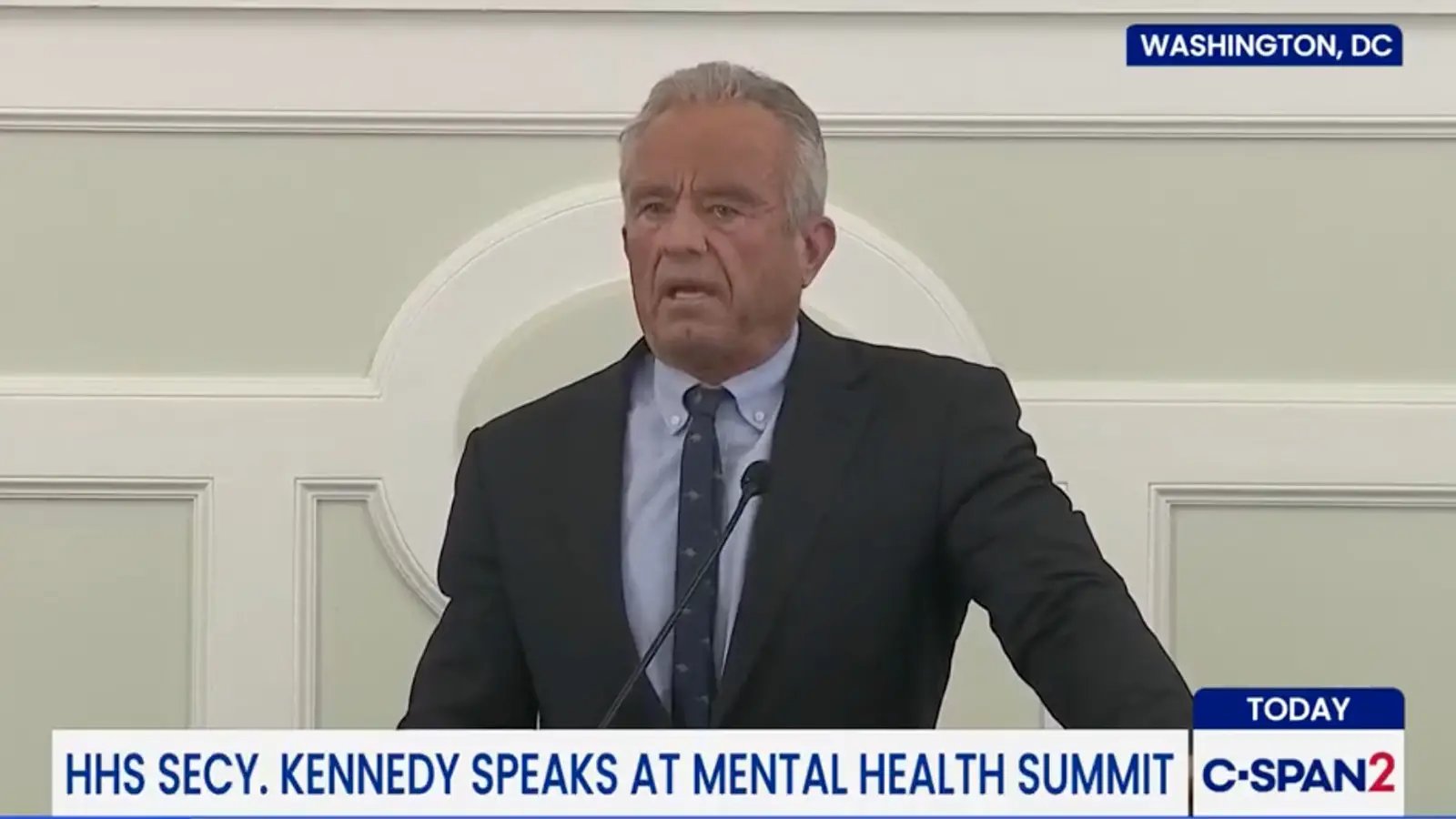
Clinicians need to do more to help wean patients off of antidepressants, according to HHS Secretary Robert F. Kennedy Jr.
“The U.S. doesn’t just face a mental health crisis; we face a dependency crisis driven by overmedication,” Kennedy said Monday at a MAHA Institute conference. “One in six adults takes an antidepressant and one in 10 children are on a prescription for mental health … Too many patients begin treatment without a clear understanding of the risks or how long they’ll stay on these drugs or how they’ll come off them.”
Kennedy has long been opposed to antidepressant use and said on X last year that the CDC was going to “confront the long-taboo question of whether SSRIs [selective serotonin reuptake inhibitors] and other psychoactive drugs contribute to mass violence.”
As part of the initiative announced Monday, the agency sent physicians a “Dear Colleague” letter that “encourages providers to prioritize informed consent and shared decision-making, and to regularly review the risks and benefits of psychiatric medications with patients,” HHS said in a press release. “The letter highlights nonmedication approaches, such as family support, psychotherapy, nutrition, and physical activity when clinically appropriate.”
The letter also lists billing codes that providers can use to get paid for tasks associated with deprescribing and the use of “evidence-based nonmedication treatments.”
“Psychiatric medicines have a role in care, but we will no longer treat them as the default,” Kennedy said at the event.
Also on Monday, the Centers for Medicare & Medicaid Services (CMS) released guidance for physicians and other practitioners “on the importance of deprescribing and related medical care,” according to the HHS press release. This guidance explains more about how clinicians can be paid by Medicare for deprescribing, and also directs clinicians to resources such as professional society guidelines, peer-reviewed deprescribing protocols, and FDA instructions for taper schedules.
At the conference, Kennedy touted his own expertise on the deprescribing issue. “I made a statement early on in my administration that withdrawal from SSRIs can be more difficult than withdrawal from heroin,” he said. “The New York Times said experts disagree … We all know when they say, ‘trust the experts,’ they’ve got nothing. I happen to be an actual expert on this because I was addicted to heroin for 14 years.”
He said that although heroin withdrawal involves 72 hours of misery, “I’ve watched people come off SSRIs and it’s not even comparable” because the latter is so much worse. One family member “was suicidal literally every day … I’ve heard that from hundreds of people and it’s the same story again and again.”
However, he added, physicians will often say that the withdrawal effects “are the original symptom reasserting itself; you need to get back on the SSRI,” and it becomes a lifetime cycle.
The American Psychiatric Association (APA) reacted cautiously to the HHS announcement. “APA welcomes the attention placed squarely on the nation’s mental health crisis and is committed to advancing solutions that improve access to high-quality evidence-based care,” the association said in a statement. “We are supportive of the Administration’s plans for further investment in research and clinician training on the issues of prescribing and deprescribing.”
However, “while APA supports efforts to improve the quality, safety, and evidence base of mental health treatment, we strongly object to framing the nation’s mental health crisis as primarily a problem of ‘overmedicalization’ or ‘overprescribing.’ That characterization oversimplifies a complex crisis and ignores the larger reality: too many patients cannot access timely, comprehensive care, while care remains unevenly distributed across our health system,” the group added. “It also fails to account for persistent workforce shortages, limited psychiatric beds, inadequate visit time, barriers to psychotherapy and social supports, insufficient integration of psychiatric expertise in primary care through the Collaborative Care model, and the lack of a true continuum of care.”
“Deprescribing alone is not a sufficient response to this crisis,” the APA continued. “In psychiatry, as in all areas of medicine, prescribing and deprescribing occur every day as part of individualized, evidence-based treatment planning between physicians and patients. The solution is not to stigmatize psychiatric medication or impose broad assumptions on clinical care, but to ensure that patients have access to the full range of evidence-based treatments and that decisions are guided by the best available science and each patient’s needs.”
The APA, along with five other psychiatric and psychopharmacology groups, also spoke out a year ago regarding the safety of antidepressants and other psychiatric medications.
“The safety and efficacy of traditional antidepressants, antipsychotics, and mood stabilizers (such as lithium and some anticonvulsants) and stimulant medications have been established through decades of rigorous research, randomized clinical trials, peer-reviewed studies, meta-analyses, national registry studies of thousands of people, post-marketing pharmacovigilance monitoring, and FDA oversight,” the groups said in a joint statement published online in the Journal of Clinical Psychiatry. “These drugs provide relief for many young people enabling them to participate fully in treatment, school, social activities, and family life — all key aspects of healthy development. Efforts to discourage, stigmatize, or curtail the use of evidence-based treatments for mental illness will have serious deleterious consequences, particularly for individuals with serious mental illness, their loved ones, and the communities in which they live.”
Protect Our Care, a nonprofit organization whose mission is to make “high-quality, affordable, and equitable healthcare a right, and not a privilege,” panned the announcement from HHS.
“While RFK Jr.’s HHS makes no mention of how they intend to incentivize therapists to be in-network with private insurance and Medicare, major studies and surveys have shown that 82.7% of psychotherapists did not accept any public insurance like Medicare while more than one-third of practicing psychologists do not accept private insurance,” the group said in a statement. “Meanwhile, the Trump administration’s [fiscal year] 2027 budget plan seeks to gut over half a billion dollars from mental health programs while eliminating the Substance Abuse and Mental Health Services Administration.”
Source link : https://www.medpagetoday.com/psychiatry/depression/121129
Author :
Publish date : 2026-05-05 21:20:00
Copyright for syndicated content belongs to the linked Source.