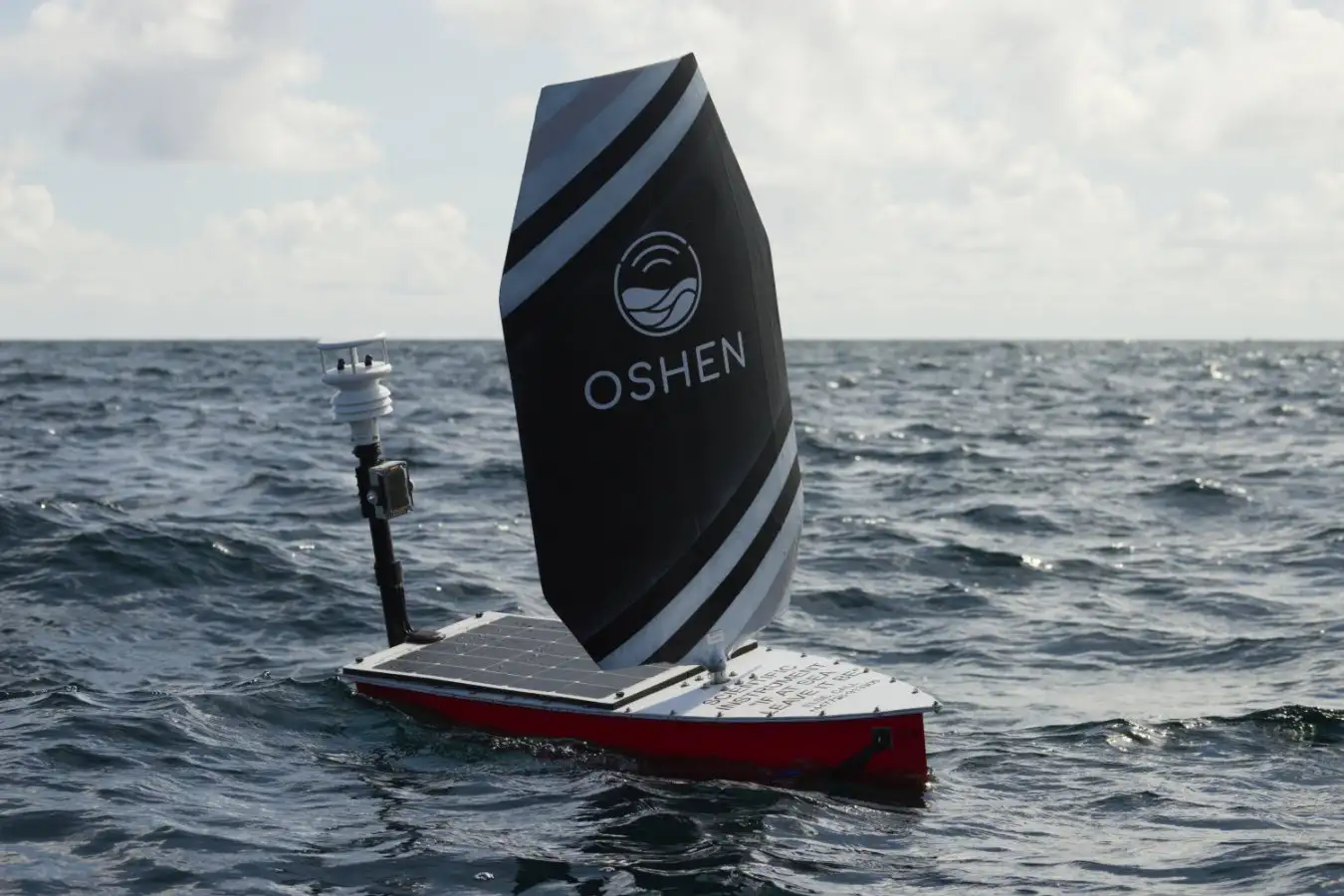
Oshen’s robotic sailboats are powered by the wind and the sun
Oshen
The UK’s Royal Navy may return to the age of sail, with a new demonstration involving a flotilla of small, wind-propelled robot boats.
Made by Oshen in Plymouth, UK, the vessels, known as C-Stars, are just 1.2 metres long and weigh around 40 kilos. Solar panels power navigation, communications and sensors, while a sail provides propulsion. Deployed as a constellation, the small vessels act as a wide-area sensor network.
“The simplest way of describing C-Stars is as self-deploying, station-keeping ocean buoys,” says Oshen CEO Anahita Laverack.
The boats can sail at about 2 knots, covering around 50 miles per day, or use the wind to remain in place rather than drifting. They don’t need to be fast. “Speed is not important when you are a CCTV network,” says Laverack. “The idea is to position sensors everywhere you need them.”
In the trial announced this month, a larger robotic vessel will transport three C-Stars and drop them off in the target area. The C-Stars will then relay acoustic signals to and from an uncrewed submarine. Many more would be deployed in a live operation.
“If you only have one, then the adversary can tell the general area of the submarine it is communicating with. If you have a hundred, the submarine could be anywhere, under any of them,” says Laverick.
The uncrewed boats can stay at sea for six months or more and survive the worst sea states. Last year, C-Stars became the first uncrewed vessels to provide live data from inside a category 5 storm, as part of a research project involving the US National Oceanic and Atmospheric Administration.
If the navy demonstration is successful, robot sailboats could take on a variety of roles. In addition to communication with submarines and seabed sensors, they could form picket lines to detect ships, incoming missiles, or drones trying to sneak under radar.
C-Stars also seem ideal for submarine detection as an alternative to disposable sonar-equipped buoys, which only last a few hours. They can use their hydrophones to listen for subs or pick up reflected sonar pings from an external source such as a warship. In this scenario, the ship’s sonar effectively lights up an area, so that the C-Stars can see anything near them.
Blair Thornton at the University of Southampton, UK, says solar- and wind-powered uncrewed vessels have gradually become accepted over the last decade, and around 100 of various types are in service. He says autonomy will be essential with a fleet of them.
“It isn’t only the platform costs, but it is how much oversight they need for their operations,” says Thornton. “The combination of long endurance, robust operations with minimal need for human interaction can be a major advantage and allow large fleets of autonomous systems to operate.”
The latest demonstration aims to show C-Stars can easily integrate with existing navy systems. Oshen could deliver 1000 boats with a nine-month lead time if the navy decides to place an order.
“The next level will involve software refinements so we can see more detail and achieve better coverage of a wider area with fewer C-Stars,” says Laverack.
Topics:
Source link : https://www.newscientist.com/article/2515214-royal-navy-returns-to-wind-power-with-trial-of-robotic-sailboats/?utm_campaign=RSS%7CNSNS&utm_source=NSNS&utm_medium=RSS&utm_content=home
Author :
Publish date : 2026-02-12 08:00:00
Copyright for syndicated content belongs to the linked Source.