


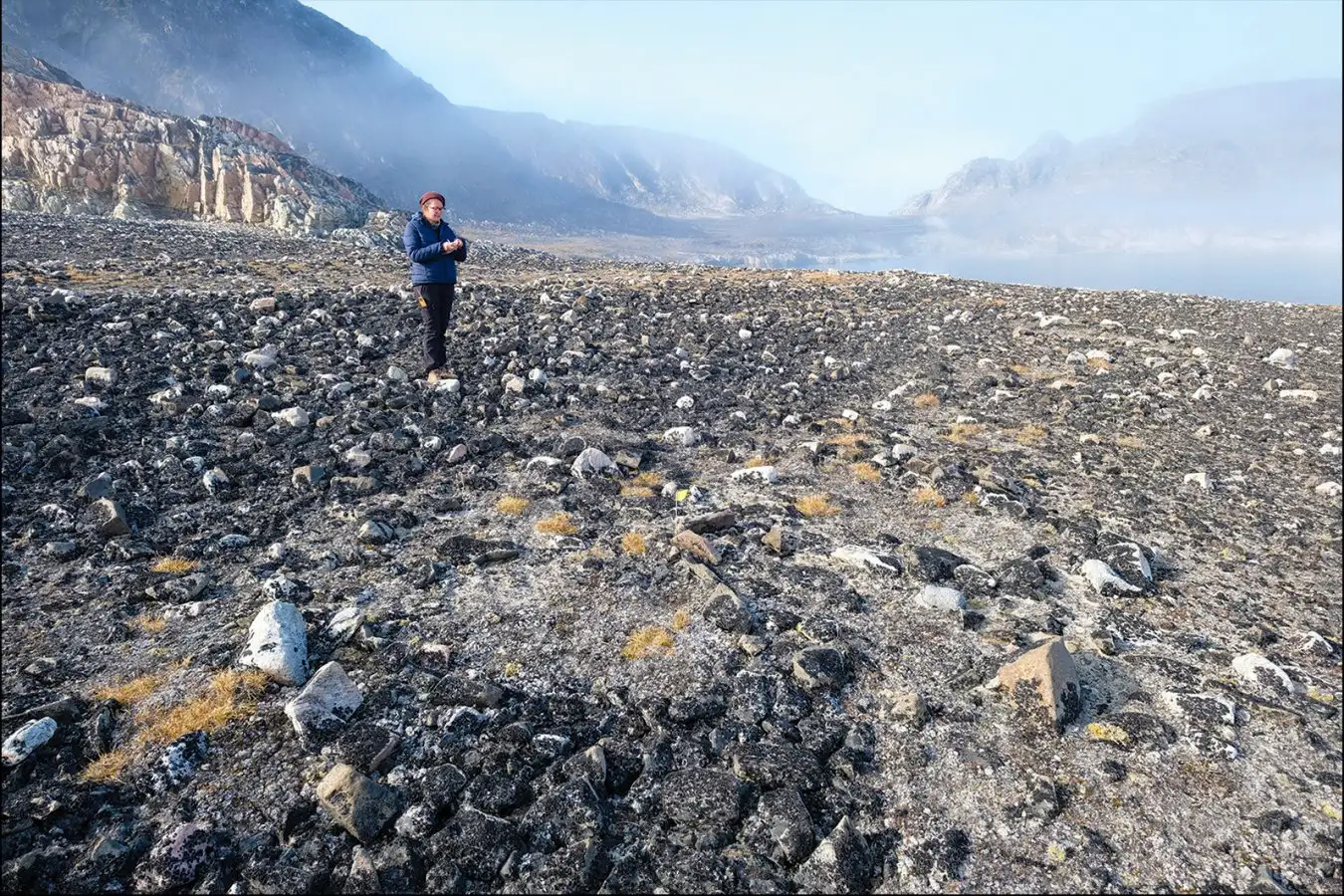
A site on Isbjørne Island where Palaeo-Inuit people erected a circular tent
Matthew Walls, Mari Kleist, Pauline Knudsen
Humans were voyaging to remote islands off the north-west coast of Greenland 4500 years ago. This required them to cross over 50 kilometres of open water – one of the longest sea journeys made by Indigenous peoples in the Arctic.
These intrepid seafarers were the first humans to ever reach these islands, says archaeologist John Darwent at the University of California, Davis, who wasn’t involved in the study.
In 2019, Matthew Walls at the University of Calgary in Canada and his colleagues surveyed the Kitsissut Islands, also known as the Carey Islands, north-west of Greenland. The islands lie in the Pikialasorsuaq polynya, an area of open water surrounded by sea ice. Studies of marine sediments indicate that the polynya only formed about 4500 years ago.
The researchers focused on the three central islands: Isbjørne, Mellem and Nordvest. They found five sites with a total of 297 archaeological features. The biggest clusters were on Isbjørne, along beach terraces. There, the team found traces of 15 circular tents, each divided into two halves by stones, with a central hearth. These “bilobate” tents are characteristic of the Paleo-Inuit, the first peoples to reach northern Canada and Greenland.
Walls and his colleagues radiocarbon-dated a single wing bone from a seabird called a thick-billed murre, found in one of the tent rings. They estimate the bone is 4400 to 3938 years old. This indicates that people were on the Kitsissut Islands by this time, very soon after the polynya formed.
“There’s a nesting colony of thick-billed murre,” says Walls. People would have collected their eggs and hunted them for meat. He suspects they also hunted seals.
The Paleo-Inuit were already on Greenland by this time and probably voyaged west from there to Kitsissut, says Walls. “The shortest distance is about 52.7 kilometres.” However, given prevailing currents and winds, they probably set off from a more northerly point, resulting in a longer but safer journey. To the west of Kitsissut is Ellesmere Island, which today is part of Canada, but it is further away and the currents in between are challenging.
The only comparable sea journey known from Arctic prehistory is the crossing of the 82-kilometre Bering Strait, from Siberia into Alaska, which was probably first made at least 20,000 years ago. However, the Diomede Islands serve as a stopping point halfway across.
“They did have to have some sophisticated watercraft in order to cross that stretch of water,” says Darwent. Given the size of the community on Kitsissut, single-person kayaks wouldn’t have been enough. “It is whole families, and you’re not going to be able to take kids and maybe elderly across into that sort of area with kayaks,” he says. Instead, the Paleo-Inuit must have used larger craft that could carry perhaps nine or 10 people.
No boat remains were found on Kitsissut, and such remains are scarce in the Arctic. “They would have been skin-on-frame watercraft,” says Walls, like those used by later Inuit communities.
These first Paleo-Inuit settlers would have helped shape the ecosystem of Kitsissut, says Walls. By bringing nutrients in from the sea and leaving their waste on land, they fertilised the barren soils and enabled vegetation to grow on the islands. “You have rich vegetation there, at least at the start, that’s dependent in some ways on humans who are part of the cycling of nutrients between those systems.”

Arctic expedition cruise with Dr Russell Arnott: Svalbard, Norway
Embark on an unforgettable marine expedition to the Arctic, accompanied by marine biologist Russell Arnott.
Topics:
Source link : https://www.newscientist.com/article/2514486-seafarers-were-visiting-remote-arctic-islands-over-4000-years-ago/?utm_campaign=RSS%7CNSNS&utm_source=NSNS&utm_medium=RSS&utm_content=home
Author :
Publish date : 2026-02-09 00:01:00
Copyright for syndicated content belongs to the linked Source.