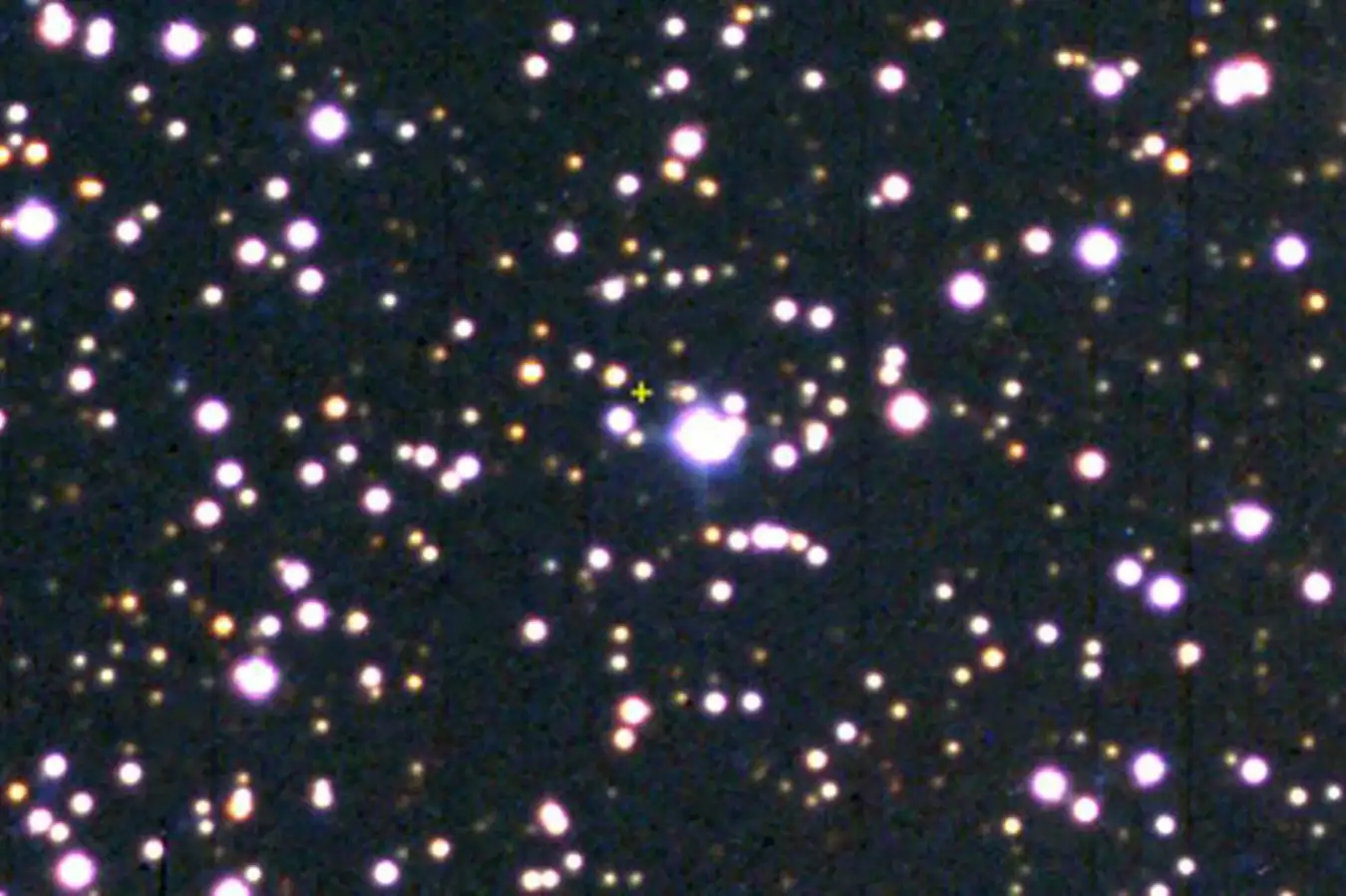
An image captured by a telescope at the Grasslands Observatory in Arizona. The “x” is where E. E. Barnard saw his mystery star
Tim Hunter et al. (2025)
A star that was spotted in 1892 by one of the most gifted astronomical observers of all time but then apparently vanished has been found again – right where he lost it.
Edward Emerson Barnard was an accomplished astronomer, famous for his discovery in 1892 of a fifth moon of Jupiter, Amalthea, almost three centuries after Galileo Galilei saw the first four. But a few weeks earlier, he had made an enigmatic observation that kept bothering him. A short article he published about it in a journal in 1906 was headlined “An unexplained observation“.
What he thought he saw was a star, close to Venus on a morning he had pointed his telescope at that planet, hoping to discover satellites.
He estimated its brightness as 7th magnitude, according to the scale astronomers use, where dimmer objects get a higher number. On a dark night, someone with good eyes can see stars of around 6th magnitude at most.
Barnard looked for the star in the only whole-sky catalogue of the day, the Bonner Durchmusterung. It listed all stars of magnitude 9.5 or brighter, so his 7th magnitude star should have been in it, but wasn’t. And observing again later, it seemed gone. The only star he could find near that position was one of 11th magnitude, about a hundred times less luminous.
Could it have been a large asteroid? “Not Ceres, Pallas, Juno and Vesta which were elsewhere,” he later wrote. Some thought the 11th magnitude star he later saw in a similar position, or another nearby star, might have temporarily brightened. Others speculated that Barnard had been fooled by a “ghost”, a stray reflection of Venus in his telescope. But the mystery remained – until, in December 2024, a group of astronomers decided to get to the bottom of it.
“On a Zoom meeting I have once a week, called the Asteroid Lunch, I just happened to mention it,” says Tim Hunter.
Before long, Hunter, an amateur astronomer based in Arizona and co-founder of the International Dark-Sky Association – now DarkSky International – was part of a group of amateur and professional astronomers examining all the explanations that had been proposed. They found good reasons to reject every one of them.
They were about to give up when group member Roger Ceragioli, an optical engineer at the University of Arizona, decided to once more test the ghost theory by looking at Venus at dawn, as Barnard had done. He did so using a telescope fitted with a vintage eyepiece similar to one that Barnard might have used. He was in for a surprise.
Although Venus wasn’t in the position in the sky where Barnard had observed it in 1892, “immediately in the field, I saw a star”, says Ceragioli. He reasoned that it must be pretty bright to be visible at dawn. But the star map on his computer told him it was actually only 8th magnitude – relatively dim.
Barnard, the group concluded, had experienced something similar. This suggests that the 7th magnitude star he believed he had seen was actually the 11th magnitude star subsequently documented at the location, which had appeared brighter than it really was in the morning light. Barnard was relatively new to the 36-inch telescope of the Lick Observatory on Mount Hamilton in California through which he saw the star next to Venus, and he had no other stars of known brightness in view with which to compare it.
Barnard’s error is forgivable, Ceragioli notes, given that determining a star’s brightness by eye was a special skill in Barnard’s time, developed only by astronomers who studied variable stars, which he never did.
Hunter, too, thinks the astronomer’s reputation is still “pretty perfect. We are all very big Barnard fans. It’s a fairly minor error.”
The world capital of astronomy: Chile
Experience the astronomical highlights of Chile. Visit some of the world’s most technologically advanced observatories and stargaze beneath some of the clearest skies on earth.
Topics:
Source link : https://www.newscientist.com/article/2509810-star-that-seemed-to-vanish-more-than-130-years-ago-is-found-again/?utm_campaign=RSS%7CNSNS&utm_source=NSNS&utm_medium=RSS&utm_content=home
Author :
Publish date : 2025-12-30 19:00:00
Copyright for syndicated content belongs to the linked Source.