[ad_1]
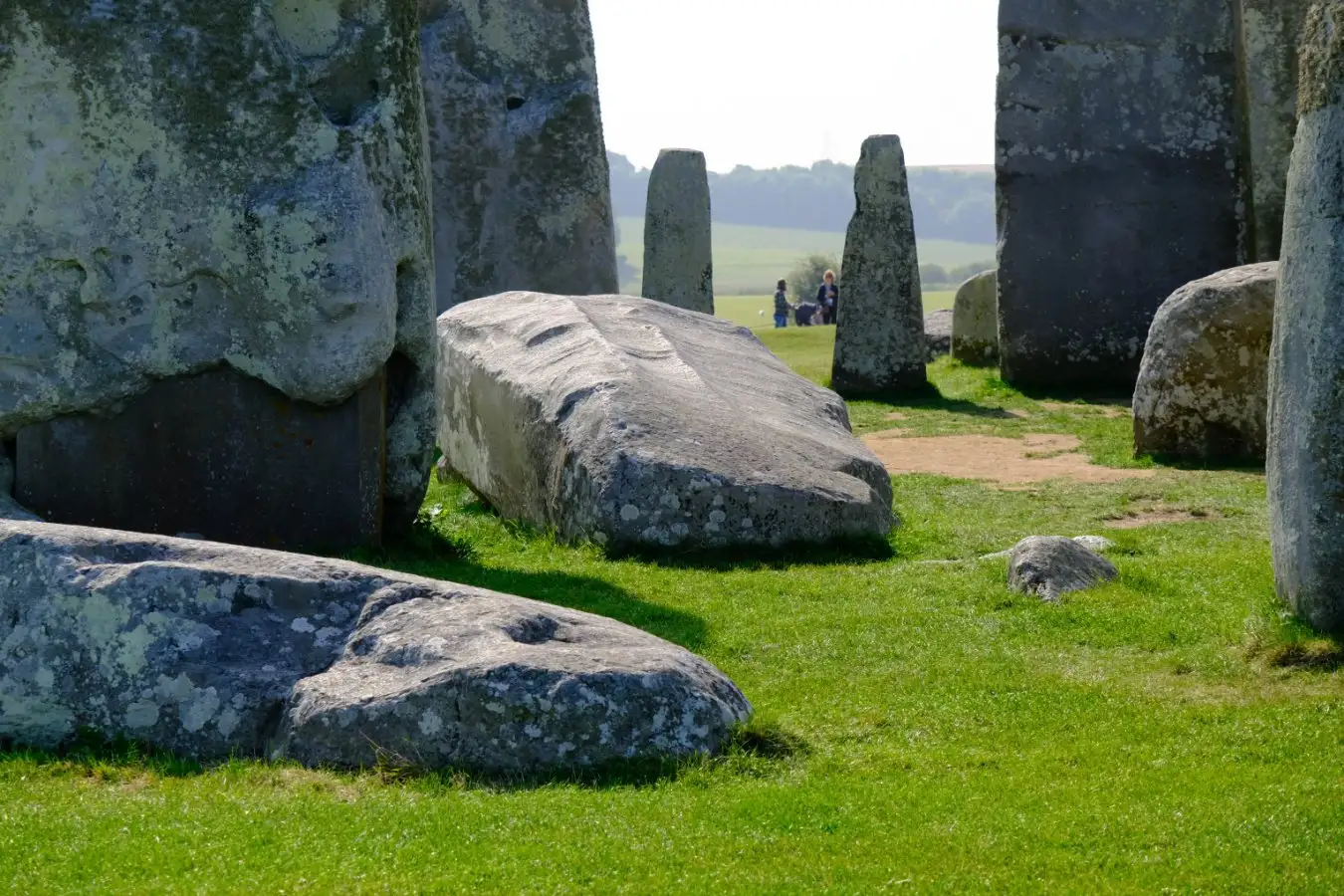
The 5-metre-long altar stone lies mostly buried at the centre of Stonehenge
Laurence Berger/Getty Images
Researchers investigating the origins of Stonehenge’s enigmatic altar stone say it is possible that the 6-tonne rock was carried southwards from Scotland by a glacier – but this hypothesis relies on an unlikely series of events, making it more likely that humans transported it.
The 5-metre-long monolith, which is partially buried and overlain by two other stones, has been in its present location, at the centre of Stonehenge’s ring of worked boulders, for around 4500 years.
In 2024, researchers including Anthony Clarke at Curtin University in Perth, Australia, determined that the altar stone came from north-east Scotland, based on the chemistry of the rock.
“The altar stone is a sandstone – you can imagine grains of sand at the beach that have been squished together,” says Clarke. “We can get an age and the chemical composition for each of those grains and build up a fingerprint, which we can then forensically compare to other rocks throughout the UK and Ireland.”
The altar stone’s chemical fingerprint matched outcrops in the Orcadian basin, a geological feature that overlays parts of north-east Scotland. This meant the stone must have been transported 750 kilometres southwards to Stonehenge, in southern England.
Clarke and his colleagues originally thought it was most likely that the stone had been transported by boat. But they also wondered whether it could have been moved by glaciers during the last glacial period, potentially reducing the distance humans would have had to carry it.
In the new study, Clarke and his colleagues used geological analysis and ice flow modelling to reconstruct ancient glacial movements.
They found that most ice flows from north-east Scotland went to the north, but some did head south and would have dumped their cargo of rock at Dogger Bank. During the last glacial period, Dogger Bank was part of a land bridge connecting Britain with mainland Europe, but it now lies under the North Sea, off England’s east coast.
If a glacier had transported the altar stone to Dogger Bank, it would have shortened the distance humans would have needed to move the stone by several hundred kilometres.
But Dogger Bank was inundated around 8000 years ago, and the construction of Stonehenge didn’t commence until around 5000 years ago. This means it requires an “increasingly elaborate set of circumstances” to envisage how glaciation could have moved the altar stone, says Clarke.
Some of the other stones that make up Stonehenge, weighing 25 to 30 tonnes, were transported tens of kilometres by humans. This means that with enough time, they would have had the technology and the will to move the altar stone even further, says Clarke.
“These people that erected Stonehenge weren’t in any rush. This could have been much like the pyramids, a multi-year endeavour, so it doesn’t need to happen on our modern timescales of months,” he says.
The researchers hope that more sampling will enable them to pinpoint the exact outcrop or quarry where the altar stone came from. But we are unlikely to ever know why these people felt compelled to undertake such a massive task, says Clarke.
“Why do we select marble from Italy for our kitchens?” he asks. “Why do we select certain gemstones to wear around our necks? Humans have always had a fascination with finding the right rock and, for whatever reason, they needed sandstone from north-east Scotland for their monument in England.”
Topics:
[ad_2]
Source link : https://www.newscientist.com/article/2529005-stonehenges-altar-stone-probably-wasnt-transported-by-a-glacier/?utm_campaign=RSS%7CNSNS&utm_source=NSNS&utm_medium=RSS&utm_content=home
Author :
Publish date : 2026-06-04 09:00:00
Copyright for syndicated content belongs to the linked Source.