


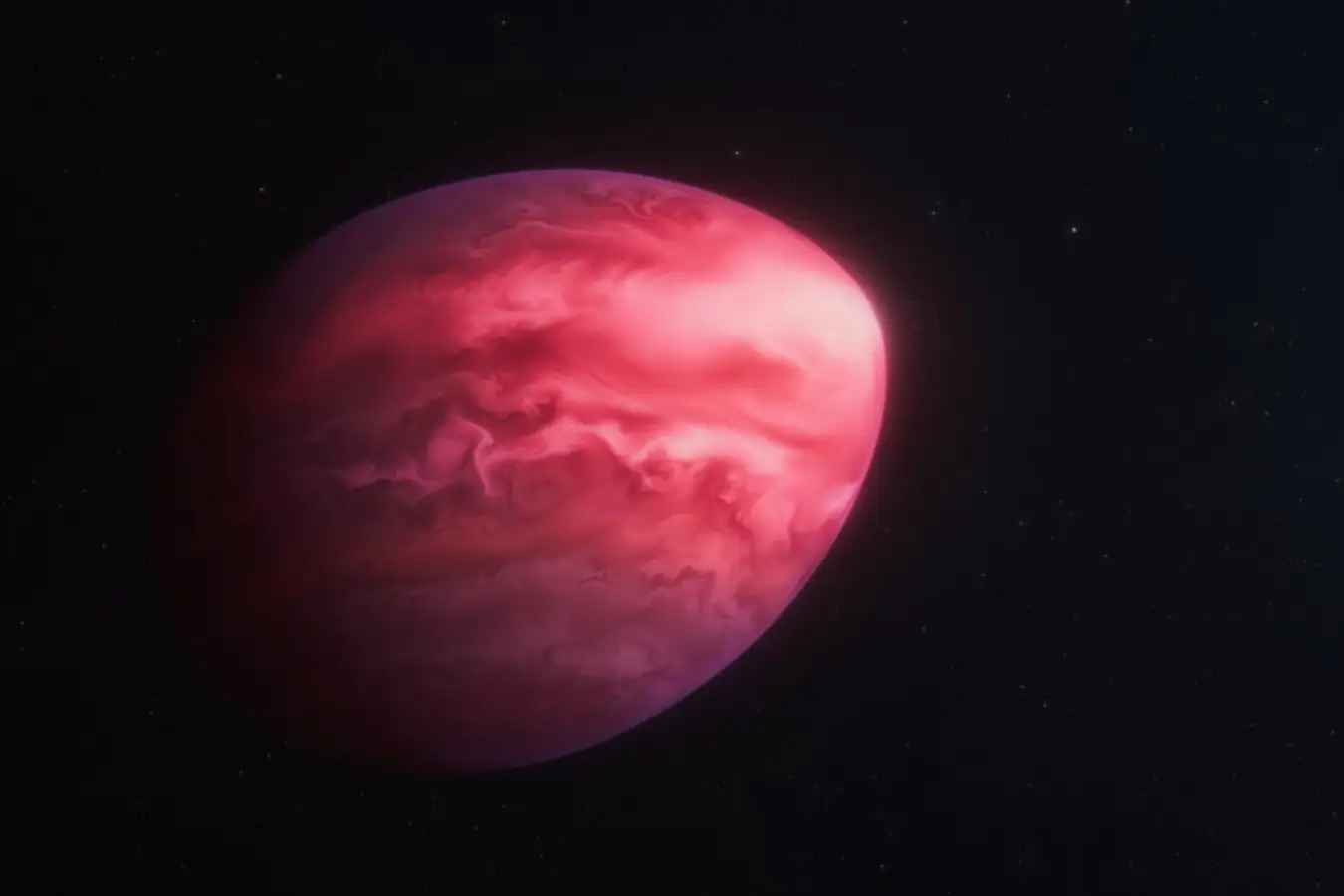
An artist’s impression of PSR J2322-2650b
NASA, ESA, CSA, Ralf Crawford (STScI)
Astronomers have found what appears to be one of the strangest known worlds in the universe. It orbits a type of rapidly spinning neutron star called a pulsar – this in itself is unusual, but it is far from the weirdest thing about the exoplanet PSR J2322-2650b.
Michael Zhang at the University of Chicago and his colleagues spotted the odd planet, which is more than 2000 light years away from Earth, via the James Webb Space Telescope, and immediately noticed that something about it was unusual. The spectrum of light they measured coming from it didn’t show the usual water and carbon dioxide we would expect to find on a Jupiter-mass world like this one, but instead molecules of carbon.
We have never seen molecular carbon in the atmosphere of any exoplanet before, because any carbon in a planet’s atmosphere is far more likely to bind to other atoms than to itself. “In order to have molecular carbon in the atmosphere, you have to get rid of pretty much everything else, all of the oxygen, all of the nitrogen, and we just don’t know how to do that,” says Zhang. “We don’t know of any other planetary atmosphere that looks anything like this.”
The planet is so close to its host star, and the host star is so massive, that it is thought to have been pulled by the pulsar’s gravity into an oblong, lemon-like shape. A full year there lasts only 7.8 hours, and even the coldest points on the planet are about 650°C (1202°F). Unlike most other giant planets, the winds there blow in the opposite direction to the planet’s rotation. “You can imagine that this planet would look deep red, with clouds of graphite in the atmosphere”, like a sort of evil lemon, Zhang says. “I would say it’s definitely the weirdest exoplanet.”
All of these oddities make it difficult to explain how PSR J2322-2650b could have possibly formed – it seems to defy the established models of planet formation. For now, this utterly strange, distant world is a total mystery.
Topics:
Source link : https://www.newscientist.com/article/2508929-strange-lemon-shaped-exoplanet-defies-the-rules-of-planet-formation/?utm_campaign=RSS%7CNSNS&utm_source=NSNS&utm_medium=RSS&utm_content=home
Author :
Publish date : 2025-12-17 16:30:00
Copyright for syndicated content belongs to the linked Source.