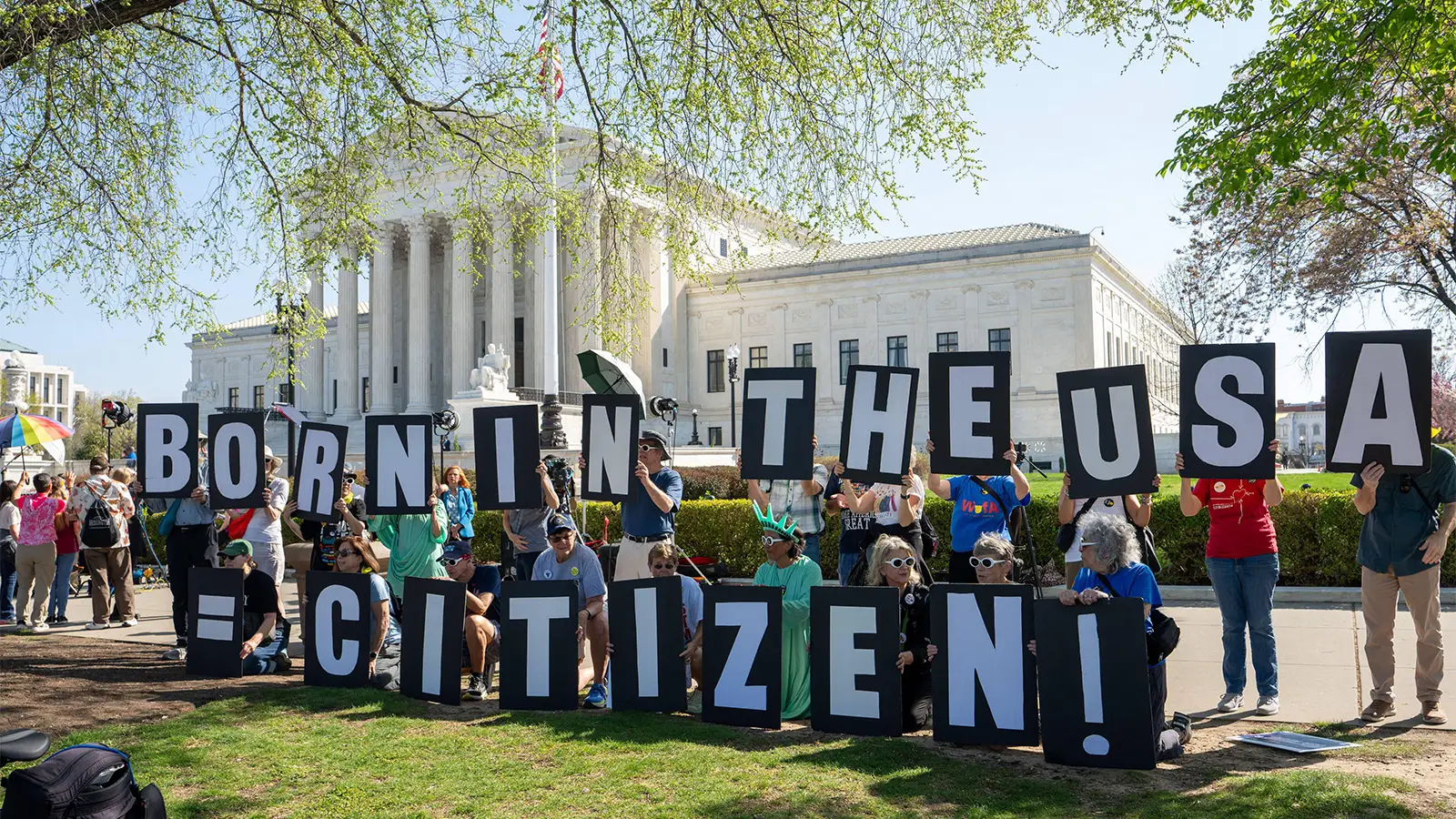
The Supreme Court heard oral arguments last week on a case involving birthright citizenship, and the court’s decision could potentially have major implications for Medicaid enrollment of some newborns, experts say.
Depending on how the court decides, said Leighton Ku, PhD, MPH, director of the Center for Health Policy Research at George Washington University, “there are large numbers of children … now thrown into limbo over what their Medicaid eligibility status is, with harmful consequences for moms and babies, but also for the hospitals and doctors who care for them.”
The case argued last Wednesday, Trump v. Barbara, revolves around an executive order (EO) that President Trump signed on Jan. 20, 2025, his first day in office. The order said the 14th Amendment to the Constitution, which states that anyone born in the U.S. and who is subject to U.S. jurisdiction is automatically a U.S. citizen, “has never been interpreted to extend citizenship universally to everyone born within the United States.”
Instead, the order continued, the amendment excludes those who are not subject to U.S. jurisdiction, including those with an undocumented mother and a father who isn’t a U.S. citizen or lawful permanent resident; or those with a mother who is in the U.S. legally but only temporarily — such as being under the Visa Waiver Program or on a student, work, or tourist visa — and a father who is not a citizen.
Therefore, according to the order, no federal department or agency “shall issue documents recognizing United States citizenship, or accept documents issued by state, local, or other governments or authorities purporting to recognize United States citizenship,” to those in the excepted categories. That would include U.S. passports and similar documents.
A woman named in the case only as “Barbara,” who lives in New Hampshire, sued in federal court over the executive order. Barbara is a Honduran citizen and is married with three children; she and her husband — who is not a U.S. citizen or lawful permanent resident — were expecting their fourth child in October 2025. Barbara’s asylum application is pending with the federal Citizenship and Immigration Services office, and she has lived in the U.S. since 2024. She “plans to seek for her child Supplemental Nutrition Assistance Program (SNAP), Medicaid, and other benefits for which citizens are eligible,” according to court papers.
During the oral arguments, the justices — including some who were appointed by Trump — seemed skeptical of the government’s argument against birthright citizenship. Chief Justice John Roberts asked Sauer how the “quirky” and “idiosyncratic” examples he used of people who everyone agrees were rightly excluded from birthright citizenship could be applied to a much larger class of individuals born on U.S. soil, CNN reported.
Sauer said the order is intended to end “birth tourism” — women coming to the U.S. while pregnant solely for the purpose of having a child in the country — but Roberts questioned whether birth tourism could have been on the framers’ minds given that the concept didn’t really exist when the authors of the 14th Amendment were around.
What would happen if the Supreme Court sided with the Trump administration and voided the birthright citizenship concept? Shelby Gonzales, vice president for immigration policy at the Center on Budget and Policy Priorities, a left-leaning Washington think tank, noted that children’s eligibility for Medicaid would be at risk, “but it would not be a straightforward situation,” she said in an email.
“Take, for example, [the fact that] for newborn babies, Medicaid includes a provision that extends Medicaid eligibility to them for their first year of life if the baby’s mother was eligible for Medicaid services on the day of its birth,” said Gonzales. “However, if the same baby met all Medicaid financial eligibility requirements, but the mother had private insurance (or no coverage) and both parents had temporary immigration statuses, that baby — no longer a U.S citizen under this EO — would not be eligible.”
Ku said in a phone interview that estimates are that “between 200,000 and 250,000 children born each year might fall into this category” in which one or both parents are undocumented or only here on temporary status, “and so they might not get birthright citizenship” and their Medicaid status would be at risk.
However, he added that the effect “potentially is much broader than that because in order to enforce the executive order, at birth or soon after birth, [both] parents would need to show documentation of citizenship or immigration status … What happens if the father is not named on the birth certificate? This just adds to doubt and means by default [officials] can’t figure out whether the child is a citizen or not.”
In addition, for some new parents, proving citizenship could be difficult, Ku said, noting that slightly less than half of the 3.5 million children born each year in the U.S. are on Medicaid. “Presumably, all moms and dads would have to show evidence of citizenship, and we know there’s a large share of people who don’t have passports or don’t have birth certificates,” he said.
Gonzales said such a change also would create challenges for government as well as for healthcare providers. “If the executive order is allowed to go into effect, federal agencies, including CMS, would have a very short turnaround time to implement this complicated and deeply troubling new policy,” Gonzales said.
“If the EO were to be implemented, there would be chaos trying to modify a staggering number of policies and processes run by the government and private entities, including hospitals,” she said. “And the consequences would be enormous — babies could be denied U.S. citizenship, leaving them stateless and unprotected.”
A Supreme Court decision is expected by the end of June or early July. If the court does agree with the executive order, what might opponents do? “Conceivably, there could be a legislative fix, but will Congress go along with it?” Ku said, leaving the question unanswered.
Source link : https://www.medpagetoday.com/publichealthpolicy/medicaid/120707
Author :
Publish date : 2026-04-08 21:25:00
Copyright for syndicated content belongs to the linked Source.