


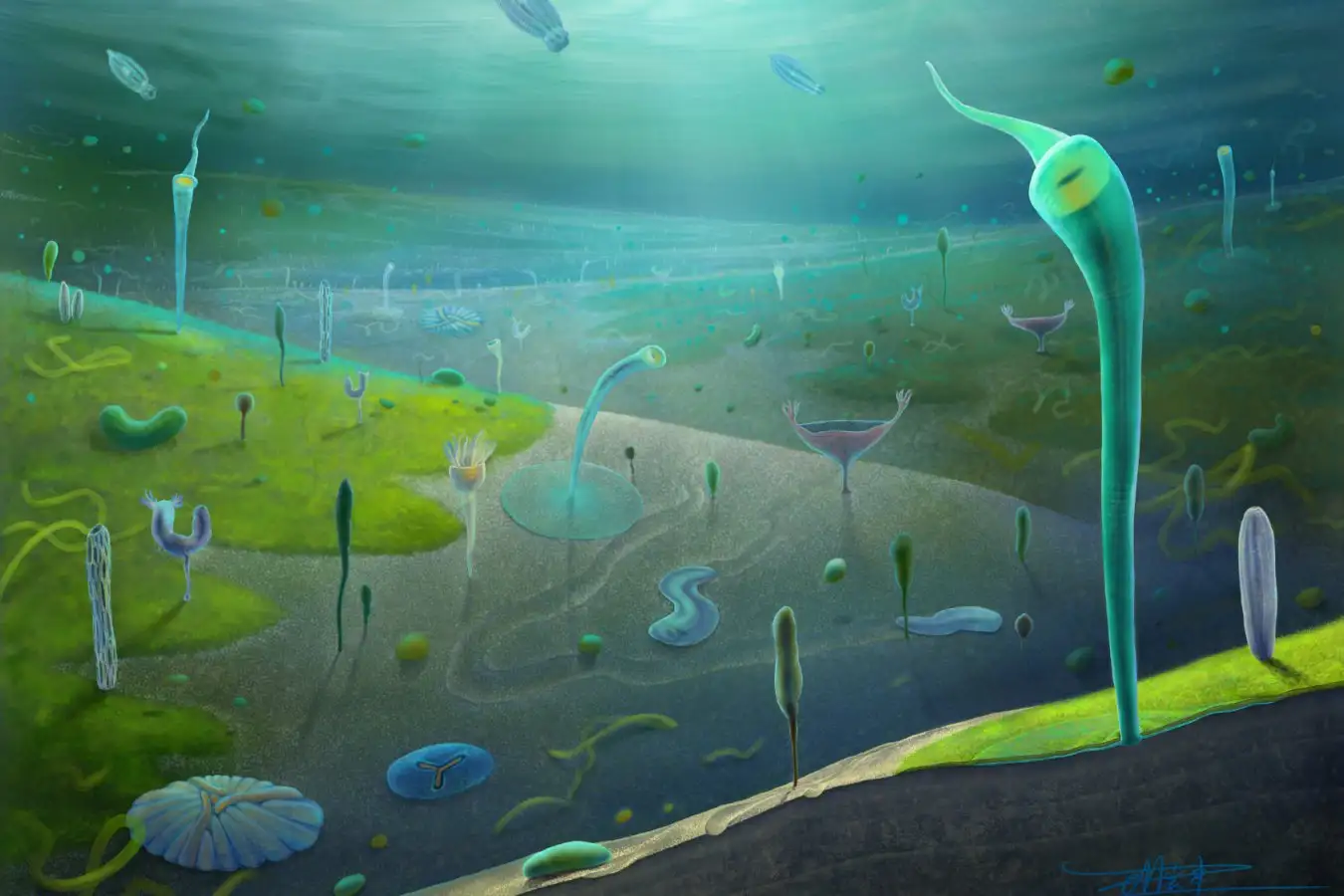
Artist’s reconstruction of the ancient ocean ecosystem preserved in the Jiangchuan biota
Xiaodong Wang
A huge and beautifully preserved suite of fossils discovered in China has cast doubt on the idea that complex life flourished dramatically during a rapid burst of evolution known as the Cambrian explosion.
This event, spanning roughly 541 million to 513 million years ago, is when most of the animal groups alive today are thought to have first appeared, along with a bizarre array of evolutionary experiments that later went extinct.
In the preceding period, known as the Ediacaran, it was thought that life was much less complex. But that is contradicted by the new fossil site in Yunnan province, known as the Jiangchuan biota, which includes more than 700 fossils dating from 554 to 537 million years ago.
“The discovery shows that Cambrian-type animal communities did not appear suddenly, but already had clear foundations and transitional forms by the end of the Ediacaran,” says Gaorong Li at Yunnan University in Kunming, China, who led the team behind the discovery.
Ross Anderson at the University of Oxford, another member of the team, says the surprising complexity of the fossils has raised questions about whether the Cambrian explosion was more of a slow burn.
“We are certainly revealing a more complex picture about the beginnings of the explosion of animal diversity and when that happened,” says Anderson.
When Li initially began looking at the site in mid-2022, all he was expecting to find was algae.
Instead, the researchers found a range of creatures known as bilaterians – animals with bilateral symmetry – of which only a few examples from the Ediacaran have been found before. They include two new species of deuterostomes – a major group that includes vertebrates – indicating that this group was already diverse in the Ediacaran period.
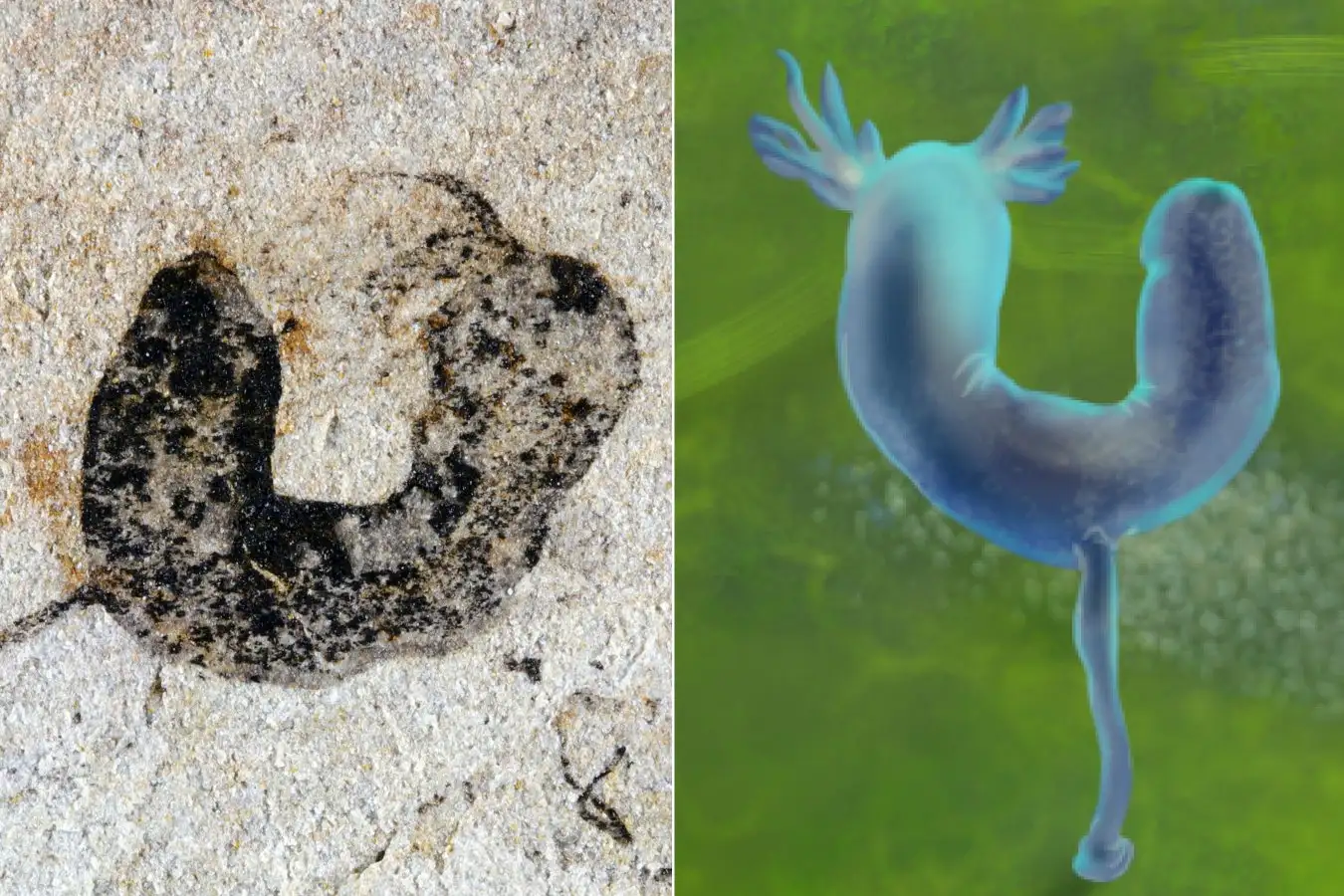
A cambroernid fossil from the Jiangchuan biota (left) and artist’s reconstruction of the animal
Gaorong Li & Xiaodong Wang
Some of the fossils have been identified as cambroernids, a group with coiled bodies and filamentous tentacles, that weren’t known to exist before the Cambrian. There are also fossils similar to the Cambrian organism Margaretia, that resemble a tube with holes in the wall, “making it look overall like an animal living inside a ventilation pipe”, says Li.
He says the most common fossil the team found is an animal that anchored itself to the sea bed at one end and had a tubular appendage that could be extended outward at the other end, reminding the team of the sandworm from the science-fiction series Dune.
“This suggests an animal that lived attached to the seafloor and stretched out this structure to feed,” says Li. “Another form is a sausage-shaped worm with a short, thick, curved body, clearly indicating the ability to move.”
These animals are both strange and oddly familiar, he says, and may represent “evolutionary experiments” from a phase when life was exploring different body plans and ecological adaptations.
“They already possess key features seen in modern animals, such as a mouth, a gut and a proboscis or pharynx, but the way these structures are combined is unlike that of most animals living today,” says Li. “In other words, although their overall appearance is strange, they still possess the basic body modules seen in modern animals.”
Joe Moysiuk at Manitoba Museum in Winnipeg, Canada, says the abrupt appearance of most modern animal body plans in the early Cambrian fossil record has been a “persistent conundrum” for palaeontologists for centuries.
“There’s good reason to think that their ancestral forms should be found in the preceding period, the Ediacaran, and the hints of these ancestors have been accumulating over the past several decades,” says Moysiuk.
“The preservation of the specimens is a bit coarse, so we’re missing some fine details, but there are some distinctly animal-looking forms among them.”
Although these fossils suggest certain animal groups were present prior to the Cambrian period, they do not invalidate the idea of the Cambrian explosion, he says.
“Rather, they give us better time constraint on the probable beginning of this evolutionary radiation, with the divergence of animal body plans likely taking place over a mere 30 million years spanning the Ediacaran-Cambrian boundary.”
Han Zeng at the Chinese Academy of Sciences, who was not part of the research, says the discovery of complex animal fossils in deposits older than the Cambrian would constitute a “significant breakthrough in palaeontology”.
“Over the past several decades, diverse carbonaceous fossils have been recovered from late Precambrian shales of similar age in South China,” says Zeng. “While most fossils have been identified as algae or cyanobacteria, some remain ambiguous with possible animal affinities. Future studies will be essential to elucidate the biological affinities of these fossils. If verified as animals, these fossils could reshape our understanding of early animal evolution.”

Dinosaur hunting in the Gobi desert, Mongolia
Embark on an exhilarating and one-of-a-kind expedition to uncover dinosaur remains in the vast wilderness of the Gobi desert, one of the world’s most famous palaeontological hotspots.
Topics:
Source link : https://www.newscientist.com/article/2521980-surprise-fossil-discoveries-push-back-the-evolution-of-complex-animals/?utm_campaign=RSS%7CNSNS&utm_source=NSNS&utm_medium=RSS&utm_content=home
Author :
Publish date : 2026-04-02 19:00:00
Copyright for syndicated content belongs to the linked Source.