
[ad_1]
Recent approvals of trastuzumab deruxtecan (T-DXd; Enhertu) in early HER2-positive breast cancer have created new questions about its optimal use in the neoadjuvant and adjuvant settings.
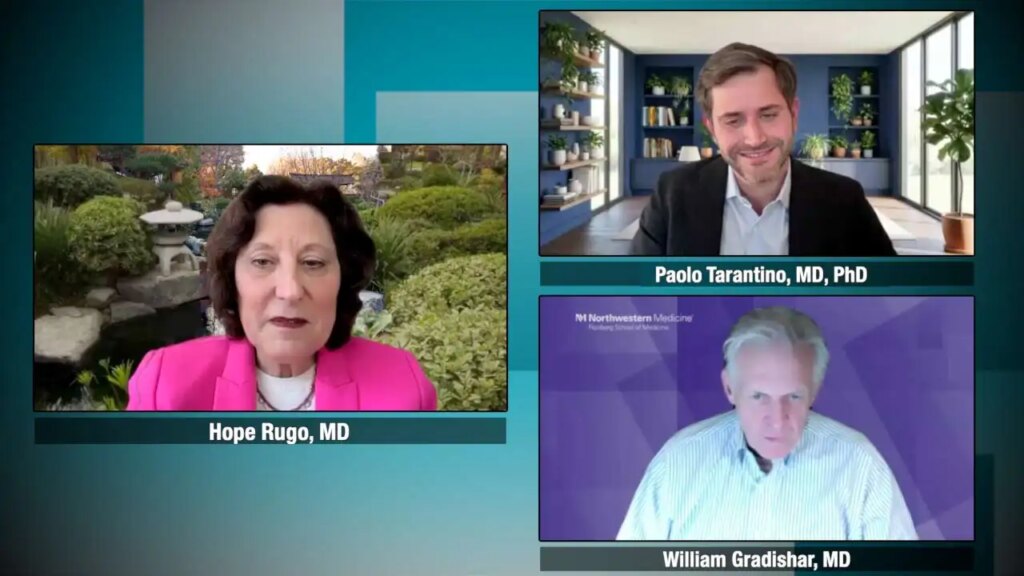
MedPage Today brought together three expert leaders in the field: Moderator Hope S. Rugo, MD, of the City of Hope Comprehensive Cancer Center in Duarte, California, is joined by William J. Gradishar, MD, of Northwestern University Feinberg School of Medicine in Chicago, and Paolo Tarantino, MD, PhD, of Dana-Farber Cancer Institute in Boston, for a virtual roundtable discussion. In this third of four exclusive episodes, the panel discusses how results from DESTINY-Breast11 and DESTINY-Breast05 may influence treatment selection for patients with early-stage HER2-positive disease.
Click here to watch the other videos from this series.
Following is a transcript of their remarks:
Rugo: Let’s go on and talk about another area I think that’s been very exciting is multiple approvals for T-DXd, three approvals just over the last few months. The approval in the first-line metastatic setting of T-DXd and pertuzumab [Perjeta] and then the approval in the neoadjuvant and post-neoadjuvant setting in DESTINY-Breast11 and DESTINY-Breast05. So let’s just talk about the early stage first. They approved widely, fairly widely, the drug in both settings. How would you choose to use the drug and what do you think about that, Bill?
Gradishar: So I think it would be patient-dependent to a degree. As you noted, we were having a rather lively discussion about this topic just a few hours ago with the NCCN [National Comprehensive Cancer Network] panel. I think that obviously right now they show activity in both settings, post-neoadjuvant with residual disease, pCR [pathologic complete response] rates giving it preoperatively is as high as anything we’ve seen and particularly in ER [estrogen receptor]-positive patients. We don’t have the event-free survival [EFS] from that trial yet.
So most of the trials in HER2-positive disease with high pCRs do translate into some long-term benefit. We just don’t have that yet from DB11. I’m getting the numbers screwed up here, but the pre-op trial. In any case, right now I think for the right patient, I would certainly consider giving it preoperatively. And one of the key questions that comes up is, if you don’t have a pCR after getting four cycles of T-DXd as part of that sequential pre-op, what are you going to do post-op? And if they had a pretty good response, I might be inclined to give them a little bit more T-DXd post-op.
Rugo: Yeah. I think it’s such a funny controversial area and some people are just so worried about pCR as an endpoint improving outcome, which being an I-SPY person, I’m pretty hot on pCR being a good outcome. But Paolo, what’s your take on this? I know we had you defend a position at Miami Breast in a really fun debate with Giuseppe Curigliano, but now seeing the additional data, the approvals, where are you standing on this?
Tarantino: Yeah. And you chaired wonderfully this debate where I was supposed to defend DB11. And of course I lost and I lost for one main reason because DB05 is the canonical, the traditional phase III trial powered on EFS, which had outstanding improvement in EFS.
And so I think the most practice-changing trial is DB05. Now the challenge is that DB05 comes later and the decision about DB11 instead comes early, you have to decide what to give in the neoadjuvant setting. And I think none of the regimens we have is perfect. I think we have anthracycline-based regimens that we kind of relegated to very rare situations. TCHP [docetaxel, carboplatin, trastuzumab (Herceptin), and pertuzumab] with some data, emerging data suggesting no benefit from carbo and nobody wants to give carbo for no benefit. And then we have CompassHER2-pCR showing relatively nice pCR rate with TSTHP [paclitaxel, trastuzumab, and pertuzumab, also known as THP], but in a relatively low-risk population and we don’t have recurrence-free survival.
So no regimen is perfect. And here we have DB11, which has an incredibly high pCR rate, no EFS data yet. The trial was not powered for EFS. And so do we need to wait? I don’t think so. I think for patients with high-risk disease … DB11 looks like the most appealing regimen, extremely active, very well tolerated, much better tolerated than anthracyclines.
Where I really struggle is the moderate risk … these patients may get away with THP alone. And so me and other people have been discussing the idea of doing THP first and it sounds appealing for everyone apart from the fact that we don’t have a trial that just did this. And so I think it’s on us to validate this strategy, but I think it’s already something we could think about, starting with THP, switching to T-DXd for four cycles if the patient seems to need it for stage II disease.
For stage III, for high risk, DB11 sounds like the best regimen and what to do after, everybody has a different opinion. My opinion is that switching … is important. And so I like the idea of giving T-DM1 [ado-trastuzumab emtansine; Kadcyla], and in some patients more chemo. So if they didn’t receive anthracyclines and they had a lot of burden of disease on the residual disease, you may want to give more chemo, and for some selected patients, maybe neratinib [Nerlynx]. We still have it there as a tool for very, very high-risk ER-positive patients.
Rugo: Yeah. I think I tend to be thinking the same way that high-risk, but in a specific category, so patients who have HR [hormone receptor]-positive, HER2-negative disease … sometimes we end up with a fair bit of patients where the HER2 is not entirely clear. It’s positive by copy number only. It’s ER-positive, strongly ER-positive, HER2-positive with a moderate Ki-67. These are patients you know the disease is not going to go away.
I mean, you just know they’re not going to have a pCR, but T-DXd offers an advantage there because we know it works in HER2-low disease. At least in the metastatic setting, we’ve seen very nice results. So I think in that setting, it might be reasonable to even start with T-DXd. I agree with you that using the THP approach and then using T-DXd out back with the four cycles after would be good because then you could say if you have very little disease at the end, you might go with a DB05 approach.
And if you have a lot of disease, maybe you figure T-DXd didn’t work, you want to give T-DM1 or something else, even neratinib at the end of the year. So a lot of options. And of course we’re going to see the T-DM1 and tucatinib [Tukysa] trial from COMPASS[HER2] RD sometime in the probably not too distant future, since it was closed to accrual a little while ago.
So I think that it’s a hard question to know, you’re looking at 14 doses versus four. So if you were able to get an 80% pCR rate from very high-risk disease, you’d be sparing a lot of people, a lot of treatment. And T-DXd is not benign. So I’m kind of thinking that for high-risk disease and the right patient, that that’s a good approach. But a lot of patients with ER-negative, HER2-positive disease will have a pCR with just the THP.
Please enable JavaScript to view the comments powered by Disqus.
[ad_2]
Source link : https://www.medpagetoday.com/meetingcoverage/ascoexpertroundtablebreastca/121881
Author :
Publish date : 2026-06-23 16:06:00
Copyright for syndicated content belongs to the linked Source.