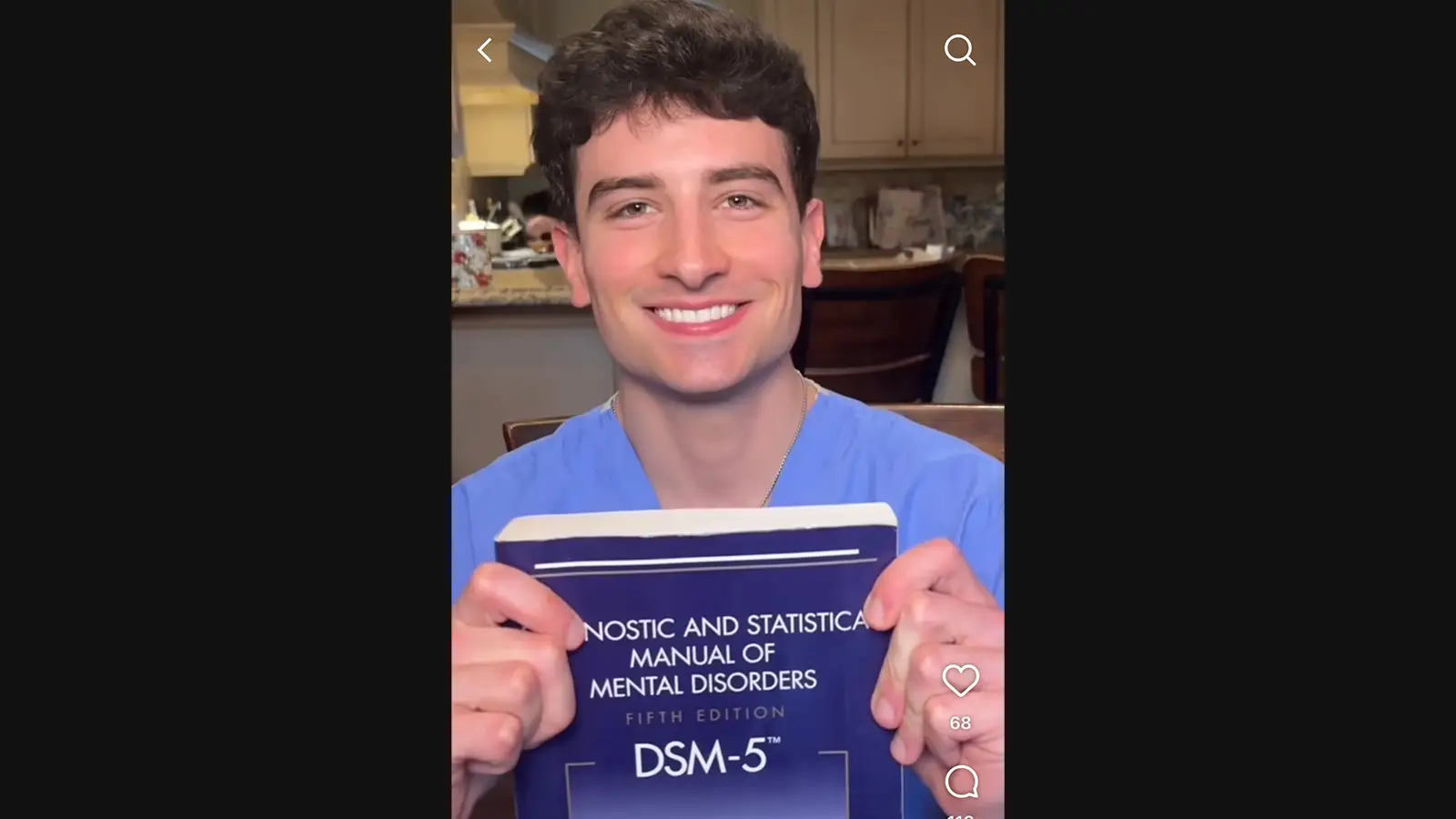
“You’re the kinda girl they write books about…” and that book is the DSM-5.
“Daaaamn girl, how many [genitalia] you got?!”
Shockingly, this content didn’t come from a random podcaster in the manosphere. These were videos created by Nick Baumel, a medical student at one of the country’s top medical schools, whose immaturity and misogyny may have earned him 2.8 million likes and labeled him with a big red flag for women nationwide.
Firstly, using sexist tropes as a punchline shows me he’s an untalented comedian. Secondly, what effect do you think it had on female patients? I imagine that an insecure girl somewhere watched and wondered, “Is that what my doctor says about me after I leave?”
In swift response, physicians like Arghavan Salles, MD, PhD, Vicki Chan, MD, and Sameena Rahman, MD, raised questions about medical professionalism and social media ethics with rightful condemnation of Baumel’s disgraceful antics. People who degrade women for content harm patient trust and don’t belong in medicine.
The Fragility of Patient Trust
“Most people do stupid things when they’re young, Dr. Lee!” I anticipate someone responding. “Yes,” I’d answer. “And most people aren’t entrusted with patients’ bodies and sensitive information. Most people shouldn’t go into medicine.”
In medicine, we demand an above average standard of excellence through demonstrated academic success, dedication, and maturity. Baumel should be no exception as an adult studying at the country’s best hospital; this was a conscious choice that should have professional repercussions. Let’s not infantilize him and others like him.
Some have argued for “rehabilitation,” a response that is, at best, kindly misguided. Students with deficiencies in clinical knowledge or skills may benefit from remediation; physicians facing addiction or other debilitating conditions may benefit from rehabilitation. But any clinician volitionally engaging in antisocial behaviors (posting overtly misogynistic content is not pro-social behavior), unable to tolerate constructive criticism, or showing unethical patterns cannot truly be rehabilitated. Like “sensitivity training” for sexual harassment, it’s nonsense. We all know not to harass anyone sexually. People who do so lack ethics, not knowledge. The same principle applies to Baumel. Even by early adulthood, we all know what’s cruel and what’s not. How do you rehabilitate cruelty?
Others argue that some physicians have transgressed more egregiously, yet evaded consequences for years — so why sanction Baumel?
Indeed, medicine is rife with sexual predators, like former physicians Robert Hadden, MD, and Darius Paduch, MD, among others. Just last week, Derrick Todd, MD, a rheumatologist formerly affiliated with Brigham & Women’s Hospital, was indicted for rape of 11 patients, on top of a class action suit for alleged sexual assault of over 200 patients.
Medicine has historically been complicit in destroying patient trust, often shielding predatory physicians. Columbia turned a blind eye to Hadden’s abuses: former chair of the Ob/Gyn Department at NewYork-Presbyterian/Columbia, Mary D’Alton, MD, vouched for Hadden’s character and Lee Goldman, MD, MPH, an executive at the medical center, allowed Hadden to see patients even after police detained him. Hadden would go on to abuse more patients. In my opinion, D’Alton and Goldman are just as responsible as Hadden for abuse of patients, and should be remembered for it.
We’ve also, inexplicably, been more aggressive about silencing voices for reform than we have been about preventing predators from practicing. Former executive director of Mississippi’s Board of Medical Licensure, John Hall, MD, was abruptly terminated with no reason given in 2018 after attempting to overhaul weak state laws around sexual contact between doctors and patients. For context, Mississippi had scored last in the nation for protecting patients against sexual assault by doctors.
These cases highlight one reason women are often distrustful of male providers and may avoid them outright. Women know that “not all men” are predatory or unsafe. What they don’t know is which ones may be safe. They’re not misandrists; they’re afraid. The damage inflicted by these bad actors and subsequent institutional betrayal of the victims shows us that we have to be harder on predatory, misogynistic, ethically compromised individuals in medicine in order to prevent patient harm.
It also shows us the fragility of patient trust; repairing that trust must be our first priority. Baumel’s inappropriate conduct further weakens that trust, and though it does not approach the enormity of Hadden, Paduch, or Todd’s actions, the damage it creates must not be dismissed.
To date, Baumel’s medical school has not released a public statement about the videos. There have been social media murmurs suggesting that Baumel was expelled, but nothing I’ve seen confirms that. Either way, the institution should not sweep this under the rug.
‘Just a Joke’
Female patients are responsible neither for trusting male doctors, nor for the bruised egos of male medical students who feel “left out” of their ob/gyn rotations. No providers are owed access to patients’ bodies. Rather, it is our responsibility as doctors to demonstrate our trustworthiness and commitment to patient well-being.
Moreover, women should not be expected to accept Baumel’s conduct quietly. Gynecologic surgeon Karen Tang, MD, noted that female physicians who condemned Baumel online faced disrespect and dismissal of their concerns: “Women physicians … got comments after comments saying, ‘Oh, this is just a joke, why can’t you take a joke?’ including from women.”
But consider the impact of this “joke” on our female patients today, with the rise of the online manosphere, political posturing over women’s rights from both parties who have historically avoided accountability for sexual misconduct and misogyny, and the Epstein files’ revelations of the pernicious extent of sexual abuse of women and girls. Consider the betrayal that women felt hearing the Olympic U.S. men’s hockey team laugh with Kash Patel and the President over casual misogyny — and the anger women felt when told (yet again): It’s just a joke, it’s locker room talk. All women heard was how men might disrespect or objectify them behind closed doors. Baumel reinforced that perspective; doubling down on misogynistic cruelty, especially at this time, is a choice that speaks volumes about his character and suggests that he would not be a good physician to vulnerable patients.
There is absolutely space on social media for ethical, legitimately funny physicians who have something valuable to contribute to medical education or want to make authentic patient outreach efforts. In fact, I encourage such physicians to lend their voices to these spaces, otherwise we run the risk of allowing juvenile content creators to misrepresent us. And we want better representatives than someone who demeans women’s mental health and genitalia for likes.
Chloe Nazra Lee, MD, MPH, is a resident physician in the Department of Psychiatry at the University of Rochester Medical Center in New York. The views above reflect only the author’s and are not shared or endorsed by any institution with which she is affiliated.
Source link : https://www.medpagetoday.com/opinion/second-opinions/120488
Author :
Publish date : 2026-03-25 19:15:00
Copyright for syndicated content belongs to the linked Source.