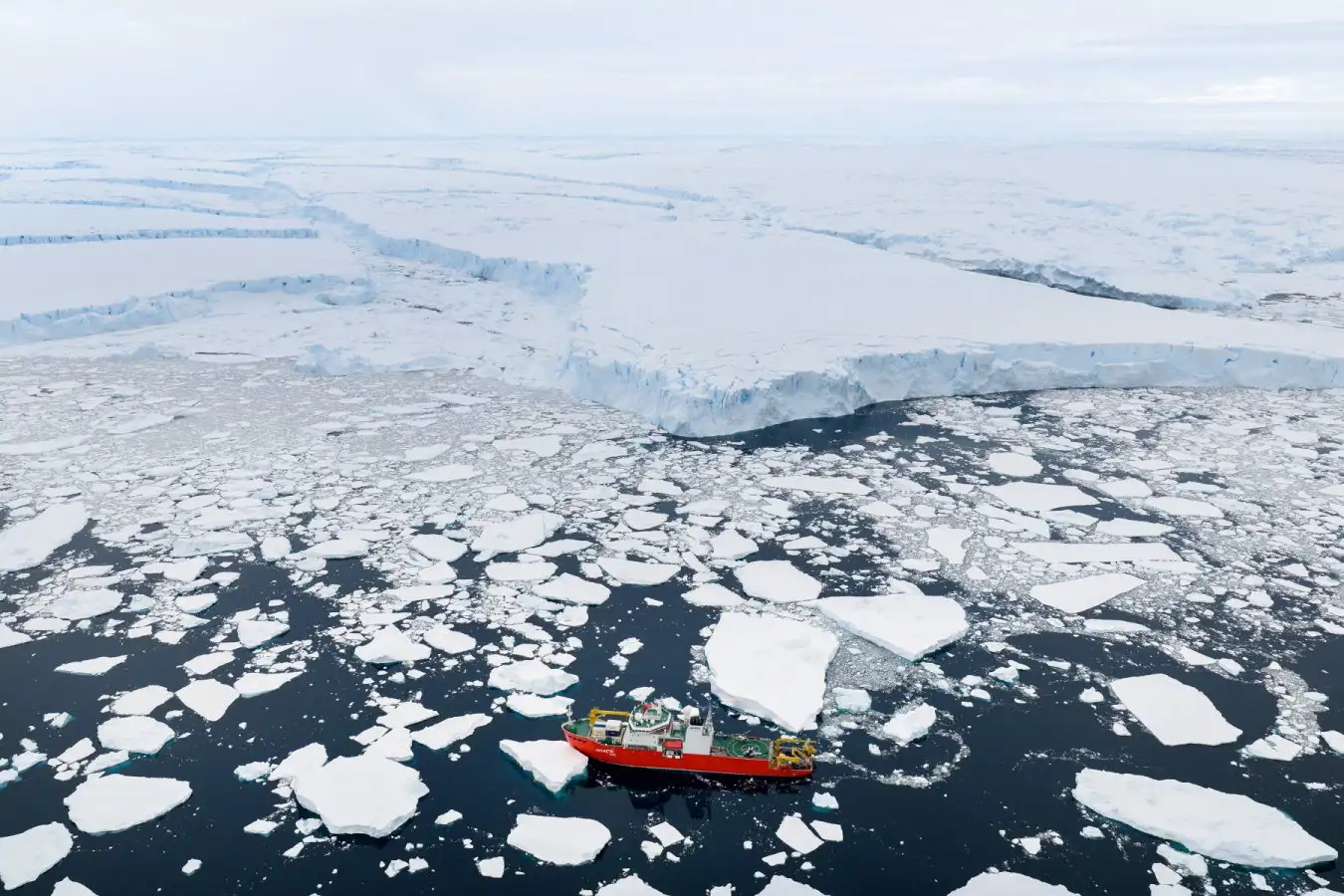
The Araon, a South Korean ice-breaker vessel, navigates a bed of sea ice near the Thwaites glacier in January 2026
Chang W. Lee/New York Times/ Redux/eyevine
Antarctica’s most threatened glacier is about be further destabilised, as the floating ice shelf in front of Thwaites glacier is set to break away.
“Its final demise could happen suddenly, and to avoid being caught on the hop, we have already prepared an ‘obituary’ press release,” says Rob Larter at the British Antarctic Survey.
Dubbed the “doomsday glacier”, Thwaites is about the size of Britain, but it is shrinking rapidly and is already responsible for 4 per cent of all global sea-level rise. Worse still, its collapse is expected to set off a domino effect in the entire West Antarctic ice sheet, ultimately resulting in a calamitous sea-level rise of 3.3 metres and changing the coastline of the entire planet.
Many Antarctic glaciers form ice shelves that float out onto the ocean and buttress against the flow of ice from the continent. Thwaites glacier has one on its eastern front, known as Thwaites Eastern Ice Shelf (TEIS), that is about the size of Greater London – 1500 square kilometres – and 350 metres thick. But satellite images show alarming signs that this will imminently detach. In fact, by some measures, this break-up is already under way.
“Suddenly, large areas are just falling to pieces,” says Christian Wild at the University of Innsbruck in Austria. “It looks like a windscreen that’s shattering.”
Huge fractures are opening up around the pinning point – where the ice shelf’s floating front is held in place by a raised ridge on the ocean floor – and along the grounding line, the point where the glacier meets the ocean and starts to float.
“It’s dramatic. I was there in 2019/2020 and when I look at the satellite images now, I don’t recognise the shelf. There are huge gashes where there used to be none,” says Karen Alley at the University of Manitoba in Canada, who has been analysing how this break-up is playing out.
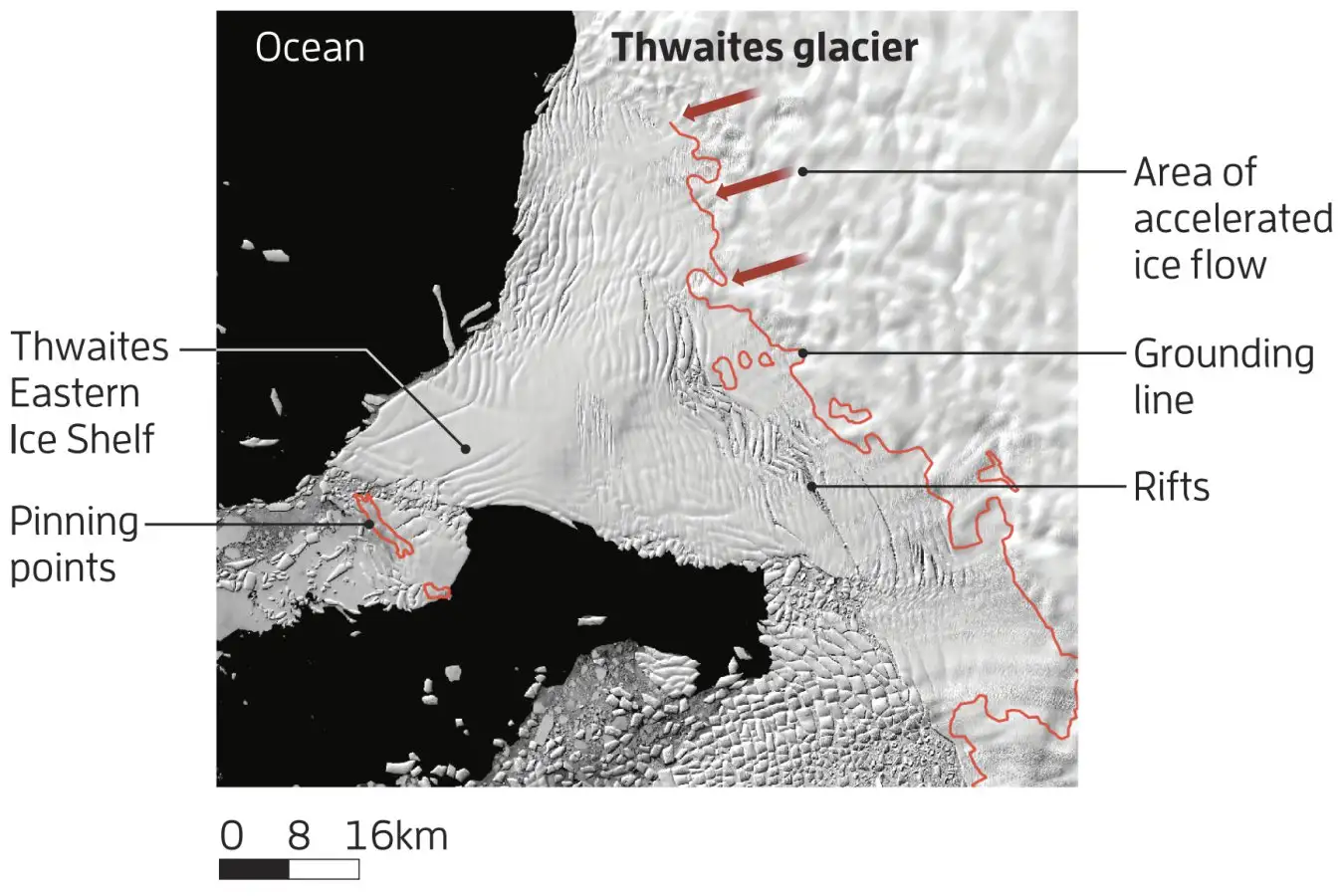
For a start, the ice has been thinned by melting due to changes in ocean circulation. Shifts in the ice-flow dynamics also mean that the shelf is now being slammed into the pinning point, tearing the ice apart. “It’s gone from a thick, strong ice shelf that is very well grounded on this pinning point to a thin, weak ice shelf that is now splitting apart around the point that used to stabilise it,” says Alley.
The ice shelf’s demise is also signalled by a dramatic speed-up in its flow rate. “It’s tripled from January 2020 to January 2026, to just over 2000 metres per year, which is nuts,” says Wild. And in the past five months, the flow has accelerated further. “It’s essentially in free fall now.”
At the same time, new rifts are opening up along the grounding line. “They started appearing in the last few years as the shelf began to accelerate significantly,” says Ted Scambos at the University of Colorado at Boulder. All this means that the ice shelf is tearing away from the glacier.
Exactly when the final break-up will occur is hard to determine. “Predicting ice shelf break-off or collapse has similarities to trying to predict earthquakes,” says Larter. “You can tell that an event is on its way, but its timing depends on… processes that are impossible to predict accurately. I wouldn’t be surprised if the next satellite image I see shows the ice shelf breaking up, but neither would I dismiss the possibility that I might still be saying the same thing this time next year.”
If you imagine that this will result in a giant iceberg suddenly floating off into the ocean, however, you might be disappointed. The geography of the area means that the detached ice is likely to remain stuck nearby, and the TEIS is unlikely to break off in one huge piece, as it is already quite fractured.
Although the break-off of huge icebergs often make front-page news, what really matters for glaciologists is the loss of the ice shelf’s buttressing power. The shelf is “gone” when it stops holding back the upstream flow, says Wild. As a result, the glacier speeds up and flows more quickly into the ocean.
In a study soon to be published, Wild and his colleagues show that between January 2020 and 2026, the flow of the glacier ice previously buttressed by the TEIS increased by around 33 per cent. “There is clear evidence that there’s very little buttressing in this area any more,” he says. So, by this measure, the ice shelf has already broken free.
This is concerning for future sea levels around the world. “That means more ice unloaded from Antarctica, more ice dumped into the ocean and more sea-level rise,” says Scambos, though he stresses that this isn’t an immediate crisis – rather, a slowly unfolding one that will hit home in decades. “It’s going to influence the way Thwaites evolves and how fast it gets to that point where it’s contributing 10 or 20 per cent to sea-level rise in the future.”
By 2067, it is estimated that Thwaites will be losing about 190 gigatonnes of ice per year, according to a study published in January by Daniel Goldberg at the University of Edinburgh and his colleagues. This is a 30 per cent increase from today’s loss from the glacier, and equivalent to the total amount of ice currently being lost from Antarctica.
It is important to stress that, while ice shelves calving off icebergs is part of the normal cycle in polar regions, there is now a trend towards increasing loss. “Since the 1990s, we’ve been watching ice shelves destabilise,” says Alley. For instance, Pine Island glacier – adjacent to Thwaites – is experiencing rapid change too, with its ice shelf also disintegrating.
“Ice shelves are only really stable when it’s quite cold,” says Alley. “The ocean has to be cold and the atmosphere has to be cold. But we’re warming the world and we’re losing the ice shelves, and that’s exactly what you’d expect.”
Topics:
Source link : https://www.newscientist.com/article/2526826-the-doomsday-glaciers-giant-ice-shelf-is-about-to-break-away/?utm_campaign=RSS%7CNSNS&utm_source=NSNS&utm_medium=RSS&utm_content=home
Author :
Publish date : 2026-05-18 10:00:00
Copyright for syndicated content belongs to the linked Source.