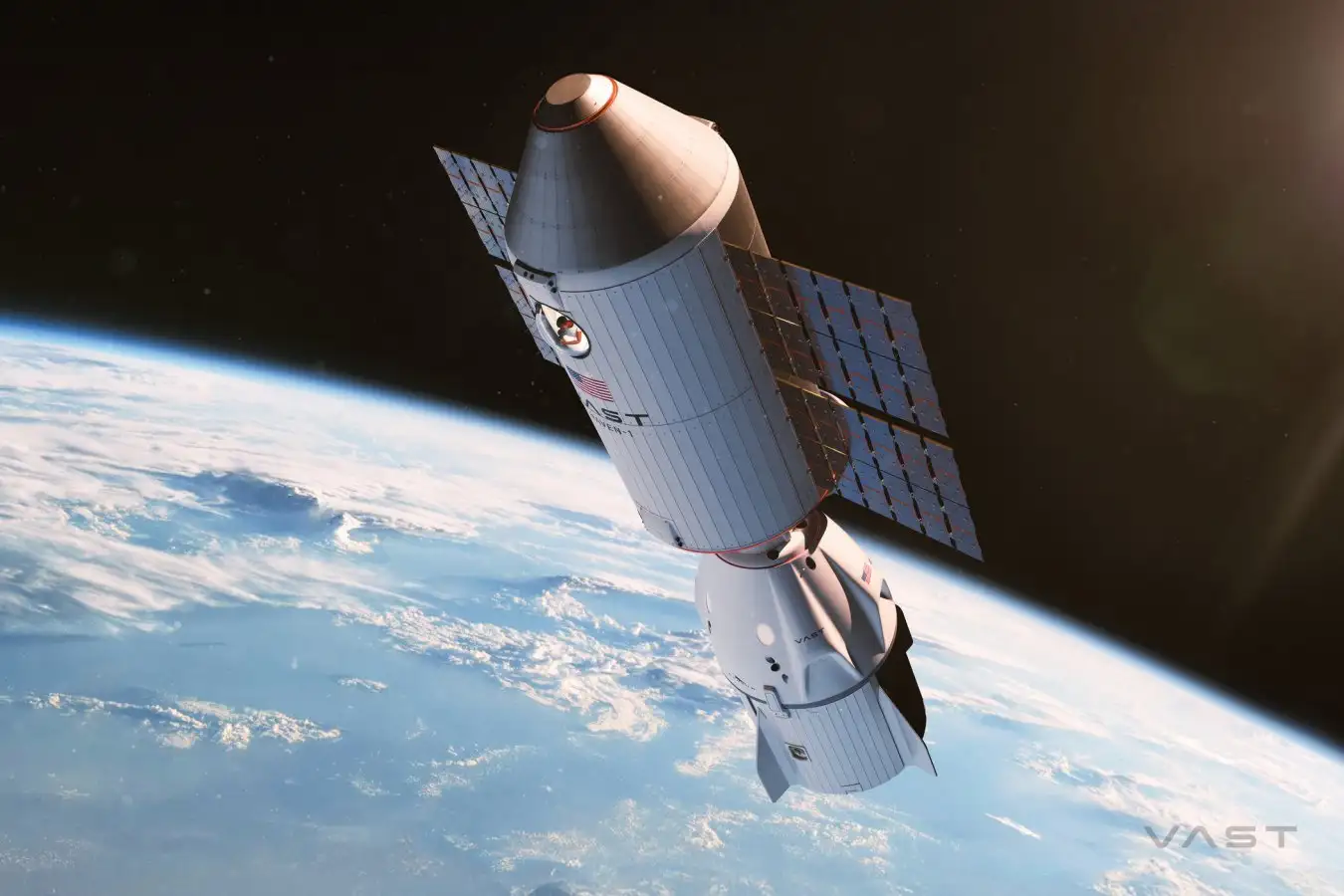
A digital rendering of Vast’s Haven-1 space station
Vast
The space station industry is starting to take off. For decades, if you wanted to send an astronaut or experiment into orbit, the International Space Station (ISS) was the only option. But now, as NASA and its partners prepare to deorbit the ISS at the end of the decade, commercially owned stations are preparing to take over.
“These have been in development for a number of years now, mostly in partnership with NASA, and 2026 is really going to be the start of hardware flying,” says Mary Guenther, head of space policy at the Progressive Policy Institute in Washington DC. There have been privately developed modules attached to the ISS before, notably from the now-dissolved firm Bigelow Aerospace, but no stand-alone commercial space stations.
In the absence of the ISS, though, such stations will be called upon to fill the gap. “It’s time for NASA to go further and do things that we’ve never done before, while leaving the rest – in this case, space stations in low Earth orbit – to commercial capabilities,” says Guenther.
In 2026, two such enterprises plan to step up to the plate in the US. The first is start-up Vast, which intends to launch its Haven-1 station atop one of SpaceX’s Falcon 9 rockets as soon as May. Haven-1 is much smaller and simpler than the ISS, and it will rely on SpaceX’s Crew Dragon capsule to supplement its life-support systems, but if all goes well, it will be the first ever private space station.
With the help of the Crew Dragon capsule, it is designed to support four crew members at a time for both space tourism – it is equipped with a photography dome and wi-fi – and relatively small microgravity experiments. It is intended as a test bed for the larger and more more ambitious Haven-2, which Vast executives have said they envision as a replacement for the ISS.
“I think everybody, Vast included, is driving towards 2030,” says Colin Smith at Vast. “The ISS is coming down at the end of 2030, so people are looking at their calendars going: ‘Uh-oh, it’s 2025, we should do something.’”
The other space station mission planned for 2026 comes from Sierra Space, which is also currently developing a space plane called Dream Chaser. Sierra Space has announced plans to launch a prototype version of its expandable space station module, the Large Integrated Flexible Environment, in 2026. Eventually, this module is planned to be part of the Orbital Reef space station project being spearheaded by Blue Origin and Sierra Space.
There is no doubt that the era of the commercial space station will be different from that of the ISS, if only because of the much higher number of potential players in the industry. “There’s the likelihood of having a bunch of different models of commercial space station, potentially serving different markets,” says Guenther. “I’ll be really excited to see how they differentiate from one another to attract business and how that competition between them will drive innovation. Hopefully iron will sharpen iron.”
Many hope that private space stations will lower the cost of operating in orbit the same way that private launch providers have made it more affordable to get to space.
“The ISS is the most expensive thing that humanity has ever built. It has just been a bonkers amount of money, and we are not going to attain a future with space commerce, space manufacturing, with people living and working in space, if it costs $150 billion to house seven people,” says Smith. “Our long-term goal is getting millions of people living and working in space, and everything else is working out the stepping stones we need to get to that point.”
It remains to be seen, of course, if there is enough demand in the market to support such a thriving economy in space: the prospect of swarms of unique, specialised space stations in orbit is exciting, but those will require customers beyond just NASA and other national space agencies. As the first of the new space stations begin to launch and open for business this year, it should become clear whether they will have staying power.
“There are these seedlings of industries that will be ready to transition to those space stations, including pharmaceuticals and materials,” says Guenther. “It will be interesting to see which of these seedlings will blossom and grow.”
Topics:
Source link : https://www.newscientist.com/article/2509494-the-first-commercial-space-stations-will-start-orbiting-earth-in-2026/?utm_campaign=RSS%7CNSNS&utm_source=NSNS&utm_medium=RSS&utm_content=home
Author :
Publish date : 2026-01-06 14:00:00
Copyright for syndicated content belongs to the linked Source.