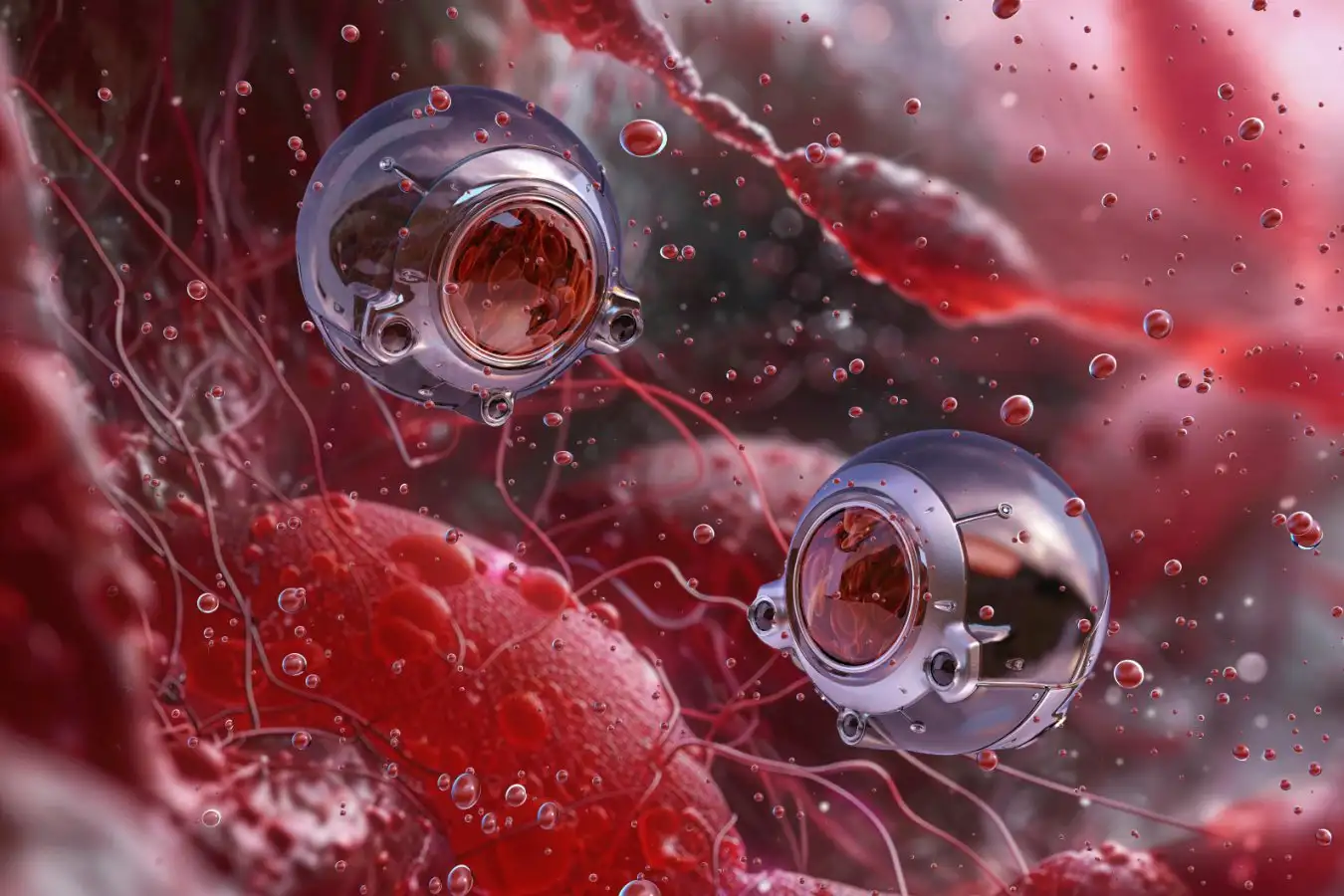
Illustration of nanobots in the human bloodstream
RUSLANAS BARANAUSKAS/SPL/Getty Images
The robot army that saves the world won’t be anything like what you imagine. Nope, they aren’t little humanoids who can do synchronised martial arts like the ones who dazzled audiences during New Year’s festivities in China. And they won’t help you find a can of Coke with embarrassing slowness like the man-shaped beast known as Optimus from Elon Musk’s Tesla Inc. Instead, they will be microscopic, and mostly made of algae, bacteria and other single-celled organisms. Engineers call them biohybrid microrobots.
If you’ve read about people swallowing pills full of tiny robots to deliver medicine – or you watched the classic 80s flick Innerspace – you’ve already experienced the dream of a future. For many years, medical researchers have imagined using little machines to get medicine into the hard-to-reach parts of our bodies such as the minuscule capillaries in our lungs. Even better, these machines could actually drive around in our organs, perhaps to seek and destroy cancer cells one by one. The problem is that we can’t actually build motorised devices small enough to do it.
That’s where biomedical engineer Joseph Wang’s work comes in. Like many in the growing field of microrobotics, Wang has dramatically expanded the definition of what most of us think of as “robots”. Any mechanism that can be controlled and move around semi-autonomously is a robot, much like the squishy, pneumatically powered turtle bot I described in a previous column. And some robots contain living tissues – or entire living creatures.
There are many things technology simply can’t do as well as biology – and one of them is motor around inside minuscule environments. Tiny synthetic engines tend to dissolve after a few minutes, Wang says, but “algae just swims and swims”. That’s why he and his colleagues power their robots with the green microalgae Chlamydomonas reinhardtii.
At the University of California, San Diego, Wang’s lab worked closely with chemical engineer Liangfang Zhang’s research group to create what are basically swarms of algae cyborgs that deliver medicine. They began with C. reinhardtii, which can swim with its powerful flagellum, or tail. It also happens to love blue light, so it is relatively simple to guide this single-celled critter by shining a blue light on its target region. Wang and Zhang can even get massive swarms of the algae into formation: by shining the blue light through a screen with a shape cut out of it, they herded thousands of algae cells into forming a circle, square and even more complex designs.
To disperse the swarm, the researchers used a red light. In a video demonstration, they show a swarm under the microscope moulding itself into the shape of the African continent and then scattering again. Essentially, Wang and Zhang created a microrobot army, “programmed” to move in particular ways by blue and red lights.
To turn this swarm into a microscopic medical team, they expose the algae to nanoparticles that stick to their outer membranes via electrostatic force. The result is half-algae, half-synthetic, all bot. Researchers can guide the fully loaded microbot swarm towards a wound using blue light. One day, doctors might use the masking technique to create custom-shaped algae bandages with many kinds of therapeutic payloads.

Sci-fi depictions of healing pods often include blue light, like what is used to direct real nanobots
Shutterstock/Pavel Chagochkin
Other parts of the body call for a different kind of algae motor. For stomach exploration, Wang says, he and his team had to use algae that had grown in mining sites where it had become used to acidic environments. That’s right – toxic mining sites produced algae that might one day swim to the rescue with drugs to treat your stomach cancer.
Light is just one way to program the bots. Scientists can also load nanoparticles onto magnetotactic bacteria – organisms that navigate via Earth’s magnetic field – then guide them around inside an animal’s body using electromagnets. Regardless of whether the payload rides on algae or bacteria, it’s referred to as “active” medicine. Traditional drugs are called “passive” because they can’t be programmed to target specific regions or cell types. The hope with much of this research is that more medicine can become active, leading to more effective therapies, fewer side effects and less invasive treatments.
Medicine isn’t the only possible application for biohybrid microrobot swarms, either. Wang’s lab is also using cyborg algae for decontamination in rivers and oceans. Instead of loading the bots up with medicine, researchers cover them in chemicals that can neutralise or absorb toxins. The algae wriggle around in the water, often for days, collecting toxins opportunistically until everything is cleaned up. Meanwhile, some research groups are testing fully synthetic microrobots for cleaning up plastics in the ocean.
The fantasy of a robot army doesn’t have to mean humanoid soldiers conquering enemies. Another future is always possible. Tiny algae-cyborg swarms could one day live inside your body – briefly – or travel in packs through the environment, decontaminating the messes that humanity made.
Topics:
Source link : https://www.newscientist.com/article/2527125-the-future-of-robot-armies-is-here-and-its-not-what-you-think/?utm_campaign=RSS%7CNSNS&utm_source=NSNS&utm_medium=RSS&utm_content=home
Author :
Publish date : 2026-05-19 09:00:00
Copyright for syndicated content belongs to the linked Source.