


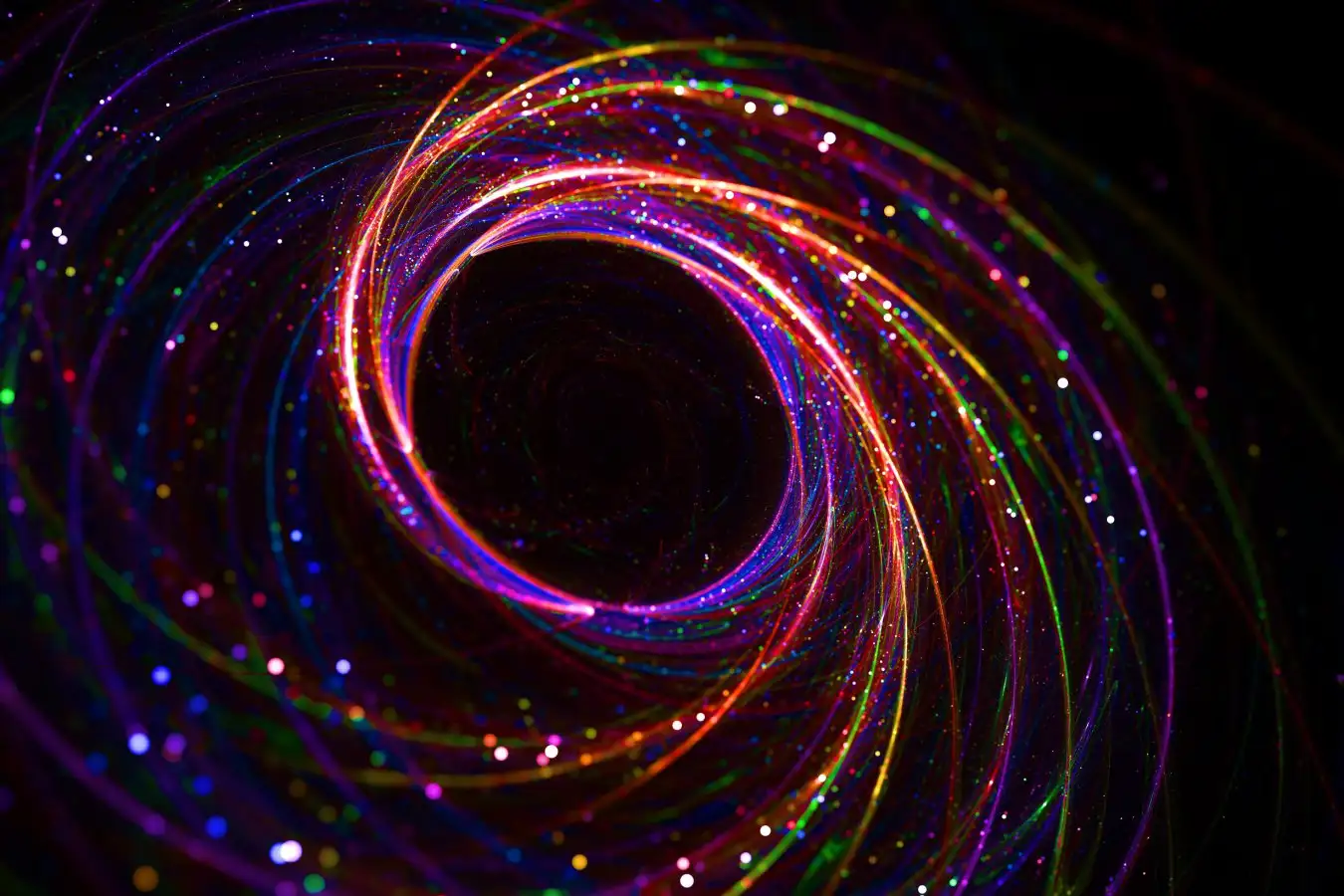
Beyond a black hole’s event horizon, there is an even stranger boundary
Zita/Shutterstock
You’re falling into a black hole. Somehow, you’ve managed to protect yourself from the spaghettification that’s happening to every object around you as the black hole’s powerful gravity pulls on the near end of each object more than the far end, stretching everything into noodles before shredding it to pieces. Maybe you’ve got some sort of high-tech compression suit holding you together; congratulations on your invention. As you pass the event horizon, the point of no return, all you see is blackness punctuated by streaks of light falling towards the singularity at the heart of the cosmic behemoth. Your impossible suit also protects you from those streaks, which would otherwise be ripping through your molecules at near-light speed.
And then you pass a second, lesser-known horizon, and time and space switch places. This second boundary is called the Cauchy horizon; if they exist within black holes, their insides are the strangest places in the universe.
All of classical physics comes from, relies upon and is inherently imbued with causality. This is the idea that one thing leads to another – the past leads to the future, with the present in between – and the reason everything that happens makes sense to us. If you have every piece of information about a system now, you can predict what will happen to it next. For instance, if I throw a stone and I know the exact mass and shape of the stone, and all the forces acting on it, I can calculate exactly where and when it will land. And on an even more basic level, I know that its presence in its new location is because I’ve thrown it there. Quantum mechanics, with its attendant randomness, tends to throw a bit of a wrench into this when you start getting into the tiniest objects, but on a human scale and larger, determinism generally holds up.
That is, until you get to the inside of certain sorts of black holes. No matter the type, black holes are already the strangest places in the universe, with masses so large that the very structure of space-time starts to break down. But if a black hole is rotating and has an electric charge (the first being very likely in the real world, and the second being very unlikely), it could get even stranger.
In regular life, you can move in any direction in space, but only one direction in time. But beyond a black hole’s event horizon, these switch. You can only move in one direction in space, towards the centre of the black hole, but the concept of time as we understand it becomes sort of irrelevant. An outside observer would still see you frozen at the edge of the black hole thanks to the time dilation demanded by the laws of general relativity, but time will seem to move normally to you. At least, it will until you pass through the Cauchy horizon – the area past that boundary is full of strange conceptual objects called closed time-like curves.
These are a bit like a Möbius strip, but in time instead of space, so when you travel forwards into the future (as we are all doing all of the time), you end up in the past, and then back in the present again, and so on. These bizarre time loops have been deemed theoretically possible within the laws of relativity, which is why they’re so prominent in discussions of time travel. But the thing about a closed time-like curve is that it completely breaks down the entire concept of causality: events in the past don’t necessarily cause consequences in the future – it can be the other way around.

Past the Cauchy horizon, time may flow in a curve like a Möbius strip
MirageC/Getty Images
Simply existing in a region full of closed time-like curves would be, for lack of a better word, a trip. The very fabric of space-time would be so warped and tangled that there would be no way to predict what happens next. You could throw a stone and it could hit you in the back of the head, or turn into a pumpkin, and even with all the available information about the stone in the moment you throw it, you’d never be able to predict or explain its next move. Everything would go completely haywire. I don’t know about you, but in such a situation, I don’t think I’d trust the magical supersuits that got us into the black hole in the first place to continue keeping me safe. That’s a real inconvenience because there’s no escape, not for me or you or the stone or the pumpkin it became.
How can any of this square with our understanding of physics? There’s an idea called cosmic censorship, which postulates that any astrophysical singularity (the point of infinite density thought to be at the centre of a black hole) must be shielded from the outside universe, so that the breakdown of physics at the singularity isn’t observable. This preserves the predictive power of physics. In the case of a bunch of closed time-like curves, the same idea applies, and it’s called chronological censorship. That means that nothing can escape after getting too close to a singularity where causality breaks down. The very inescapability of it all is what enables it to be possible without breaking all of physics everywhere.
It also means that testing the hypothesis that some black holes contain Cauchy horizons is extraordinarily difficult. Well, that’s a pretty severe understatement. We can test whether black holes rotate – in fact, the researchers of the Event Horizon Telescope (EHT) team have already found that they do. And we can test whether they have an electrical charge, which they aren’t expected to have because they would simply discharge it into the surrounding environment.
We can also calculate how stable a Cauchy horizon would be, were one to form, and generally researchers find that it wouldn’t be stable at all, collapsing upon even the smallest perturbation. This would create a sort of extended singularity, so when you hit the horizon you would be blasted with infinite energy density. Again, I don’t know that I’d put much trust in my suit in the face of that. Which makes me think that the only thing more dangerous than experiencing what’s beyond the Cauchy horizon is never passing it at all.
Topics:
Source link : https://www.newscientist.com/article/2526781-the-hidden-pockets-of-the-universe-where-the-future-can-cause-the-past/?utm_campaign=RSS%7CNSNS&utm_source=NSNS&utm_medium=RSS&utm_content=home
Author :
Publish date : 2026-05-18 09:00:00
Copyright for syndicated content belongs to the linked Source.