Feedback is New Scientist’s popular sideways look at the latest science and technology news. You can submit items you believe may amuse readers to Feedback by emailing [email protected]
It’s a gas
Feedback is feeling bold, so here is a prediction: the research we are about to describe is going to win an Ig Nobel award within the next decade. The entire project feels tailor-made for the Igs. It is an effort to objectively measure human flatulence using biosensors, or “Smart Underwear”.
We learned of this from a press release from the University of Maryland, flagged to us by physics reporter Karmela Padavic-Callaghan with the phrase: “Surely, Feedback can do something with this.”
The essential problem is that we do not know the normal range for flatulence, unlike other key biomarkers like blood glucose. Most studies have relied on self-report, which doesn’t really work because people often don’t remember all their farts and are poor judges of how big each was. Plus there is “the impossibility of logging gas while asleep”: anyone who has shared a bed with anyone else knows that everyone farts in their sleep.
Hence the Smart Underwear developed by Brantley Hall and colleagues. The press release calls it “a tiny wearable device that snaps discreetly onto any underwear and uses electrochemical sensors to track intestinal gas production around the clock”. Wondering what constituted “tiny” in this context, Feedback checked the scientific paper, and it turns out the sensor is 26 × 29 × 9 millimetres – which we concede is pretty small, but participants in the experiment might like to avoid skinny jeans.
Based on the first round of studies, “healthy adults produced flatus an average of 32 times per day”, which is about twice as often as previously thought. People vary a lot, though: daily totals ranged between four and 59 farts.
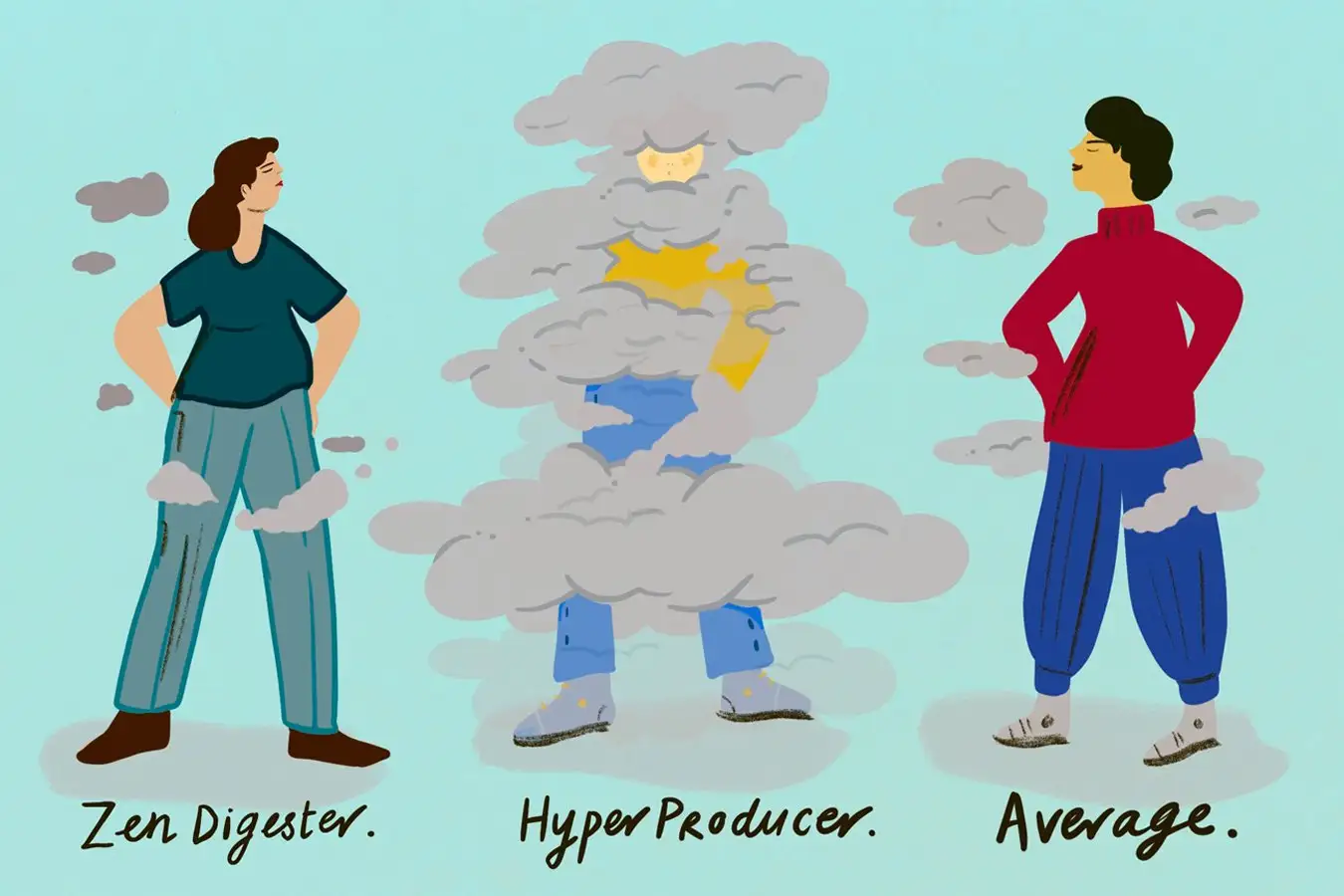
As the Smart Underwear is rolled out more widely, the data it gathers will be fed into a larger project, the Human Flatus Atlas. This has a website (flatus.info) where one can sign up to have one’s farts tracked. Participants are enticed with the prospect of discovering if they are a Hydrogen Hyperproducer, a Zen Digester who barely farts even on a diet of baked beans, or in between.
Feedback wonders how resilient the sensors are against substantial farts. We recently learned of a gentleman who visited a French hospital after inserting an unexploded shell from the first world war into his bottom, forcing staff to operate with assistance from a bomb disposal squad. We assume anything emanating from that quarter might have been too much for the Smart Underwear.
Meanwhile, the lead researchers have founded VentosCity to exploit the tech. Its website is minimal, just an animation of some gas, a slogan (“Measure. Master. Thrive.”) and a promise: “The future of gut health is coming soon”. Feedback suspects the imminent arrival of an app with a monthly subscription.
Ghost in the machine
As AI companies introduce their tech into every aspect of our lives, we need help to understand it. Since most of us don’t really get AI, and aren’t going to without a crash course in pretty advanced maths, we turn to metaphors and analogies.
Feedback has been made aware of some literary devices that may help readers to get their heads around the AI phenomenon.
First, someone who goes by hikikomorphism on Bluesky suggested the phrase “hungry ghost trapped in a jar” as a guide to whether you are using AI sensibly. She says that if you can substitute “hungry ghost trapped in a jar” for “AI” in your description of what you are doing, and it still kind of makes sense, you are probably using AI in a plausible way.
“Take ‘I have a bunch of hungry ghosts in jars, they mainly write SQL queries for me’. Sure. Reasonable use case,” writes hikikomorphism. “‘My girlfriend is a hungry ghost I trapped in a jar’? No. Deranged.”
Second, we now find ourselves confronted with endless AI-written content that we didn’t ask for: fake romance novels, AI summaries of search queries, AI summaries of meetings, just AI everything. We need a way to sum up our reaction to these texts.
Well, one of the most popular abbreviations of the internet era is “tl;dr”, which stands for “too long, didn’t read”. Hence the new phrase “ai;dr”, the meaning of which should be clear from context.
Finally, Feedback has been inundated by anecdotes of people using AI to do important tasks, only for it to foul up in spectacular ways. Perhaps you have seen the one where the venture capitalist asks an AI tool to organise the desktop on his wife’s computer, only for it to say “ooops” because it had deleted 15 years’ worth of photos (he later got them back).
Or the one where the AI hallucinates three months’ worth of analytics data.
With these stories in mind, we are going to give the last word to writer Nick Pettigrew. He wrote on Bluesky: “I’m convinced AI is our generation’s radium – a discovery with genuinely useful applications in specific, controlled circumstances that we stupidly put in everything from kid’s toys to toothpaste until we realised the harm far too late where future generations will ask if we were out of our minds.”
Feedback had more to say about this, but our AI deleted it – a phrase that is sure to become the new “the dog ate my homework”.
Cue bits
Somehow, Feedback has gone all these years without learning of the existence of quantum information theorist Toby Cubitt.
Got a story for Feedback?
You can send stories to Feedback by email at [email protected]. Please include your home address. This week’s and past Feedbacks can be seen on our website.
Source link : https://www.newscientist.com/article/mg26935844-200-the-human-flatus-atlas-plans-to-measure-the-explosivity-of-farts/?utm_campaign=RSS%7CNSNS&utm_source=NSNS&utm_medium=RSS&utm_content=home
Author :
Publish date : 2026-02-25 18:00:00
Copyright for syndicated content belongs to the linked Source.