
A secret society of mathematicians has been working under a pseudonym for nearly a century
Shutterstock/Stephen Ray Chapman
One of the most important mathematicians in the world has been working for almost a century, producing dozens of books totalling thousands of pages that have served as a guiding light for the entire field. His name is Nicolas Bourbaki, and he doesn’t exist.
Bourbaki is a pseudonym for a secret society of mathematicians. First formed in France in 1934, the group began with a simple goal: to update mathematical textbooks and make them more suitable for a contemporary audience. Instead, it created an entirely new way of writing mathematics that would make waves for decades.
Initially, the group thought that its work would be around a thousand pages long and take six months. By 1935, Bourbaki had decided to write a series of six books, each building upon the previous one to “provide a solid foundation for the whole body of modern mathematics”, as later stated in an explanatory introduction. The group thought it would run to over 3000 pages and be completed within a year. They got the first bit broadly right, and the second very wrong.
Despite intending for the books (which ultimately consisted of multiple physical volumes) to be read in order, the first text published by Bourbaki, in 1939, was the last chapter of what became the first book, Theory of Sets. From there, the group jumped around, publishing various chapters from other books over the years and only returning to Theory of Sets in 1954, eventually completing it in 1970. The entire work was eventually labelled Elements of Mathematic, with the unusual singular meant to emphasise the work of mathematicians as a cohesive whole. The six books were not finalised until the 1980s, with a final tally of almost 4000 pages – though at that point Bourbaki continued to publish new books as the scope of the original project expanded further.
This anarchic publishing schedule is down to Bourbaki’s unique way of working. The original group consisted of half a dozen young maths professors, including André Weil, who would go on to be incredibly influential in number theory and algebraic geometry. Most were former students of the École Normale Supérieure in Paris, France, and it was a prank from their university days involving an incomprehensible “Bourbaki’s theorem” that inspired the group’s name.
This prankster attitude was key to the group’s cohesion. Meetings were chaotic and alcohol-fuelled, often devolving into shouting matches and lewd jokes. One member would produce a suggested text and read it out, line by line, for the rest of the group to critique and dispute. Another member would then produce a revised text, and on the process went until there was unanimous agreement. It is no wonder it took so long, with the average chapter taking 10 years to produce. Bourbaki members were asked to retire when they reached the age of 50, with others recruited to replace them, so this was a multi-generational mathematical effort.
An eternal problem
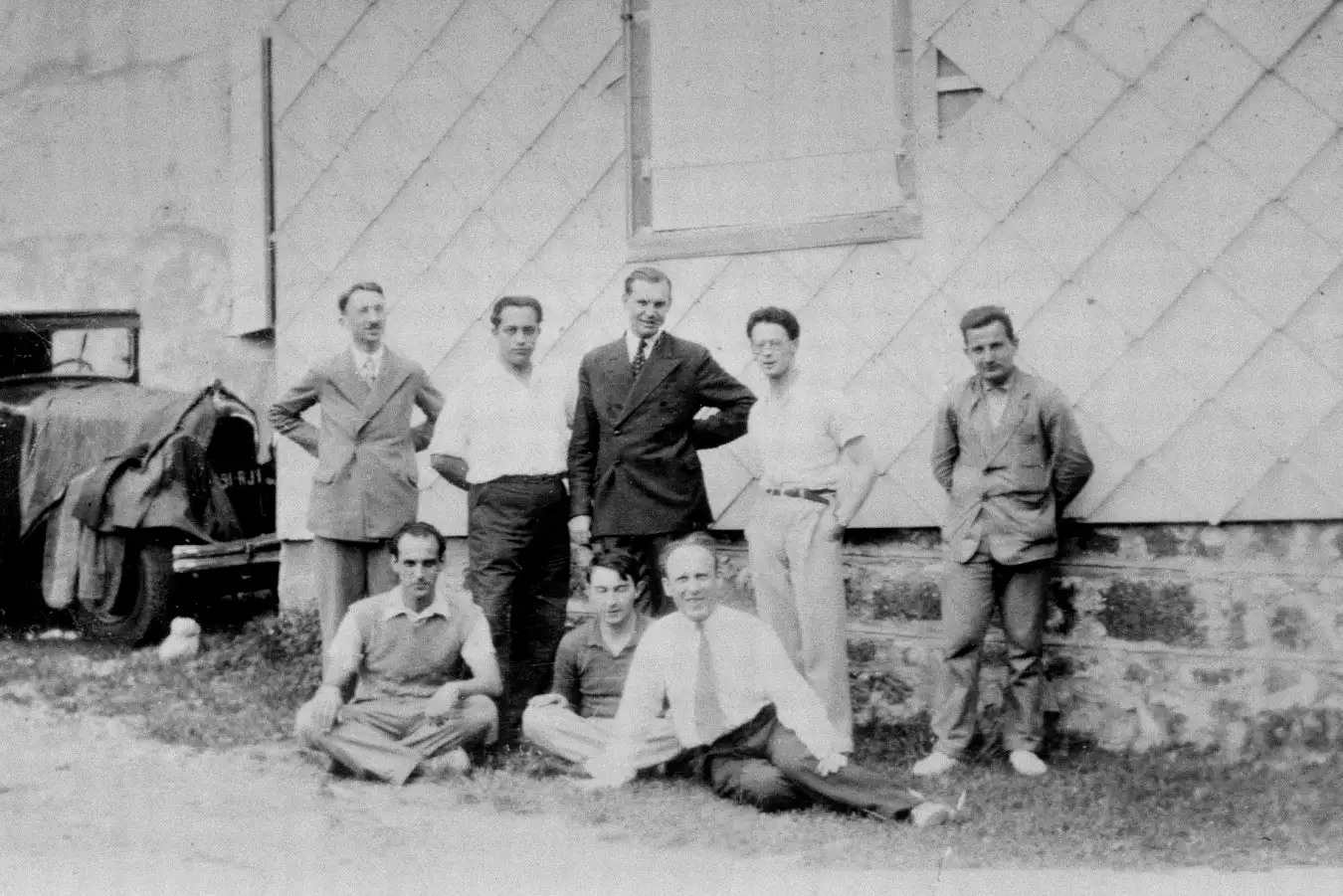
Some of the founding members of the Bourbaki group at a meeting in France in 1935
Archives Charmet/Bridgeman Images
But what was Bourbaki actually doing? In contrast to the way it was produced, Bourbaki’s work was sober and rigorous to a fault. Theory of Sets aimed to build a foundation that could tackle an eternal problem at the heart of mathematics, which is that the mathematical objects and ideas that mathematicians concern themselves with are independent from human language or symbols.
To understand why, think about the word “addition” or the symbol “+”. These have an entirely arbitrary relationship with the actual underlying mathematical concept – we could use any string of symbols to denote addition, as long as we agree what it means. By contrast, addition has a strict, intrinsic relationship with subtraction, because one reverses the other and this is true no matter what we call them.
In practice, the labelling of mathematical concepts is not a problem because mathematicians have conventions for a standard mapping between concepts and words or symbols, but in principle, there is the possibility for contradiction or disagreement.
Bourbaki was not the first to attempt this kind of formalisation (I recently wrote about some early efforts here) but it was perhaps the most pedantic. For example, the number 1 is carefully defined in a footnote on page 158 of Theory of Sets. Bourbaki writes that “the symbol ‘1’ is of course not to be confused with the word ‘one’ in ordinary language” but instead, it should be considered equal to the following definition:
τZ ((∃u)(∃U)(u = (U, {∅}, Z) and U ⊂ {∅} × Z and (∀x)((x ∈ {∅}) ⇒ (∃y)((x, y) ∈ U)) and (∀x)(∀y)(∀y’)(((x, y) ∈ U and (x, y’) ∈ U) ⇒ (y = y’)) and (∀y)((y ∈ Z) ⇒ (∃x)((x, y) ∈ U))))
Don’t panic. I cannot attempt a full breakdown of this here, though a very high-level explanation is that ∅ is a set (a mathematical term for a collection of objects) and that set contains zero objects, making it “the empty set”. From there, 1 is defined as {∅}, the set containing one object, with that object being the empty set. You can read more about that in a previous column.
What is incredible though is that this mess of symbols actually hides a far larger formal definition, with each squiggle carefully and excruciatingly defined based on the earlier text of the book, using only the symbols τ, ∨, ¬, ☐, =, ⊂ and ∈. It’s worth saying that Bourbaki never writes these out in full – the footnote estimates that doing so for this definition would require tens of thousands of symbols. This turns out to be a significant underestimation, with later mathematicians calculating that writing out the full expression for the number 1 would require more than 4.5 billion symbols, or possibly 2,409,875,496,393,137,472,149,767,527,877,436,912,979,508,338,752,092,897 symbols, depending on how strict you want to be.
Clearly, deviating from such intense formalisation is necessary if mathematicians want to actually get any work done, and Bourbaki admits as such – while always insisting that the use of shortcuts like “1” or “one” are “abuses of language”. By making the rules, Bourbaki granted mathematicians permission to break them.
The trouble with New Math
So what did all of this actually achieve? For one, it enabled Bourbaki’s goal of unifying mathematics as a singular entity. If, in theory, terms and concepts from two different branches of mathematics can be described using the same basic symbols, this provides a rigorous basis for passing from one to the other. In practice, no one actually does this, but it places mathematics on firmer philosophical ground. And decades later, Bourbaki’s approach is proving surprisingly influential, as mathematicians explore using computer-aided formalisation to verify proofs produced by artificial intelligence. Bourbaki also introduced many concepts and symbols (∅ for the empty set, for example) that remain in use by mathematicians today. More broadly, the Bourbakian style of writing continues to influence modern mathematical textbooks.
Bourbaki was not without detractors, however. As the publication of Elements of Mathematic continued, some mathematicians rebelled against the group’s insistence on pedantic rigour. More bizarrely, Bourbaki inspired a catastrophic attempt to remake the way mathematics is taught in schools. First emerging in the late 1950s in France, and later spreading to the US and other countries, “New Math”, as it was called, sought to abandon traditional pedagogical tools like multiplication tables and instead lead with a rigorous set-theory-based approach to mathematics based on the teachings of Bourbaki. The goal was to understand the general idea of multiplication, for example, rather than memorising specific facts like 3 × 4 = 12.
New Math was broadly seen as a disaster. Parents didn’t understand what their children were being taught, and neither did teachers in many cases. A bestselling book, Why Johnny Can’t Add, served as a scathing rebuke, and by the late 1970s New Math had mostly been abandoned. The 1970s were also bad for Bourbaki on another front, as the group was forced to wage a legal battle over copyright and royalties with its publisher.
Nevertheless, Bourbaki remains in operation today, publishing two new book chapters just this year, though, as is traditional, the authors behind them remain secret. In a way, the secrecy allows mathematicians to treat Bourbaki as a slightly embarrassing uncle – everyone is glad that he is there, doing work that nobody else wants to do, but at the same time mathematicians are relieved that they don’t actually have to invite him to dinner.
Topics:
Source link : https://www.newscientist.com/article/2525614-the-mathematician-who-doesnt-exist/?utm_campaign=RSS%7CNSNS&utm_source=NSNS&utm_medium=RSS&utm_content=home
Author :
Publish date : 2026-05-08 09:00:00
Copyright for syndicated content belongs to the linked Source.