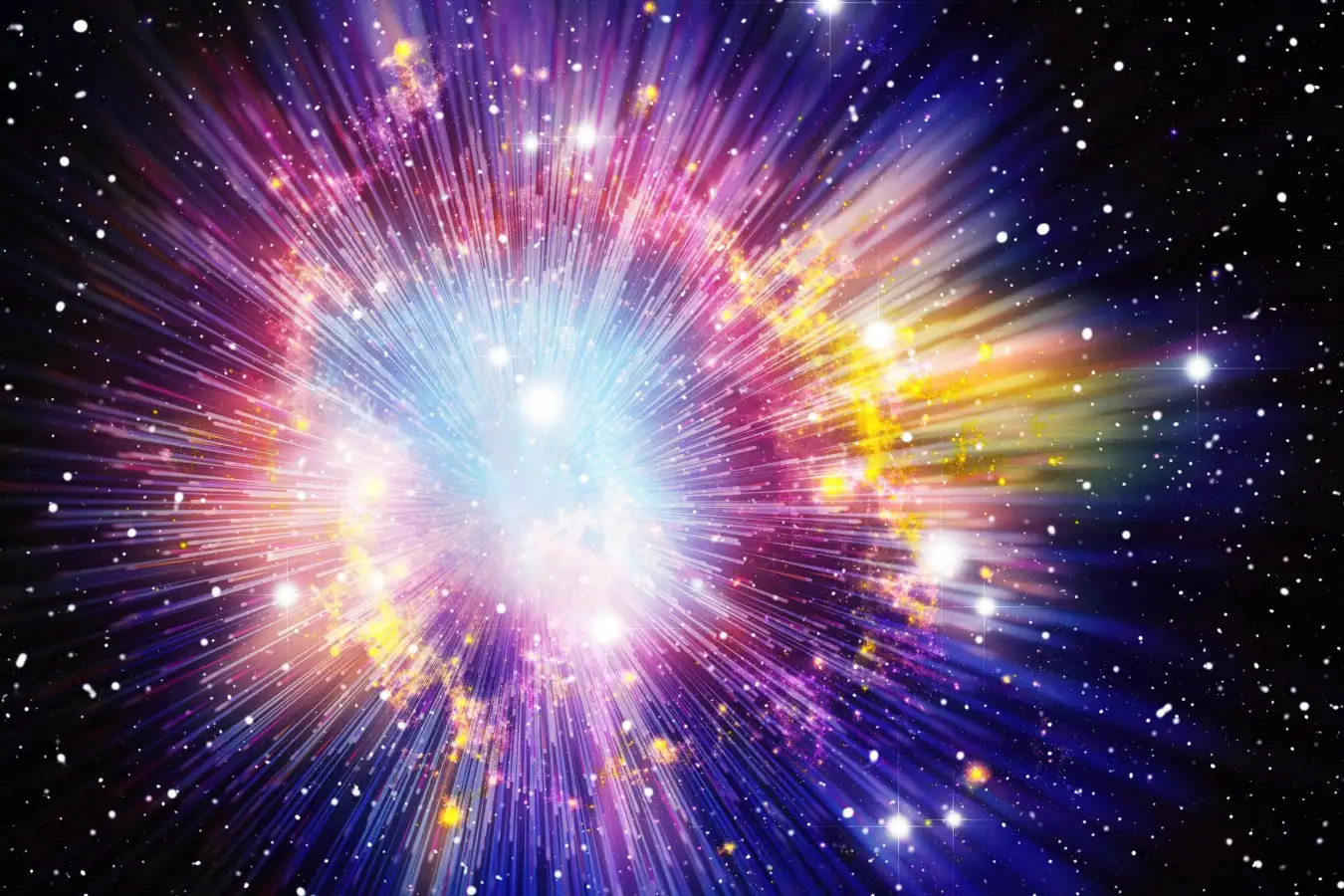
Artist’s interpretation of the universe in its first moments
ALFRED PASIEKA/SCIENCE PHOTO LIBRARY/Alamy Stock Photo
The first second of the universe was, without a doubt, the most eventful in all of history. The universe started small. Infinitely small, in fact, if you subscribe to big bang cosmology, which most cosmologists do. In the first second of the universe, though, it went from being an infinitely tiny, infinitely dense point to a complex cosmos spanning light years.
It all began with inflation. We’re not exactly sure why the universe immediately began to expand exponentially, but about every 1037th of a second, the distance between any two points in space doubled. This carried on until the cosmos had multiplied in size one billion billion billion billion times. That is, it grew by at least a factor of 1026 – that’s more than 100,000 times the number of grains of sand on all the beaches on Earth. It’s more than 1000 times the total number of stars in the known universe.
During the inflationary period, the cosmos laid the bricks that would later become the largest structures we know of. As everything spread out, inhomogeneities that were extremely minuscule in the beginning became bigger too, spreading across the new expanse of space-time. These tiny fluctuations are inevitable because of the innate randomness of quantum mechanics, and as they made waves throughout our young universe, they created subtle differences in the density of the sizzling hot plasma that filled all of space.
It is debated exactly how long the inflationary epoch lasted and exactly what size the universe was at the end of it – ask a cosmologist and they will probably compare it to a fruit, but whether it’s a blueberry or a grapefruit or a melon will be a surprise, and all of them are equally valid estimates. But everyone agrees that it lasted a tiny fraction of a second, and at that point the entire universe would have been somewhere between the size of a grain of sand and a few metres across, despite its astonishingly rapid expansion. At that point, the entire universe was, essentially, a hot, opaque ball of plasma, the first few particles and antiparticles mixed in with raw energy.
As that hot ball expanded, it started to cool and things got increasingly complex. The particles lost enough heat to begin combining with one another, forming the first hadrons, among them the protons and neutrons that make up so much of matter today. These were also the first baryons that formed – before this event, called baryogenesis, there were only fundamental particles, such as the sub-subatomic quarks that make up subatomic baryons. For some as-yet-unknown reason, there was more matter than antimatter, so most of the antimatter collided with matter and annihilated while the matter persisted.
As the particles were evolving, our small universe went through a series of what cosmologists call “phase transitions”, in which the state of all matter in the entire cosmos changed all at once. That was the last time this kind of synchronicity existed across the whole universe. From there, paths split. The four forces – gravity, the strong force, the weak force and the electromagnetic force – were unified at the big bang, but through a series of phase transitions within the first billionth of a second, they separated out and began behaving differently from one another, as they do today.
Those phase transitions heralded a series of changes. The universe stopped being opaque, and radiation flowed freely, lighting up the cosmos. Newborn matter particles gained mass by interacting with the Higgs field, which was itself newly separated from the other fields. Before this moment, a trillionth of a second after the big bang, they had all been massless. The universe, at a size of less than a light year across, was beginning to become recognisable as the one we live in.
It was also beginning to get clumpy, thanks to those quantum fluctuations that began when everything else banged into existence. The subtle clumping they caused would turn out to be one of the most important things that ever happened, allowing denser areas of space to eventually collapse into stars, which made up galaxies and clusters to form the large-scale structure of the universe – but that took aeons, not seconds.
Around a second after the big bang, the frenzy of cosmic evolution started to slow down. The diameter of the whole universe was still far less than the current distance between the sun and Alpha Centauri, our nearest stellar neighbour, so everything was still extraordinarily hot and dense compared to today, but most of the particles and forces that shaped the later universe had already taken the forms in which we see them now.
Atomic nuclei didn’t come around until a few minutes later, and they didn’t start holding onto the electrons that they needed to become neutral atoms for hundreds of thousands of years. Stars and galaxies didn’t start to form until at least tens of millions of years after that. But the foundations were laid, and all that foundation-laying, the baking of bricks and the pouring of the concrete, took only a single second. The specific details are still somewhat fuzzy, because an awful lot of seconds have happened since then, and cosmologists are wading through everything that arose between then and now to try to untangle it.
But however it played out in that one second, that’s all it took: just a single second to push the universe from a point in a sea of nothingness to the cosmological primordial soup from which everything would emerge.
Source link : https://www.newscientist.com/article/2512097-the-most-important-second-in-the-entire-history-of-the-universe/?utm_campaign=RSS%7CNSNS&utm_source=NSNS&utm_medium=RSS&utm_content=home
Author :
Publish date : 2026-01-19 13:00:00
Copyright for syndicated content belongs to the linked Source.