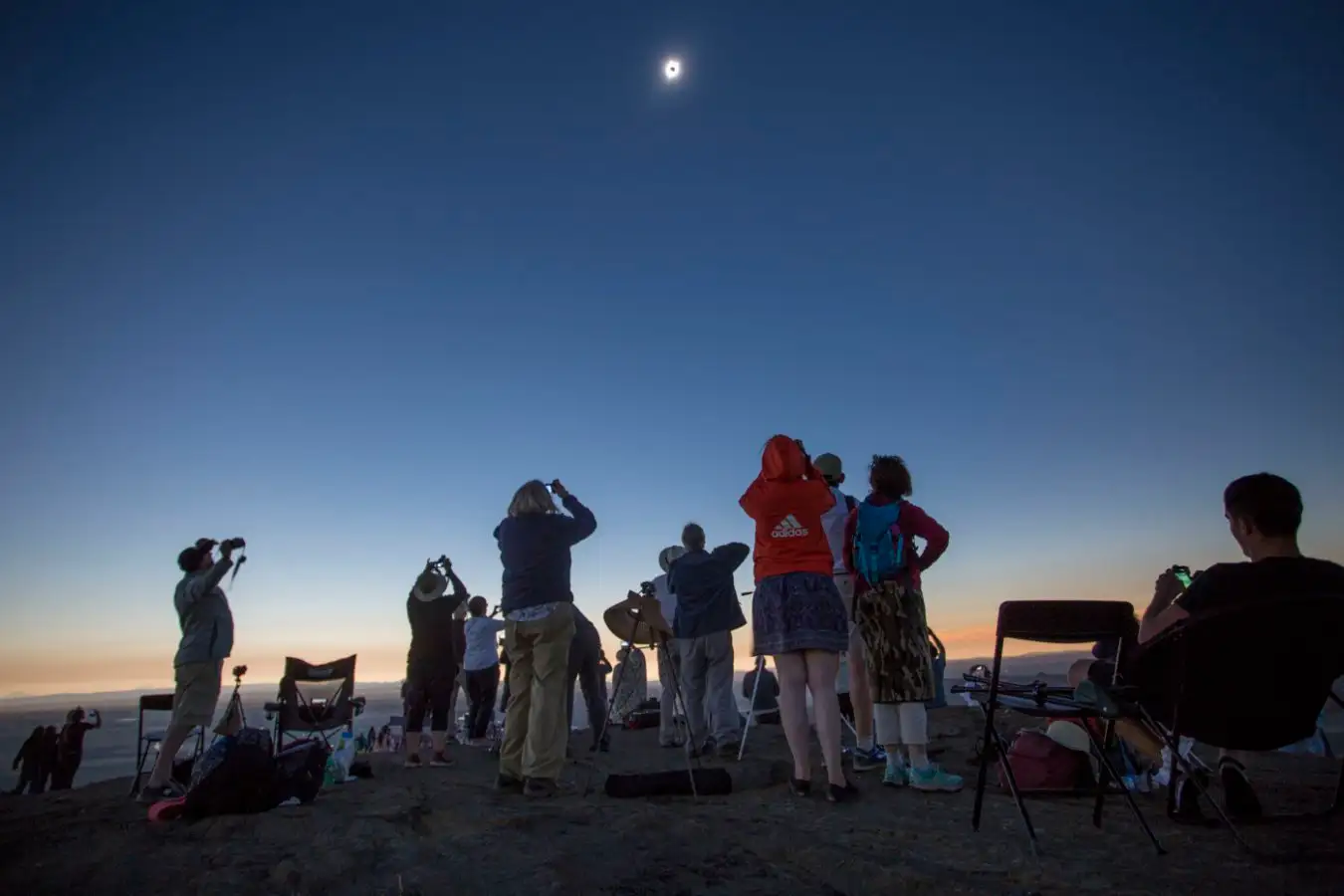
Watching the solar eclipse in Menan, Idaho in 2017
Natalie Behring/Getty Images
As one year draws to a close, I like to get excited about what the year ahead has in store for me in terms of astronomical events, and pop them in my calendar. For 2026, top of my list are the planets lining up, various eclipses and the usual calendar of meteor showers. All these events are visible in both hemispheres, unless I’ve specified.
In January, the dark skies in the northern hemisphere will hopefully bring us plenty of chances to glimpse the aurora, as it continues to be an active time for solar flares. The Quadrantid meteor shower, peaking on 3 January, should also be a lovely spectacle, although the full moon that night might obscure some of the fainter meteors.
Jupiter will be bright in the sky throughout January, as it reaches opposition, meaning it is on the opposite side of Earth from the sun. This is the best time to look at this stunning planet through binoculars or a telescope.
At the end of February, there will be a chance to see an impressive six-planet parade as Mercury, Venus, Neptune, Saturn, Uranus and Jupiter will stretch across the sky, all visible at once, just after sunset on 28 February.
On 2 and 3 March, there will be a total lunar eclipse visible from parts of North and South America, Asia, Australia and the Pacific Islands. The moon will enter a shadow cast by Earth, turning it darker and a red colour – giving it the evocative name Blood Moon.
Other meteor showers to pop in the diary include the Lyrids, peaking on 22 April, the Perseids, peaking on 12 August, the Leonids on 17 November and the Geminids on 14 December.
As well as these showers, another exciting event will be the total solar eclipse on 12 August. The moon and sun will align in the sky so that the moon perfectly blocks out the sun’s light for a few moments, viewed from certain parts of Earth (the one pictured is from 2017, seen in Menan, Idaho).
Totality – the time in which the sun’s light is fully blocked by the moon – will be up to 2 minutes and 18 seconds long. The total eclipse will be visible from northern Spain, the Balearic Islands, parts of Russia, Greenland and Iceland. But partial eclipses will be seen from many more places around the world. As usual with solar eclipses, a couple of weeks later, there will be a partial lunar eclipse, or Blood Moon, on 28 August.
If you have a powerful telescope, 25 September will be a perfect time to look for Neptune, as it will be at its closest to Earth and fully lit by the sun. Then, on 4 October, Saturn will be at opposition, making it the best time of the year to view the planet and, possibly, its rings through a small telescope. It will be visible all night.
There are also two supermoons to watch out for at the end of 2026. The first, on 24 November, is the Beaver Moon. Then the year rounds off with a Christmas eve supermoon. Happy stargazing!
These articles are posted each week at
newscientist.com/maker
Abigail Beall is a specials editor at New Scientist and author of The Art of Urban Astronomy. Follow her @abbybeall
Topics:
Source link : https://www.newscientist.com/article/mg26835731-300-the-stargazing-events-to-look-forward-to-in-2026/?utm_campaign=RSS%7CNSNS&utm_source=NSNS&utm_medium=RSS&utm_content=home
Author :
Publish date : 2025-12-10 18:00:00
Copyright for syndicated content belongs to the linked Source.