


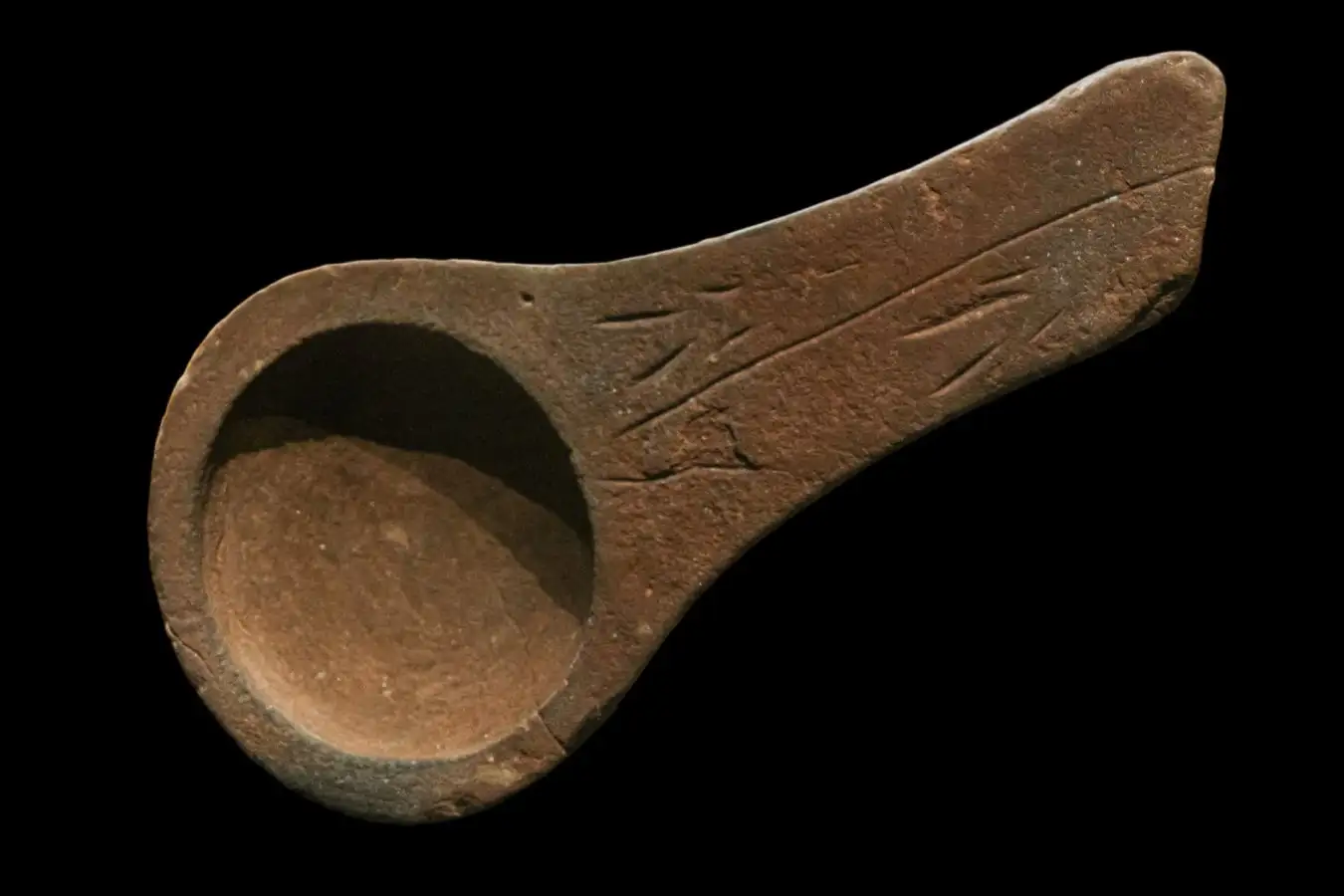
An oil lamp found in Lascaux cave in France
Sémhur CC BY-SA 4.0
This is an extract from Our Human Story, our newsletter about the revolution in archaeology. Sign up to receive it in your inbox every month.
In the prehistoric opening of 2001: A Space Odyssey, the first tool is a club: a long limb bone that proves handy for killing prey animals, murdering the leader of a rival hominin group and, finally, for throwing into the air ready for a dramatic jump cut. In this view, the first tool was a weapon.
This interpretation can be neatly fitted onto the earliest stone tools. Rounded rocks were used for hitting things, sharp ones for cutting and stabbing. We imagine that early stone tools were used for breaking things open, for hunting, for killing.
However, early people probably used other kinds of tools as well, ones made of other materials. Plant materials like wood were probably used all the time; it’s just that they are less likely to be preserved. The Stone Age was also the Botanic Age (and if you haven’t read Sophie Berdugo’s 2024 feature on this, I urge you to do so).
This opens up a lot of other possibilities, one of the most thought-provoking being: containers. What if the first tool was an object that could hold something valuable, so you could carry it around or store it?
If you think about it, a container is one of the most useful things you can have. “It solves a lot of problems,” says palaeoanthropologist Marc Kissel at Appalachian State University in North Carolina. “It opens up this new niche.” He and his colleagues have compiled a database of prehistoric containers. There are hundreds of examples, spanning over 100,000 years, but they argue – I think rightly – that this is a tiny fraction of what once existed. Furthermore, the container was one of the most important tools. “It’s one of the things that allow humans to be so successful,” says Kissel.
Back in time
Creating a database of prehistoric containers isn’t easy. Kissel and his colleagues spent over a year scouring the scientific literature for examples. They couldn’t rely on the word “container” or a synonym turning up in the texts, so they had to look for a lot of other terms that represented specific types of container. They called a halt last year, realising that “we have to stop adding stuff”, he says, and recently published a paper describing the dataset in the Journal of Anthropological Archaeology on 8 April.
A further challenge was deciding what counts as a container. They chose a deliberately broad definition: “an object which fulfils the basic container principle (that of holding something inside themselves and acting as a barrier, separating that something from the external world) and is transportable via carriage on or by the human body”.
This has the effect of including a lot of objects that you might not, at first glance, think of as containers. One example is spoons, which we think of as utensils, but which hold something and allow you to transport it. There are also a lot of items interpreted as lamps. Each one is a small slab of rock with a divot carved out, into which people could place animal fats and burn them. The most famous example is from Lascaux Cave in France: it was carved from red sandstone and has a handle.
Other containers are made of hollow bones. For instance, tubes made from the wing bones of swans may have been used to carry needles. Ostrich eggs, which are large and sturdy, were used as containers in Africa, perhaps to carry water on long journeys. There are also some examples of rock art that show containers, such as an engraving from Gönnersdorf in Germany showing what looks like a net.

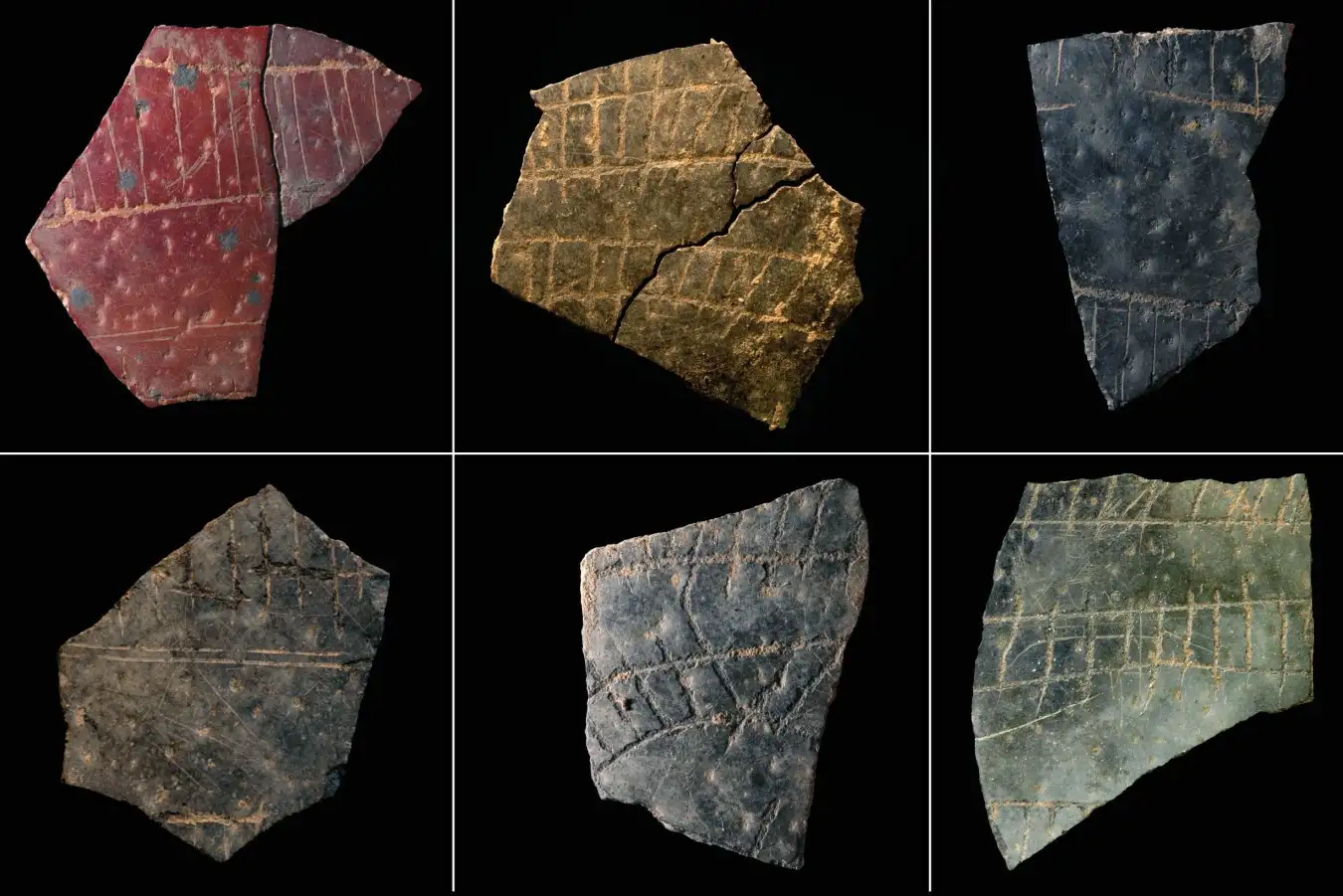
Engraved ostrich eggshells, likely fragments of ostrich eggshell containers from South Africa
Texier et al. 2013
The team ended up with 793 mobile containers. While they tried to find containers from the entire Pleistocene, the period spanning 2.58 million to 11,700 years ago, all the examples they found seem to be from the last 500,000 years.
Nevertheless, this represents a big push into the deep past. Traditionally, archaeologists have thought of containers as arising only within the last 10,000 years or so. The idea was that they were tied to the advent of farming and settled living – the so-called Neolithic revolution – and the invention of pottery. Agricultural societies would produce food surpluses, which needed to be preserved and stored, whereas hunter-gatherers probably didn’t have surpluses, and in a highly mobile society pots would probably get broken anyway.
However, Kissel says this idea had largely been abandoned already, because it presents the Neolithic as a hard break with the past, when in reality it was much more gradual and piecemeal. In line with that, some Indigenous peoples in Australia made pottery more than 2000 years ago (though that gets us into the complicated question of whether they were hunter-gatherers, farmers or – probably more likely – something more complicated in between). Likewise, foragers that settled in the Amazon 10,000 years ago left behind shards of pottery, and there is evidence of pottery in China as early as 18,000 years ago.
This suggests that people developed containers gradually, building up more types over many years. “I think it’s more helpful to see containers on a spectrum,” says Kissel.
The origins of containers lie deep in the past. Perhaps not too far back, though, because non-human primates like great apes don’t use them. “They will occasionally take a leaf, dip the leaf into the water, and have it act as a sponge to get the water to their mouths,” says Kissel. “But they don’t have containers, and that, to me, seems like a foundational difference.”
The oldest container in the database is a tray or dish made of bark. It was found at Kalambo Falls in Zambia and is between 400,000 and 500,000 years old. Kalambo Falls has some incredible preserved wooden objects: in 2023, archaeologists described what seem to be large wooden structures, perhaps houses, from 476,000 years ago. However, the dating of the tray/dish is less clear.
This exemplifies another problem Kissel’s team had, which is that a lot of these objects were excavated a long time ago. This means the information about them is buried in old literature, which is often not online, and the dating methods used would not pass muster today. The tray from Kalambo Falls was excavated in the 1950s by a team led by archaeologist John Desmond Clark. The main source about the tray is Clark’s two-volume book Kalambo Falls Prehistoric Site (1969), which contains a three-page chapter by botanist Timothy Charles Whitmore on “bark and other specimens”. There’s also a 1958 article Clark wrote for Scientific American. That’s not a lot to go on.
Hence, while there are some trends in the dataset, Kissell says they should mostly be understood as reflecting the limitations of the archaeological record, rather than the facts of prehistory.
For instance, 87.8 per cent of the containers in the database were found in Europe. “I don’t think that is showing that Europe is the place where containers began,” says Kissel. Instead, it’s a reflection of the huge amount of archaeological work performed in Europe compared to elsewhere. Also, we just saw that the oldest container in the database is from Africa.
Likewise, of the containers that have dates at all, only two are older than 100,000 years. However, Kissel is explicit that hominins were probably using containers long before this: these objects either haven’t been preserved or haven’t been spotted. (Other researchers have made this same point.)
What we can start to see, Kissel argues, is how ubiquitous containers were. In Europe, which is well studied, there are lots of examples despite the preservation issues. That suggests they were crucial to human survival.
Storage, not wars

We’re still using one of the oldest tools humans invented
Ron Giling/Alamy
One of the earliest uses of containers, Kissel argues, was to carry babies – perhaps in slings. A lot of anthropologists – especially female ones – have suggested this over the decades.
Among great apes like chimpanzees, the babies cling to their mothers, who are helpfully covered with thick fur that serves as a handhold. However, we have lost most of our body hair, and our newborns are so helpless that they can’t cling to anything.
With that in mind, Kissel suggests that baby carriers would have become useful when hominins started routinely walking on two legs, and when they lost most of their body hair. That happened several million years ago. “Australopithecines were probably using slings,” he says. If that’s true, then Lucy, the famous Australopithecus afarensis, was probably carried in a sling as a baby 3.4 million years ago.
One thing Kissel emphasised is that none of these ideas are new. People have been saying things like this for decades, but the ideas are only slowly moving to the forefront, perhaps because they were first articulated in feminist reinterpretations of prehistory, which were unfairly treated as kooky or unrealistic.
In 1976, anthropologists Nancy Tanner and Adrienne Zihlman proposed that some of the first tools might have been baskets, which women used to carry things like food. They were pushing back against male-dominated ideas of prehistory, which emphasised activities like hunting of large animals – incorrectly assumed to be primarily male-driven – and paid little or no attention to females.
Feminist journalist Elizabeth Fisher suggested much the same thing in her 1979 book Woman’s Creation: Sexual evolution and the shaping of society, in which she wrote that “Many theorizers feel that the earliest cultural inventions must have been a container to hold gathered products and some kind of sling or net carrier”.
Speculative fiction writer Ursula Le Guin cited Fisher directly in her essay The Carrier Bag Theory of Fiction. “If you haven’t got something to put it in, food will escape you – even something as uncombative and unresourceful as an oat,” she wrote. Even a simple container will allow you to gather a surplus, which means you can stay inside the next day if the weather is bad.
Le Guin pushed this idea a long way. She said that our ideas about history and prehistory are shaped by action and violence, like the first tool in 2001 and all the heroic stories about killing dragons and bad guys. But, she argued, there are other equally valid stories to tell about gathering and parenting and building.
Many of our stories are focused on “how Cain fell on Abel and how the bomb fell on Nagasaki and how the burning jelly fell on the villagers and how the missiles will fall on the Evil Empire, and all the other steps in the Ascent of Man,” Le Guin wrote. “Lest there be no more telling of stories at all, some of us out here in the wild oats, amid the alien corn, think we’d better start telling another one, which maybe people can go on with when the old one’s finished.”
As I write this, I can feel some of the reader letters being written: the ones that say violence has always been part of the human story and that when it comes to understanding prehistory, we should just follow the data.
The thing is, as best I can, I am following the data. There is growing evidence that the thing that makes our species unusual isn’t that we’re intelligent or creative or aggressive – though we undoubtedly can be all those things – but that we’re friendly and emotionally needy and dependent on each other. For instance, whenever a human population has become isolated from others, they have been at far greater risk of extinction; they had no one to ask for help.
Our survival depends on networking and cooperating. Like, say, sharing some of your stored food with a friend who has come up short, using that handy container you made.
Topics:
- archaeology/
- ancient humans
Source link : https://www.newscientist.com/article/2526004-the-story-of-the-first-human-tool-the-humble-container/?utm_campaign=RSS%7CNSNS&utm_source=NSNS&utm_medium=RSS&utm_content=home
Author :
Publish date : 2026-05-11 18:00:00
Copyright for syndicated content belongs to the linked Source.