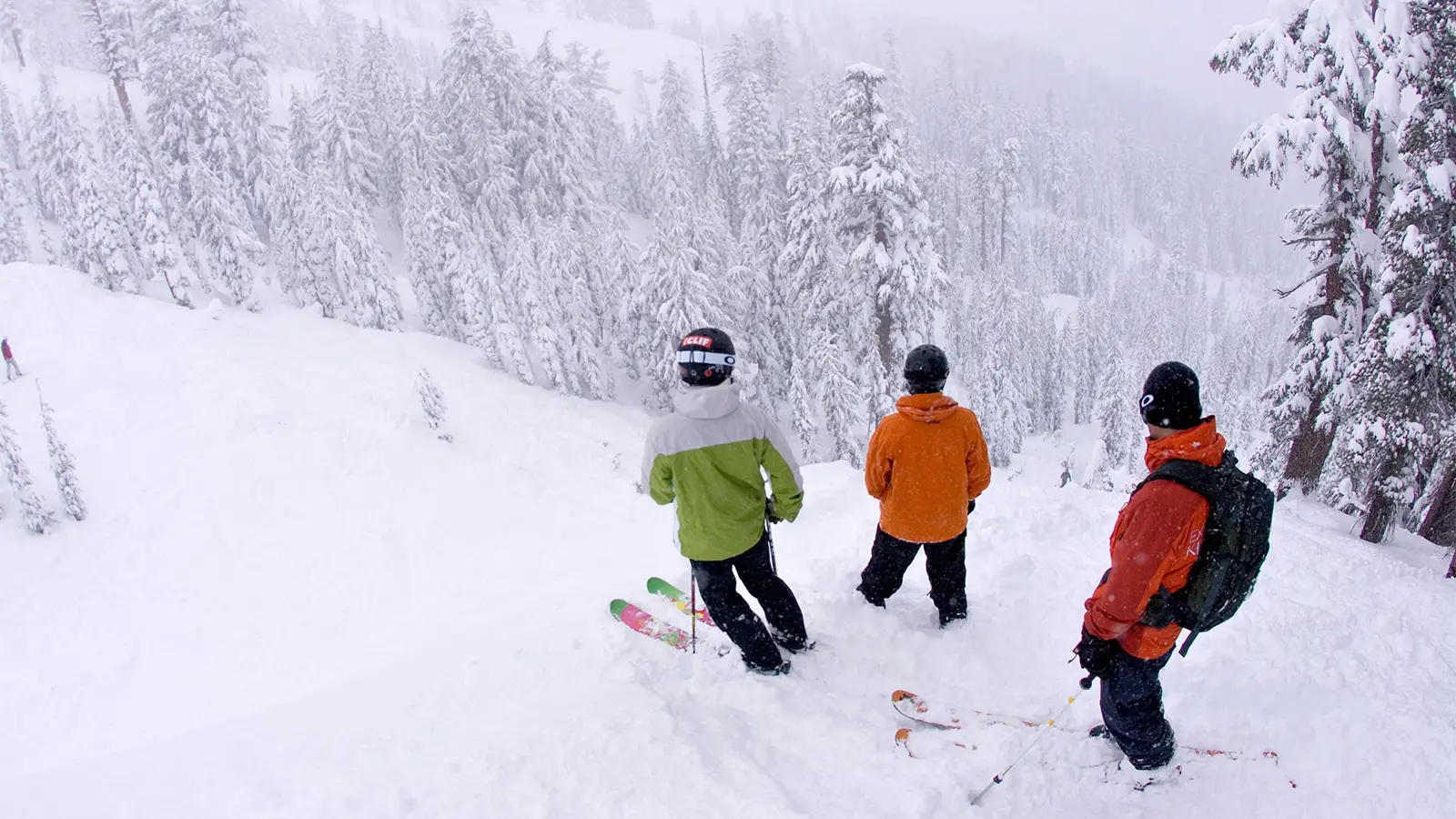
Today, I write with a heavy heart. I grew up in Sacramento and have spent much of my life skiing the Sierra Nevada mountains that ring Lake Tahoe. They’re honestly incomparable — timeless, imposing, and otherworldly when blanketed in snow. They’re one of the most beautiful places on earth and, as we were all recently reminded, sometimes one of the most treacherous.
The events that led to Tahoe’s recent avalanche tragedy are by now well-known. On February 17, 15 skiers (four guides and 11 clients) were completing a backcountry trip in a remote area near Donner Summit. They left cabins where they had stayed for 2 nights, intent on reaching the trailhead where they started, a distance of approximately 3.5 miles.
By the time the group set off — having cut the trip short in the face of a severe, multi-day snowstorm — they faced hazardous and rapidly deteriorating conditions, including 60 mile-per-hour (mph) winds, whiteout visibility, and 4 feet of new snowfall. They made it less than a mile. As they reached a clearing underneath a steep peak, a slab of snow the size of a football field tumbled 40 stories to instantly bury 13 of the skiers. Nine died in what is now the deadliest avalanche in California history.
Today, my Bay Area community is mourning an utterly senseless loss of life — one described by some as “100% preventable,” even as others have cautioned to withhold judgment. One of the most difficult tasks in disaster preparedness and emergency medicine is to ask what lessons we can learn from today’s tragedies to lessen the brunt of tomorrow’s. It is in that vein that I now write about avalanches.
Picking Out the Stone That Began the Avalanche
The fact that any members of the group survived is a minor miracle. Avalanches come in two flavors: sluffs and slabs. The more lethal version — slabs — are due to a weak layer low in the snowpack, which breaks off and carries all the compressed snow on top of it, like a magazine sliding off a table. Once in motion, slabs can reach 80 mph within seconds, making them nearly impossible to outrun or outski. It’s also nearly impossible to dig yourself out once submerged in that dense snow block — it’s like being buried in concrete. You’d have to have someone nearby to get you out.
And survival depends on just how quickly you can get someone out. The human body tends to sink quickly in avalanche debris. For those who can be extracted within the first 10 minutes, the probability of survival is 91%; by 30 minutes, it plummets to 31%; after 30 minutes, few survive. Survival is higher for individuals rescued by companions (74.8%) versus organized rescue teams (22.9%), which reflects that critical time to extraction.
The recent Tahoe avalanche was a slab. By chance, two skiers had fallen behind and arrived at the clearing unharmed moments later. These two, along with a third skier who was able to self-extricate, quickly uncovered three of the buried skiers. The fourth and fifth victims they reached had expired. They then got off the slab and sheltered nearby until a search team — in blizzard conditions — reached them 5 hours later.
Death in an avalanche is usually due to asphyxia as expired carbon dioxide quickly accumulates around a person’s airway (much like breathing into a plastic bag), and sometimes from trauma. Enhanced education and training, rescue equipment such as beacons and artificial breathing devices, and highly efficient search and rescue efforts all aim to boost these low survival statistics.
This Is Not a Drill
But the true backbone of avalanche safety is the avalanche warning system, a 5-point scale that rates risk from low to extreme. The Forest Service manages 13 avalanche centers across the nation; on any given day, each of these produces a risk estimate.
Avalanche prediction is admittedly a tricky science, given that it involves forecasting complicated, often chaotic natural systems. Nonetheless, it’s pretty good, with an overall accuracy of 70-80% (although accuracy does tend to drop at higher risk levels). It’s good enough that most experienced backcountry skiers trust it.
In the week preceding the disaster, conditions in Tahoe were ripe for an avalanche: warm weather and scant snowpack had created a slippery, unstable layer of ice upon which 6 feet of powder were expected to drop. The day the group set out, the Sierra Avalanche Center warned that “rapidly accumulating snowfall and strong winds may cause widespread avalanche activity.” The next day, risk was elevated to moderate. By the time the group left their cabins, the risk was high, with “widespread areas of unstable snow and numerous avalanches” expected.
So why would a guide company — reportedly staffed with highly respected guides — and 11 competent skiers undertake the expedition at all, let alone the most risky route out under harrowing conditions when there were other viable options?
What Were They Thinking?
Whole books have been dedicated to trying to understand the decisions people make in high stakes, complex situations. What we know is that disastrous events rarely result from a single decision; rather, they tend to be caused by a slow accumulation of compounding mistakes, in which mounting warning signs are ignored until a full-blown crisis has occurred. And much of the time, these mistakes involve something called heuristics.
Heuristics are mental shortcuts that people subconsciously rely on to problem-solve. We use them constantly, but especially when pressed to prioritize speed or efficiency over precision. They’re essentially an autopilot for our brains, “rules of thumb” learned over the course of a lifetime about what usually works and what doesn’t in various situations. And, for the most part, heuristics serve us well — until they don’t.
In the early 2000s, an extreme skier named Ian McCammon investigated 715 backcountry avalanche incidents and came to the startling realization that the problem did not arise from lack of education or rescue equipment, but rather, from a flaw in human psychology — a set of fairly predictable heuristic traps. To begin with, people in familiar terrain often feel a false sense of confidence and may ignore evidence of risk. There’s also a group dynamic that influences decision-making: people defer to the person felt to be the expert (the “expert halo” effect) and hesitate to be the singular person who voices concern. And finally, once committed to a plan, people are generally hesitant to change it, even when overwhelming evidence suggests that it is flawed.
What’s troubling is that similar heuristic errors help explain many of history’s most notorious disasters, including Hurricane Katrina, the Chernobyl meltdown, and the Challenger explosion — these include normalization of deviance, justification of risk, and other group dynamics. And it should escape no one’s notice that healthcare workers, often under pressure to work quickly and efficiently, can default to similarly flawed cognitive shortcuts.
For me, this is the real lesson of the Tahoe avalanche tragedy. As both a skier and physician, I am constantly involved in high-stakes decision-making. The Tahoe avalanche is a poignant reminder to check my own heuristic biases: to avoid the act-first-strategize-later approach; to remind myself that sometimes the “do nothing” option is the best one; and to always, always ask myself if the decision I am making will make sense in 5 years.
We will never know exactly what those skiers were thinking, but we should view this tragedy with humility and empathy. We all share a tendency towards heuristic error: it could have been many of us.
This perspective is the author’s alone and does not necessarily reflect that of any institutions or companies with which she is affiliated.
Source link : https://www.medpagetoday.com/opinion/calamities/120459
Author :
Publish date : 2026-03-24 16:42:00
Copyright for syndicated content belongs to the linked Source.