


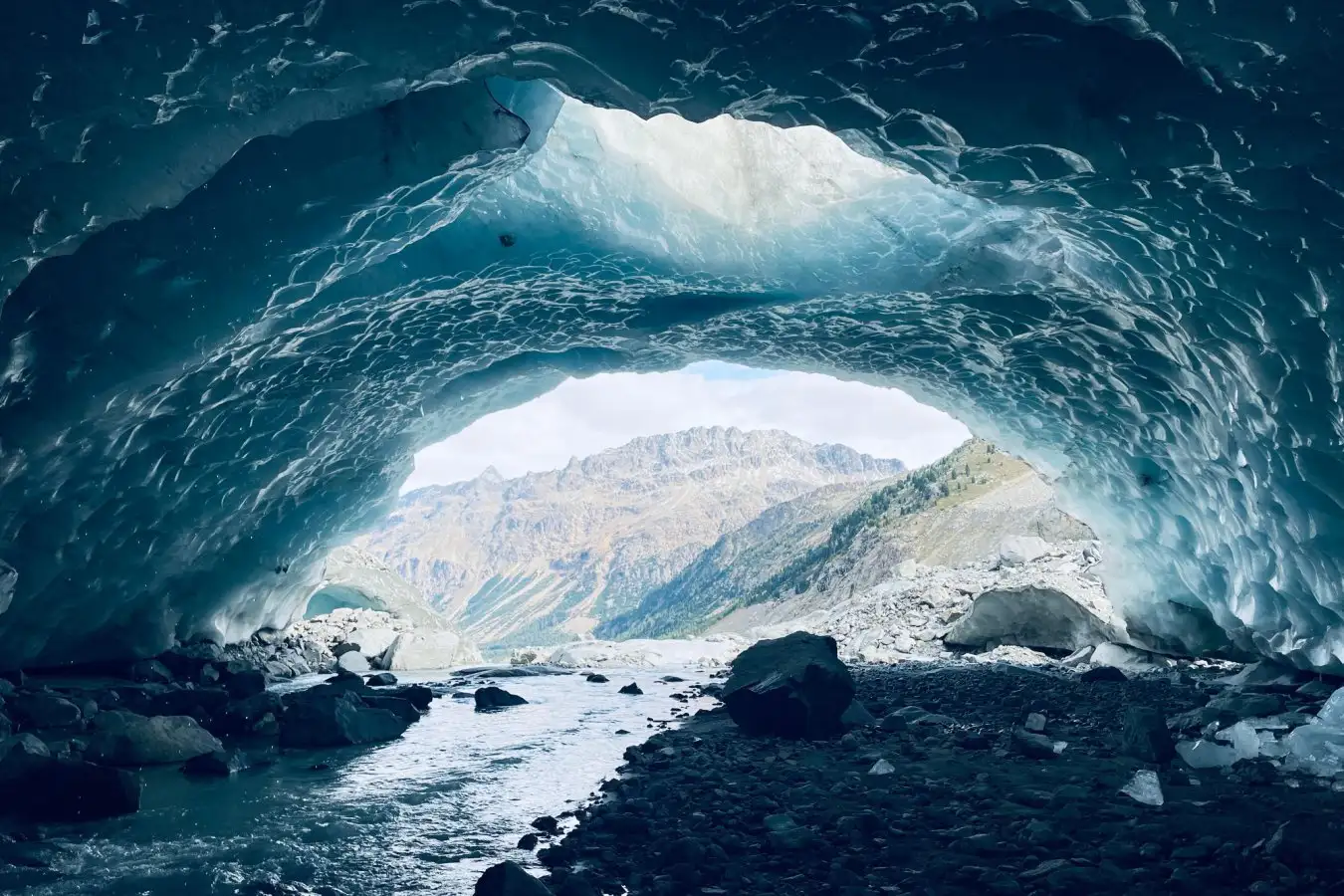
Meltwater runs through a glacier cave at the front of Morteratsch glacier in Switzerland
Lander Van Tricht
About 1000 glaciers are now being lost every year and this rate could climb to 3000 per year as soon as 2040, even if countries meet their targets to cut carbon emissions.
At least 4000 glaciers have melted away in the past two decades. Lander Van Tricht at ETH Zurich in Switzerland and his colleagues used climate models to predict what will happen to the world’s 211,000 glaciers in the coming century under different global warming scenarios.
Current climate goals put the world on track for 2.7°C of warming above pre-industrial temperatures this century. This would mean 79 per cent of the world’s glaciers will disappear by 2100. If humanity limits global warming to 2°C, however, 63 per cent of glaciers will disappear.
“We’re going to lose many of our glaciers, but we have the ability to preserve a lot of them as well,” says David Rounce at Carnegie Mellon University in Pittsburgh, Pennsylvania, who worked on the study.
If countries don’t meet their targets and the world warms by 4°C, 91 per cent of glaciers will be lost.
Glacier melt is projected to boost sea levels by 25 centimetres this century. It will also undercut the summer melt that many regions rely on for irrigation. Two billion people live in drainage basins fed by mountain snow and ice, many near rivers originating from Himalayan glaciers.
Melting ice also means that floods caused by a sudden release of water from a glacial lake are becoming more frequent, like the one that killed 55 people in India in 2023.
Previous research found that half of all glaciers would melt away this century even if humanity restricted warming to 1.5°C, the most ambitious Paris Agreement goal. This study upgrades those estimates, finding that 55 per cent would be lost with this amount of warming.
It also projects the rate of glacier loss by year and by region. This rate will peak around mid-century, then slow once smaller mountain glaciers are gone and bigger ones are left, such as in the Arctic and Antarctica.
“The larger ones, it just takes a lot of time to melt the ice, [so] they will disappear later,” says Van Tricht.
Under current climate targets, western Canada and the contiguous US will lose almost all glaciers by 2100. In a blow to tourism, Glacier National Park in Montana will be largely bereft of glaciers, although some could remain as miniature glaciers or ice patches, according to upcoming research from the United States Geological Survey.
The Alps will also be almost bare. Communities are already holding funerals for glaciers, and the Global Glacier Casualty List website is collecting their stories. Matthias Huss at ETH Zurich, who worked on the study, and 250 other people climbed to the remains of Pizol glacier in 2019.
They came to say goodbye, but also to tell the public “we are attached to our glaciers,” says Huss. “If they are gone, it matters to us.”
Topics:
Source link : https://www.newscientist.com/article/2508713-the-world-will-soon-be-losing-3000-glaciers-every-year/?utm_campaign=RSS%7CNSNS&utm_source=NSNS&utm_medium=RSS&utm_content=home
Author :
Publish date : 2025-12-15 16:00:00
Copyright for syndicated content belongs to the linked Source.