
[ad_1]
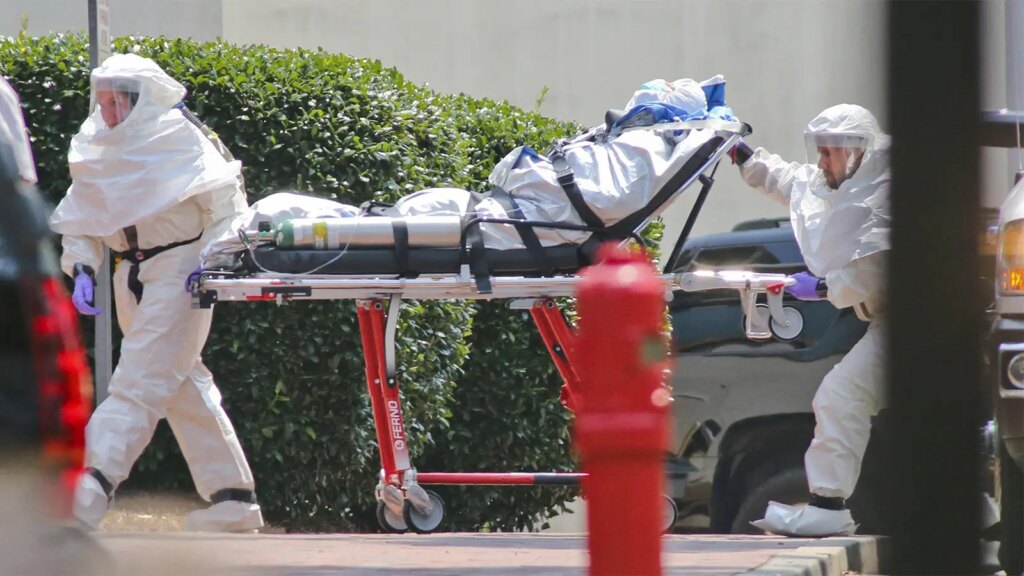
Aneesh Mehta, MD, was the physician on call when the first Ebola patient arrived at Emory University Hospital on Aug. 2, 2014.
“None of us, at that time, had taken care of patients with Ebola,” Mehta, who is now chief of infectious diseases at Emory, told MedPage Today.
Back then, there were only three biocontainment units in the country: Emory’s, one at the University of Nebraska Medical Center (UNMC) in Omaha, and the NIH Clinical Center in Bethesda, Maryland.
MedPage Today spoke with healthcare professionals who helped care for Ebola patients in the U.S. during that outbreak in 2014. They described the nerves of doing so, but also the reassurance that their training and preparation would keep them safe.
“We felt, as a team, that our preparedness was there, our knowledge was there,” Mehta told MedPage Today.
Roughly a month later, Angela Vasa, MSN, RN, then a staff nurse, now director of the Emergency Preparedness and Special Pathogen programs at UNMC, received an alert: “This is not a drill.” Nebraska’s biocontainment unit would be receiving Ebola patients.
“I remember, just like, grinning,” along with a rush of adrenaline, she said.
The team had “trained towards Ebola,” because it was the most dangerous pathogen they thought they might see, outside of smallpox, if it were developed as a bioweapon, Vasa said.
Morgan Shradar, MPH, BSN, RN, was similarly excited. But the moment before entering the unit, as she stepped into her personal protective gear, she felt some trepidation. “Am I smart enough to do this?” she remembered thinking. She was confident in her training, but the thought of an accidental exposure endangering not only her, but her entire community, gave her pause, she said.
The virus spreads through contact with body fluids such as blood, feces, or vomit of an infected person, or surfaces with such residue. With Ebola, there is “zero margin for error,” Vasa said.
At Emory, Mehta recalled that every interaction of every single person in the unit was independently monitored by a “safety partner” outside the room, to avoid potential exposures.
Vasa had expected more blood, and a mortality rate between 60% and 80% — and was relieved when that was not the case. UNMC received three patients: Rick Sacra, MD, and Martin Salia, MD, — both of whom had cared for Ebola patients in West Africa — and Ashoka Mukpo, a freelance cameraman. Salia died from the virus in November 2014.
Vasa credited the fact that most patients did not end up with the most severe symptoms to “early aggressive intervention,” with IV fluids, electrolyte replacement, and critical care. Mehta agreed that early supportive care, including blood monitoring, had helped most patients recover.
This kind of care — IV fluids, “really good nutrition,” and daily blood work — wasn’t something that was available on the ground in West Africa. When patients “needed replacements of certain electrolytes, we were able to do that without difficulty,” he added.
Another difference in the biocontainment unit was the amount of time nurses had with patients, Vasa said. Typically two to three nurses would enter the room in 4-hour shifts. “They were our only patient. So, all of our focus was on them all day,” she said.
Emory received four patients: Kent Brantly, MD, and Nancy Writebol, both of whom fell ill working at a missionary hospital in Liberia (Writebol was responsible for decontaminating clinicians leaving the unit); Ian Crozier, MD, a physician volunteer for the World Health Organization in Sierra Leone; and Amber Vinson, RN, a nurse in Dallas who contracted the virus stateside as she cared for a Liberian patient with Ebola, Thomas Eric Duncan, who later died.
“Two of our patients … were sick and progressively got better, but two of our patients were sick and got worse in the first few days that they were with us,” Mehta said.
One patient had a predicted mortality rate over 90%, he told MedPage Today. While Mehta did not name patients, Crozier, based on media reports, was severely ill.
The interventions they used to care for him were “things that have never been tried on patients with Ebola,” Mehta said, including mechanical ventilation, dialysis, and “aggressive medication” to keep Crozier’s blood pressure up and inflammation down.
Mehta recalled checking in with patients’ family members, eager for news, multiple times a day.
“Our job as healthcare workers is trying to return people back home to their family,” he said, adding that the fear of not delivering on that responsibility worried him.
After several days, the patient’s extreme level of illness subsided, he said.
Over at UNMC, Vasa recalled their three patients being very different. Caring for Sacra, as a physician who readily understood each intervention, was different from caring for Mukpo, a non-clinician.
As for Salia, “we didn’t really get to experience him in the same way that we did our first two admissions,” Vasa said.
On arrival, he was fighting to breathe, his kidneys had failed, and he was unconscious, according to NBC News.
He died within 72 hours, Shradar recalled.
Vasa and others wondered whether he might have lived if he’d returned to the U.S. sooner. Salia arrived on day 13 of illness and his evacuation may have been delayed by logistical issues.
Being unable to stop the progression of illness for someone who dedicated his life to helping others was difficult, Vasa said. Knowing that Ebola survival rates in the U.S. were relatively high and yet their patient did not survive is “always hard to carry,” she added.
It also wasn’t lost on Vasa that her team caught only a glimpse of what colleagues in Africa experienced on a much larger scale. Ebola killed more than 11,000 people in West Africa from 2014-2016.
Sacra’s departure was emotional in a different way, Vasa remembered. It involved a “tunnel walk” with the Nebraska Cornhuskers, the football team introduced to him during his recovery. Both Sacra and Mukpo were equally excited to leave, and very appreciative, Shradar said.
After their experience, Emory, Nebraska, and New York City’s Bellevue hospital, which treated Craig Spencer, MD, formed a national network for managing high-consequence infectious diseases. While it first focused on Ebola, it’s now called the National Emerging Special Pathogen Training and Education Center, and is funded by the Administration for Strategic Preparedness and Response.
“We are ready 24/7 365 to take in any patient that may have a disease like Ebola,” he added.
Please enable JavaScript to view the comments powered by Disqus.
[ad_2]
Source link : https://www.medpagetoday.com/infectiousdisease/ebola/121428
Author :
Publish date : 2026-05-26 16:17:00
Copyright for syndicated content belongs to the linked Source.