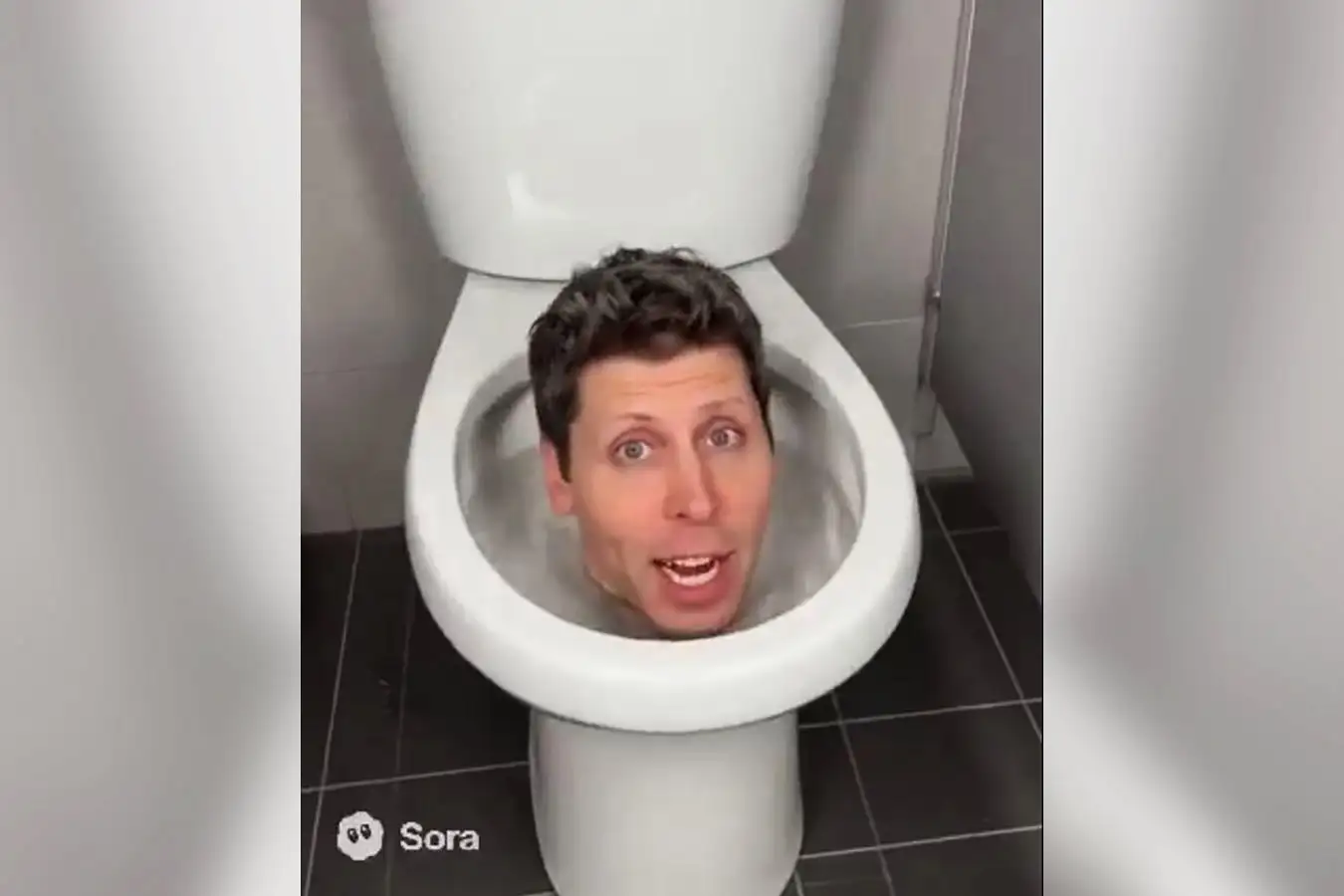
OpenAI founder Sam Altman is featured on Sora
Sora/Screenshot
There is no doubt that 2025 will be remembered as the year of slop. A popular term for incorrect, weird and often downright ugly AI-generated content, slop has rotted nearly every platform on the internet. It’s rotting our minds, too.
Enough slop has accumulated over the past few years that scientists can now measure its effects on people over time. Researchers at the Massachusetts Institute of Technology found that people using large language models (LLMs) such as those behind ChatGPT to write essays show far less brain activity than those who don’t. And then there are the potential ill-effects on our mental health, with reports that certain chatbots are encouraging people to believe in fantasies or conspiracies, as well as urging them to self-harm, and that they may trigger or worsen psychosis.
Deepfakes have also become the norm, making truth online impossible to verify. According to a study by Microsoft, people can only recognise AI-generated videos 62 per cent of the time.
OpenAI’s latest app is Sora, a video-sharing platform that is entirely AI-generated – with one exception. The app will scan your face and insert you and other real-life people into the fake scenes it generates. OpenAI founder Sam Altman has made light of the implications by allowing people to make videos featuring him stealing GPUs and singing in a toilet bowl, Skibidi Toilet style.
But what about AI’s much-touted ability to make us work faster and smarter? According to one study, when AI is introduced into the workplace, it lowers productivity, with 95 per cent of organisations deploying AI saying they are getting no noticeable return on their investments.
Slop is ruining lives and jobs. And it’s ruining our history, too. I write books about archaeology, and I worry about historians looking back at media from this era and hitting the slop layer of our content, slick and full of lies. One of the important reasons we write things down or commit them to video is to leave a record behind of what we were doing at a given period in time. When I write, I hope to create records for the future, so that people 5000 years from now can catch a glimpse of who we were, in all our messiness.
AI chatbots regurgitate words without meaning; they generate content, not memories. From a historical perspective, this is, in some ways, worse than propaganda. At least propaganda is made by people, with a specific purpose. It reveals a lot about our politics and problems. Slop erases us from our own historical record, as it’s harder to glean the purpose behind it.
Perhaps the only way to resist the slopification of our culture right now is to create words that have no meaning. That may be one reason why the Gen Z craze for “6-7” has percolated into the mainstream. Even though it isn’t a word, 6-7 was declared “word of the year” by Dictionary.com. You can say 6-7 anytime you have no set answer to something – or, especially, for no reason at all. What does the future hold? 6-7. What will AI slop do to art? 6-7. How will we navigate a world where jobs are scarce, violence is on the rise and climate science is being systematically ignored? 6-7.
I would love to see AI firms try to turn 6-7 into content. They can’t, because humans will always be one step ahead of the slop, generating new forms of nonsense and ambiguity that only another human can truly appreciate.
Topics:
Source link : https://www.newscientist.com/article/2507742-this-year-we-were-drowning-in-a-sea-of-slick-nonsensical-ai-slop/?utm_campaign=RSS%7CNSNS&utm_source=NSNS&utm_medium=RSS&utm_content=home
Author :
Publish date : 2025-12-10 18:00:00
Copyright for syndicated content belongs to the linked Source.