Guy Crittenden/Getty Images
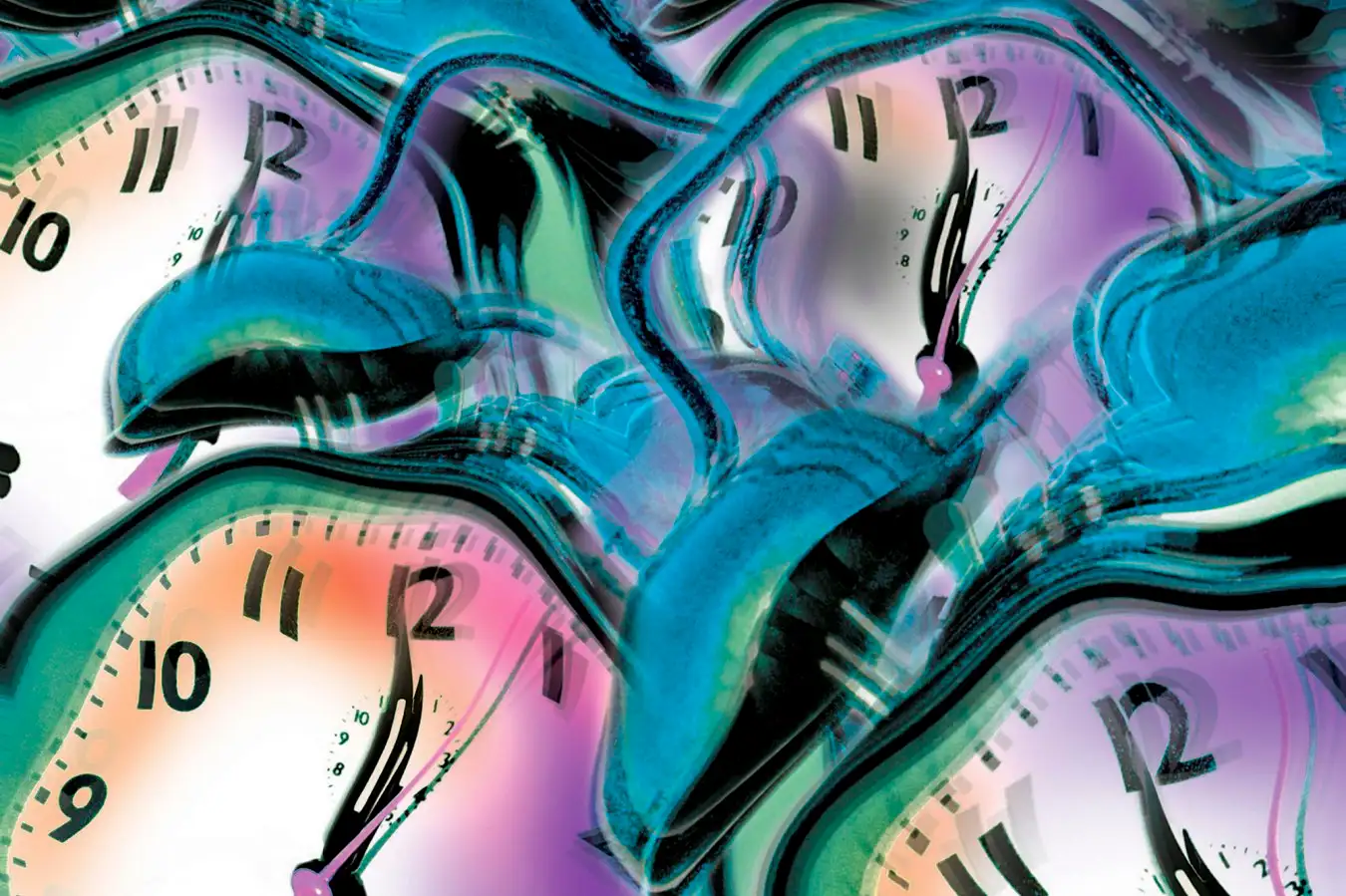
Time crystals are an oddity of quantum physics, but new calculations show that these bizarre materials could be useful for building very accurate clocks.
All crystals are defined by repetition – conventional crystals are made from atoms arranged in repeating patterns, and time crystals have a repeating structure in time. If you observe a time crystal for long enough, you will see it cycle through the same set of configurations over and over. Moreover, this cycling arises spontaneously, not because the material is forced to maintain it, but because that is its preferred phase, similar to how the preferred phase of water at low temperature is ice.
Ludmila Viotti at the Abdus Salam International Centre for Theoretical Physics in Italy and her colleagues have now shown that some time crystals could be a good building block for very accurate quantum clocks.
They mathematically analysed a system of up to 100 quantum mechanical particles, each of which had two distinct states determined by the property of quantum spin, similar to how a coin on a table has two distinct states determined by which side is facing up. The specific spin system that the researchers studied could become a time crystal or exist in a more conventional phase that didn’t spontaneously oscillate in time, and it could be used as a clock in either phase. The team calculated how the performance of the clock made from spins – its accuracy and precision – in the time crystal phase would compare with a clock made from spins in this “normal” phase.
“In the normal phase, if you want to resolve smaller intervals of time, you will lose accuracy exponentially. In the time crystalline phase, for the same resolution, you can get much higher accuracy,” says Viotti. Although the spin-based clock would normally become less accurate if you wanted to, for example, measure seconds rather than minutes, this didn’t happen if the spins formed a time crystal first.
Mark Mitchison at King’s College London says it isn’t surprising that a time crystal would be a promising starting point for making a clock, but a rigorous analysis of that advantage was missing until now. He and his colleagues previously proved that nearly any random sequence of events can be turned into a clock, but a system that has self-sustained oscillations provides a more clock-like structure from the start, he says.
“For about 10 years, we have known that time crystals can exist, but it is still unclear how to exploit them,” says Krzysztof Sacha at the Jagiellonian University in Poland. “Just as ordinary crystals can be used both for jewellery and for building computer processors, we would like time crystals to enable useful technologies as well.”
Time crystals are unlikely to overtake the current best clocks in the world, which are made from extremely cold atoms, he says, but they could still be an alternative to timekeeping based on satellite systems such as GPS, which can be disrupted by nefarious actors. Clocks built from time crystals could also become the basis of sensors for magnetic fields, since even tiny amounts of such fields would disturb the clocks’ ticks, says Mitchison.
Yet, a lot more work remains before time crystals can be used practically, says Viotti. For instance, her team’s spin system ought to be compared with other systems that behave as accurate clocks and tested in an experiment with actual spins, she says.
Topics:
Source link : https://www.newscientist.com/article/2514626-time-crystals-could-be-used-to-build-accurate-quantum-clocks/?utm_campaign=RSS%7CNSNS&utm_source=NSNS&utm_medium=RSS&utm_content=home
Author :
Publish date : 2026-02-10 17:00:00
Copyright for syndicated content belongs to the linked Source.