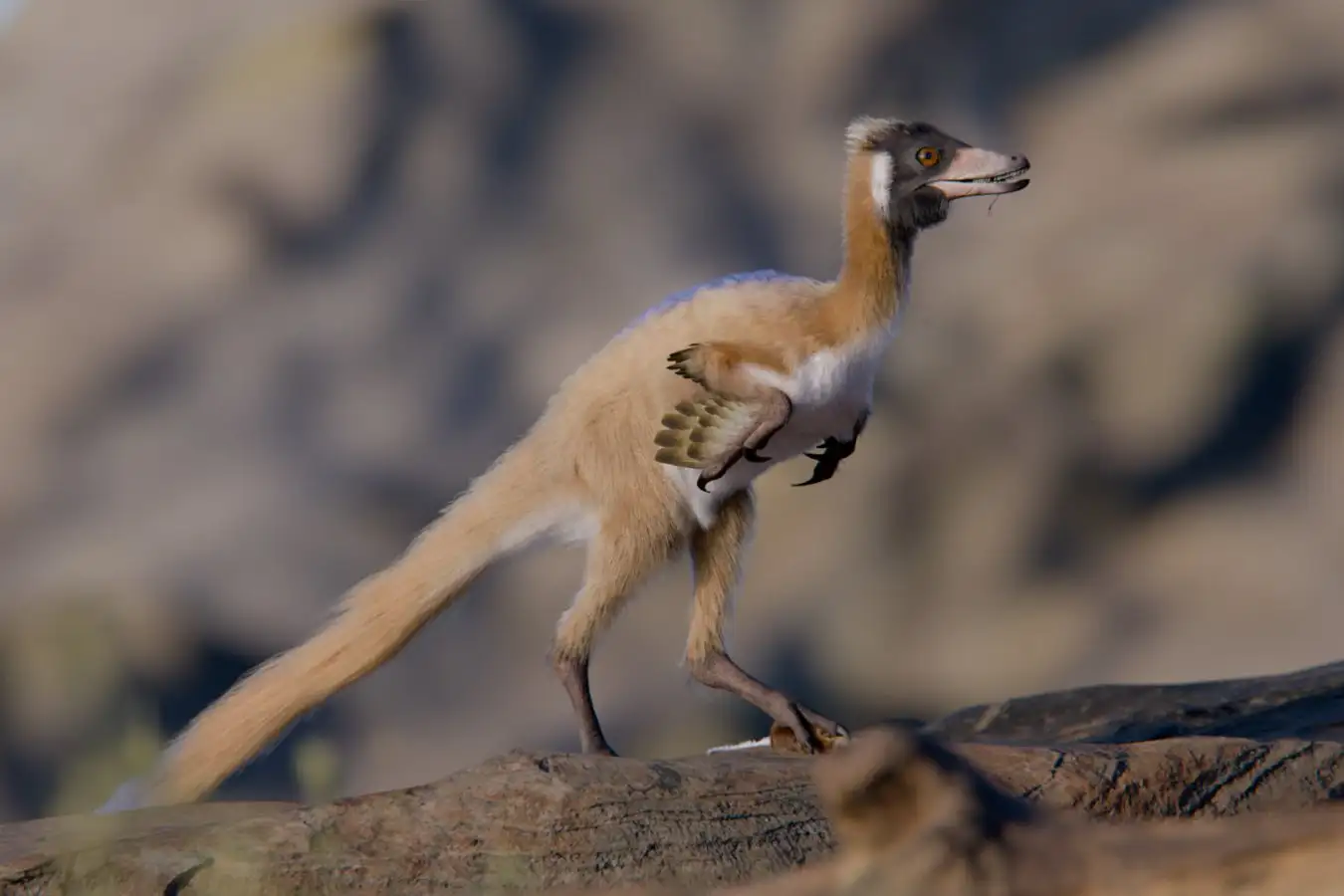
Reconstruction of Alnashetri cerropoliciensis
Gabriel Díaz Yantén, Universidad Nacional de Río Negro.
An almost-complete skeleton of a dinosaur that weighed less than a small chicken has provided new insights into the evolution of alvarezsaurs, which are among the smallest dinosaurs that ever lived.
The 95-million-year-old fossil of Alnashetri cerropoliciensis was found at the La Buitrera site in northern Patagonia, Argentina, in 2014.
The first specimen of Alnashetri, found in 2012, was a set of incomplete hindlimb bones, says Peter Makovicky at the University of Minnesota, who was part of the study on the new fossil. With only fragmentary remains, it was impossible to say more than that it was probably an alvarezsaur. “We were not even sure if it was a juvenile or fully grown,” he says.
“With a whole skeleton, we suddenly had all the information to understand how Alnashetri was similar or differed from other species, and a key to understanding how the unusual anatomy of alvarezsaurs evolved,” says Makovicky.
The new fossil has very long, slender hind limbs and surprisingly long forelimbs that retain three well-developed fingers. Detailed analysis of the fossil bones revealed the dinosaur was an adult and at least 4 years old.
It is estimated to have weighed only 700 grams when it was alive. “The specimen is truly tiny, smaller than a chicken,” says Mackovicky.
Alvarezsaurs were once thought to be early ancestors of birds. However, it is now clear that, while Alnashetri might have had some superficial resemblance to a bird, it and all the alvarezsaurs were, in fact, non-avian theropods. “The new discovery certainly underscores this,” says Mackovicky.
Previously, it was thought that all the tiny alvarezsaurs had very short, stout forelimbs with a large thumb but shrunken side digits, and tiny teeth. Palaeontologists thought these anatomical features evolved alongside their shrinking body size because they only ate ants and termites, says Makovicky. “But Alnashetri does not fit that mould – it is among the smaller alvarezsaurs, but neither its teeth nor its forelimbs are reduced, because it represents a much earlier branch on the alvarezsaur evolutionary tree.”
In fact, its forearms are more typical of other theropods rather than a specialist ant-eater, he says. “Alnashetri is tiny but is otherwise built like a more typical theropod – given its small size, it probably ate its fair share of invertebrates, but probably had a wider range of prey.”
That means palaeontologists still don’t fully understand why these dinosaurs became so small. “We’re left with only a vaguer sense that alvarezsaurs were successful at occupying the niches of very small predators,” says Mackovicky.
Topics:
Source link : https://www.newscientist.com/article/2517011-tiny-predatory-dinosaur-weighed-less-than-a-chicken/?utm_campaign=RSS%7CNSNS&utm_source=NSNS&utm_medium=RSS&utm_content=home
Author :
Publish date : 2026-02-25 16:00:00
Copyright for syndicated content belongs to the linked Source.