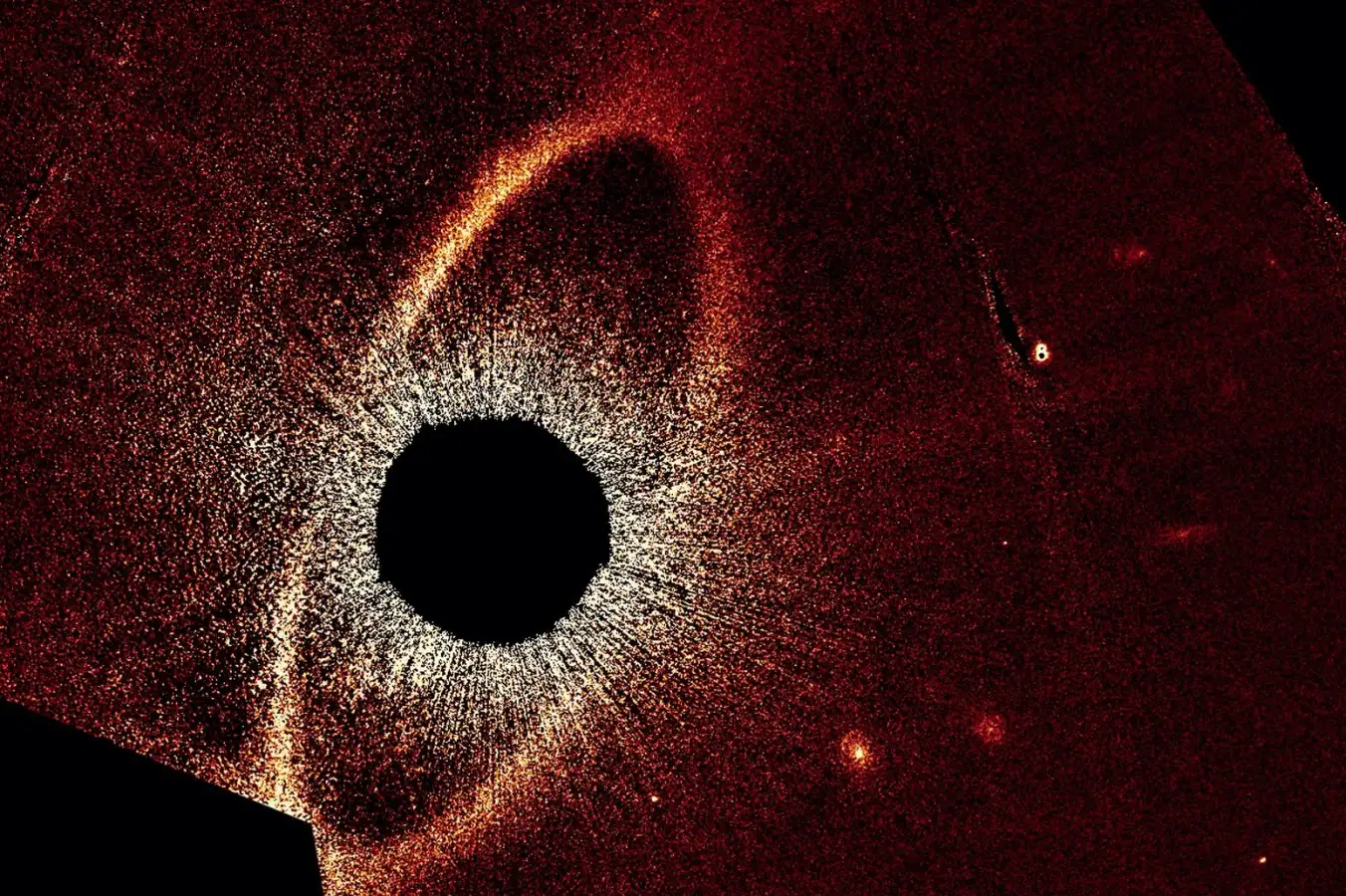
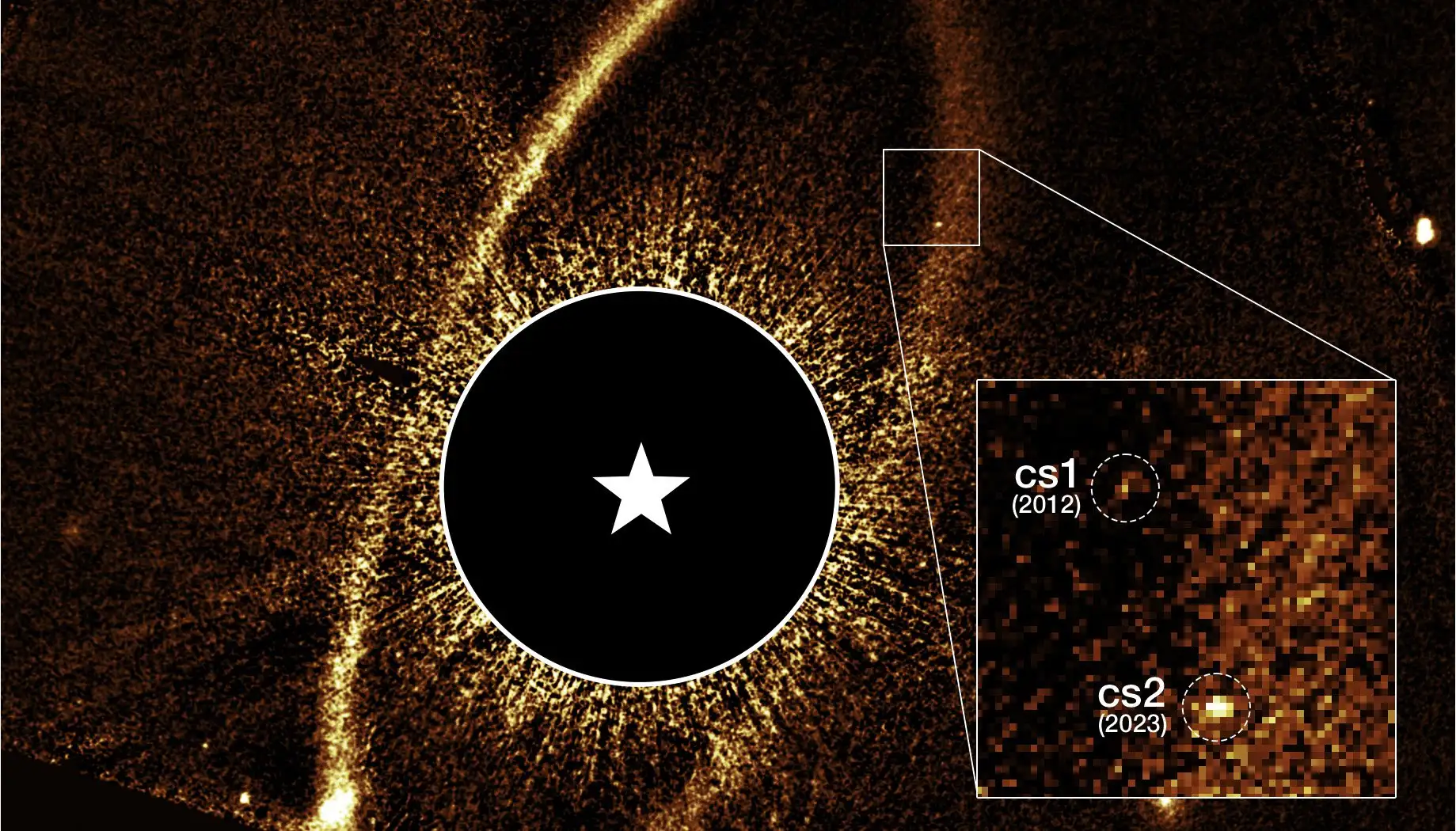
A composite image of the dust belt around Fomalhaut (obscured in the middle). In the inset, dust cloud cs1, imaged in 2012, is pictured with dust cloud cs2, imaged in 2023
NASA, ESA, Paul Kalas/UC Berkeley
Around the nearby star Fomalhaut, asteroids are smashing into each other in a series of cosmic cataclysms, creating huge clouds of dust. For the first time, astronomers are watching one of these collisions as it occurs, which could provide a window into the early days of our own solar system.
Fomalhaut has a history of strange observations: in 2008, Paul Kalas at the University of California, Berkeley, and his colleagues reported what seemed to be a giant planet in orbit around the young star, based on observations with the Hubble Space Telescope made in 2004 and 2005. Over the years, though, as more observations have rolled in, researchers have hotly debated over what this strange object, called Fomalhaut b, might be. It was either a planet a bit larger than Jupiter, or a cloud of debris.
Now, Kalas and his team have used Hubble to look at Fomalhaut once again. “In 2023, we used the same instrument we’d used [before], and we did not detect Fomalhaut b – it wasn’t visible anymore,” says Kalas. “But what really shocked us was [that] there was a new Fomalhaut b.”
This new bright spot, called Fomalhaut cs2 (short for “circumstellar source”), couldn’t be a planet, or it would have been seen sooner. The best explanation is that it is a cloud of dust created by the collision of two large asteroids, or planetesimals, each around 60 kilometres in diameter. The disappearance of Fomalhaut b hints that it was probably a similar dust cloud all along.
“These sources are noisy and erratic, so we’re still some ways off a firm conclusion,” says David Kipping at Columbia University. “But, all of the evidence to date seems to fit neatly under the umbrella explanation of collisions between proto-planets in a nascent system.”
Spotting two such smash-ups is unexpected, though. “Theory dictates that you shouldn’t see these collisions except once every 100,000 years or rarer. And yet, for some reason, we’ve seen 2 events in 20 years,” says Kalas. “Fomalhaut is sparkling like a holiday tree, and that is a surprise.”
It may mean that collisions between planetesimals are more common than we had thought, at least around relatively young stars like Fomalhaut. Kalas and his colleagues have more observations scheduled over the next three years with both Hubble and the more powerful James Webb Space Telescope (JWST) to watch how Fomalhaut cs2 behaves moving forward and to try to find the now-dimmer Fomalhaut b.
This is a unique opportunity to study these collisions in real time. “We no longer have to depend solely on theory to understand these violent impacts; we can actually see them,” says Kalas. More observations could teach us not just about young planetary systems in general, but also about our own early solar system and where it fits in the cosmic menagerie.
“We’ve long wondered if the moon-forming impact was typical or not beyond our cosmic shore, and here we see compelling evidence that collisions are par for the course,” says Kipping. “Perhaps we’re not as unusual as some have speculated.”
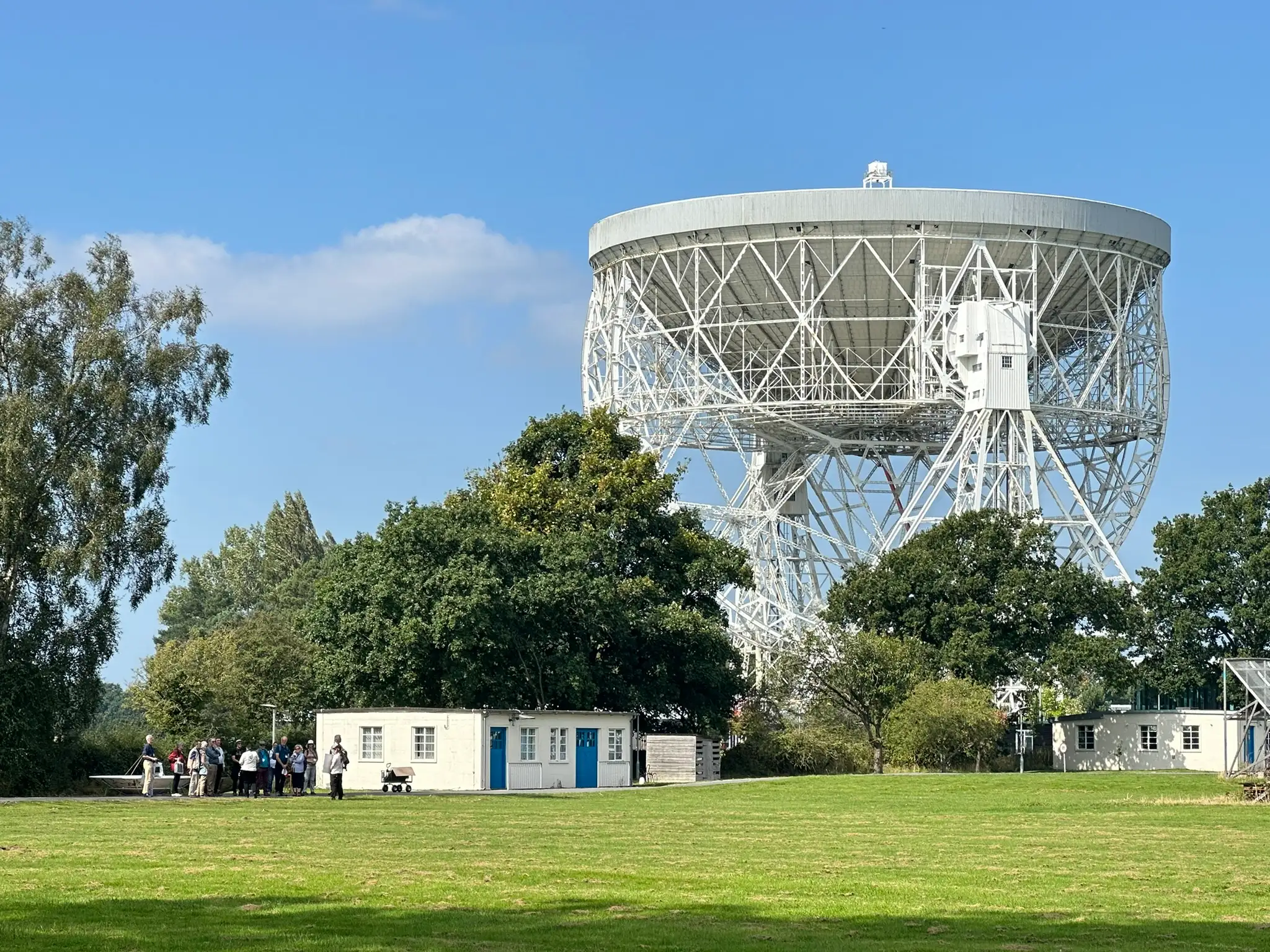
Mysteries of the universe: Cheshire, England
Spend a weekend with some of the brightest minds in science, as you explore the mysteries of the universe in an exciting programme that includes an excursion to see the iconic Lovell Telescope.
Topics:
Source link : https://www.newscientist.com/article/2509086-two-asteroids-crashed-around-a-nearby-star-solving-a-cosmic-mystery/?utm_campaign=RSS%7CNSNS&utm_source=NSNS&utm_medium=RSS&utm_content=home
Author :
Publish date : 2025-12-18 19:00:00
Copyright for syndicated content belongs to the linked Source.