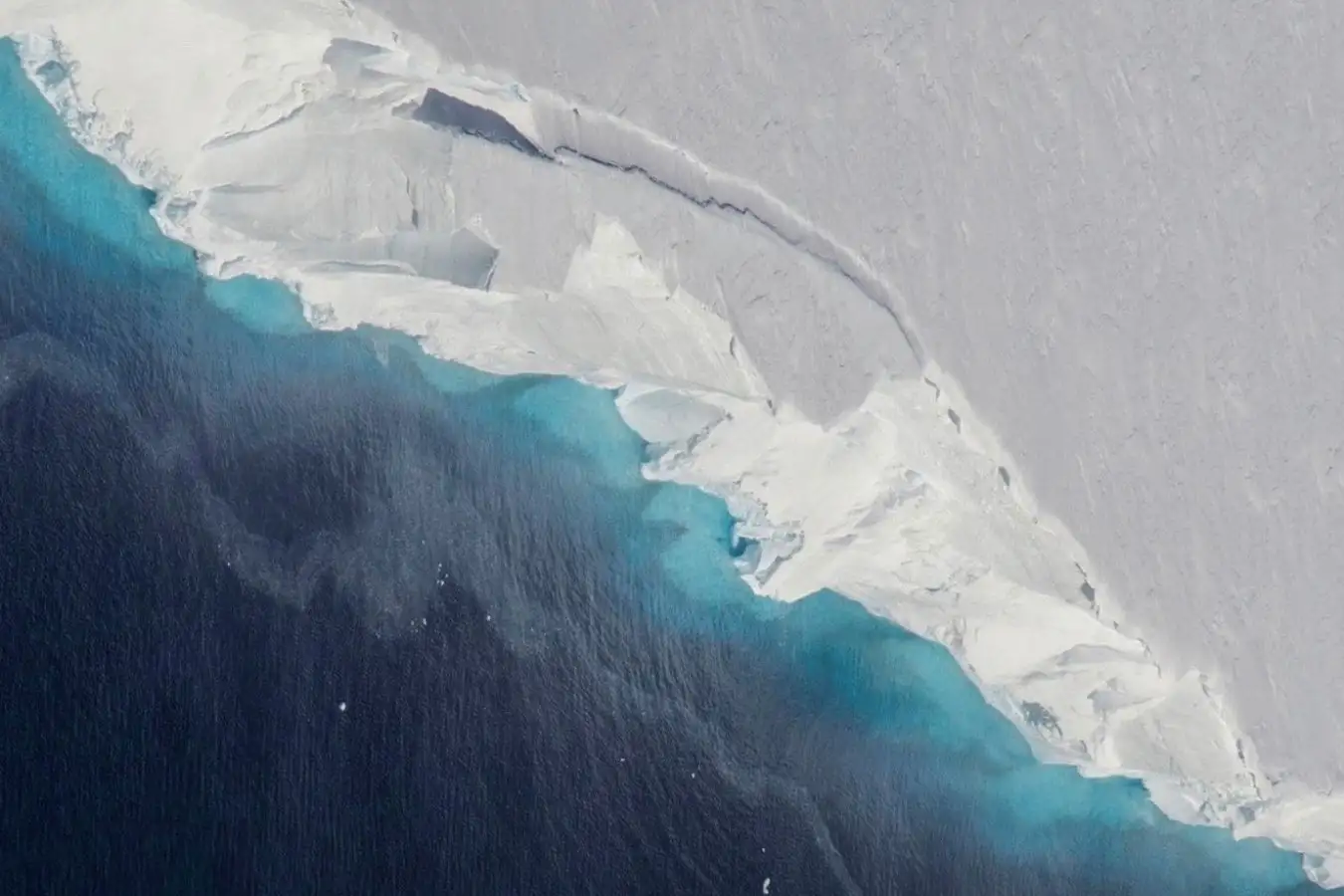
The Thwaites glacier in West Antarctica
NASA/ZUMA Wire/Shutterstock
Underwater “storms” are melting the ice shelf protecting the Thwaites “doomsday” glacier in Antarctica, raising concerns that we could be underestimating future sea level rise.
Up to 10 kilometres wide – making them “submesoscale” features – these storm-like vortices start swirling when waters of different density or temperature collide in the open ocean, much like hurricanes forming through the mixture of air bodies in the atmosphere. And like hurricanes, some of them barrel towards the coast, which in Antarctica is largely made up of ice shelves – the floating extensions of glaciers that stick dozens of kilometres out into the sea.
“They have so much motion, and they’re really hard to stop,” says Mattia Poinelli at the University of California, Irvine. “So the only way they could go is just get trapped under the ice.”
Poinelli and his colleagues’ modelling showed that these submesoscale features were responsible for one-fifth of the total melt of the Thwaites and neighbouring Pine Island ice over nine months. It is the first study to quantify the impact of these storms across an entire ice shelf.
Ice shelves slow glaciers’ slide into the sea and protect them from wave erosion. The vulnerable Thwaites glacier loses 50 billion tonnes of ice each year and could raise sea levels 65 centimetres if it collapsed.
In the waters around Antarctica, several hundred metres of colder, fresher water sit on top of warmer, saltier deep water. If a storm becomes trapped in the cavity under an ice shelf, its whirling pushes the cold surface water outwards away from the centre of the vortex, drawing warm deep water up into the resulting void and melting the ice shelf from the bottom up.
This sets off a feedback loop, in which the cold, fresh water released by that melt interacts with the warm, salty water to intensify the spinning of the underwater storm, causing even more melting.
In 2022, a deep-water float measuring temperature, salinity and pressure was “captured” by a large spinning eddy that became trapped beneath the Stancomb-Wills ice tongue at another point along the Antarctic coast. With the data later gathered from the captured float, Cathrine Hancock at Florida State University and her colleagues estimated that eddies cause 0.11 metres of melt under that ice tongue each year.
“It shows that the concept of an eddy spinning down underneath an ice shelf is important,” says Hancock.
The smaller submesoscale storms in the Poinelli study are likely having a similar effect, she says – which suggests swirling bodies of water at a range of scales are melting significant amounts of ice. “Those have to be better quantified,” says Hancock.
As the climate warms and more fresh meltwater pours off Antarctica, underwater storms are likely to intensify, which could potentially cause more sea level rise than we currently expect.
Tiago Dotto at the UK National Oceanography Centre says the “astonishing” new results call for more observations from under ice shelves.
“Given the current changes in the wind pattern and sea ice around Antarctica, how much are we actually missing by not observing these small scales?” he asks.
Topics:
- climate change/
- Antarctica
Source link : https://www.newscientist.com/article/2505394-undersea-storms-are-melting-the-doomsday-glaciers-ice-shelf/?utm_campaign=RSS%7CNSNS&utm_source=NSNS&utm_medium=RSS&utm_content=home
Author :
Publish date : 2025-11-21 15:00:00
Copyright for syndicated content belongs to the linked Source.