
Nelson Dellis holds his trophy after winning the annual USA Memory Championships in New York in 2011
DON EMMERT/AFP via Getty Images
Nelson Dellis is a six-time US memory champion who once memorised the order of a shuffled deck of cards in 40.7 seconds and knows the first 10,000 digits of pi. Now, scientists have studied his brain in unprecedented detail, revealing how he achieved such feats and how we can acquire some of the same skills.
Dellis claims he had an average memory until around 25 years old, when his grandmother’s decline from Alzheimer’s disease inspired him to start memory training for hours every day, including memorising numbers, names and words. “I still train my memory regularly,” he says. “It’s like a muscle; if you don’t use it, it fades.”
While memory impairment – like that which occurs with dementia – has been widely studied, less is known about people with extraordinary memory. To address this gap, researchers – including scientists at Washington University in St. Louis, Missouri – have turned to Dellis.
Dellis had his brain extensively scanned for a total of around 13 hours in 2015 and 2021 while he rested and was tested on his memory. In one of the tests, Dellis was asked to repeatedly remember a set of four to seven words that each flashed on a screen for just over 1 second. He was told to use rote memorisation, a technique that involves repeating things over and over to make them stick.
“You’re lying still in a scanner trying to memorise things, which is not exactly how I normally train, but it was really cool to be part of something that’s trying to bridge the gap between what memory athletes do and what science can measure,” says Dellis. His brain activity was then compared with that of two scientists, who acted as the controls and were deemed to have very good – but not extraordinary – memories.
The Washington University in St. Louis researchers have now analysed this data, and found that Dellis and the controls had similar brain activity during the task. Across all three individuals, electrical signalling increased in their retrosplenial, extrastriate visual and dorsal frontal cortices, which are linked to navigation, visual information and working memory, respectively. But Dellis doesn’t generally use rote memorisation. “Rote memorisation is a terrible approach to memorising, but it’s what most people know how to do,” he says.
To step things up, another task – which was done only by Dellis – involved him memorising the order of a shuffled deck of cards while his brain was scanned. This time, Dellis employed the method of loci, also known as a memory palace. This involves associating information with specific locations, such as within your house, and then mentally walking through it to recall the information in order. “That simple shift, from abstract to visual, is the foundation of almost every memory technique I use,” says Dellis.
This fired up activity in the same three cortices, but changed activity in his hippocampus, a curved structure deep in the brain that is critical for memory. In the first task, his hippocampal activity was greater during encoding – the process of taking in new information and linking it to existing knowledge – than during recall. But this was reversed in the second task, which also activated Dellis’s caudate nuclei – C-shaped structures that are involved not only in memory, but also in learning. The researchers, who declined to be interviewed, speculated that the involvement of the caudate nuclei makes memory a “consolidated skill”.
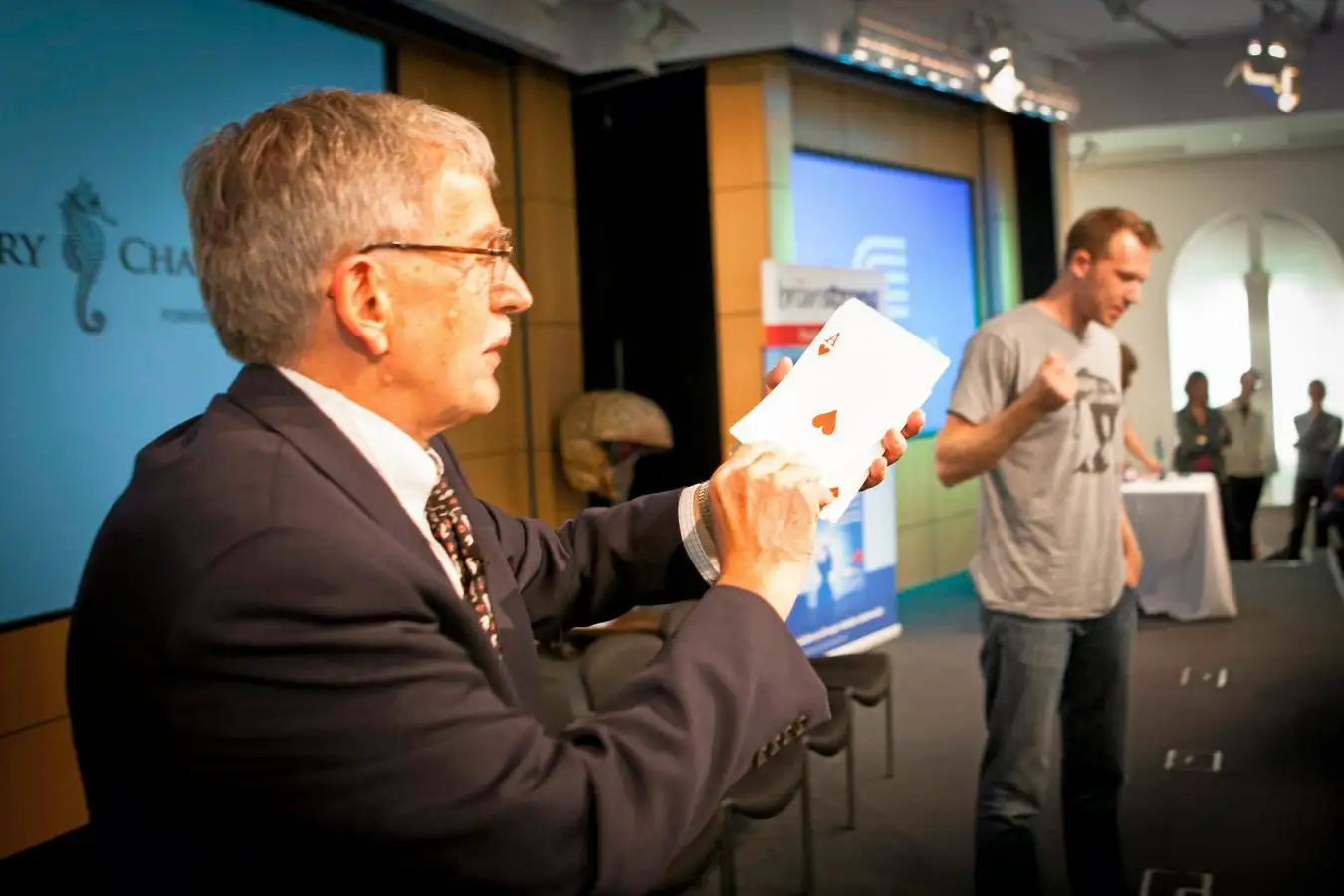
Dellis (right) after winning the championships in 2012, where he recited the order of 104 playing cards
Nelson Dellis
Finally, they compared Dellis’s brain activity with that of 887 participants of the Human Connectome Project. The team found that the memory champion had much greater functional connectivity, which refers to how different brain regions coordinate their activity, indicating that these regions are working together efficiently.
Dellis and others think that the method of loci should be used more broadly. “Given the very clear behavioural benefit, it is somewhat surprising that techniques such as the method of loci are not more widely used in educational and clinical settings,” says Martin Dresler at Radboud University Medical Center in the Netherlands.
Dresler adds that this technique may be particularly effective because it taps into our evolved strengths. “The reason why the method of loci works so well is probably because it translates abstract information into visuo-spatial information,” he says. “Our brains did not evolve to memorise numbers or playing cards or dates or even something as abstract as language, but we evolved to find our way through nature to the next food source and know where to avoid predators. So we’re very good at visuo-spatial settings and finding our way through nature, and that is exactly what the method of loci does.”
But Craig Stark at the University of California, Irvine, says it is unclear to what extent others can use this technique to even approach the level of Dellis’s extraordinary memory. “We don’t have a good handle on which aspects are training-derived and which are just him. They’re not looking at [the effects of] training or at strengthening. They’re looking at him.”
If memory training feels too intense to squeeze into your routine, Dellis also credits his skills to a healthy lifestyle, including exercising regularly. “For better everyday memory, do what your mother told you — pay attention, eat well, sleep well and exercise,” adds Morris Moscovitch at the University of Toronto in Canada.
Topics:
Source link : https://www.newscientist.com/article/2521782-unprecedented-insight-into-memory-champions-brain-reveals-his-tricks/?utm_campaign=RSS%7CNSNS&utm_source=NSNS&utm_medium=RSS&utm_content=home
Author :
Publish date : 2026-04-02 14:00:00
Copyright for syndicated content belongs to the linked Source.