
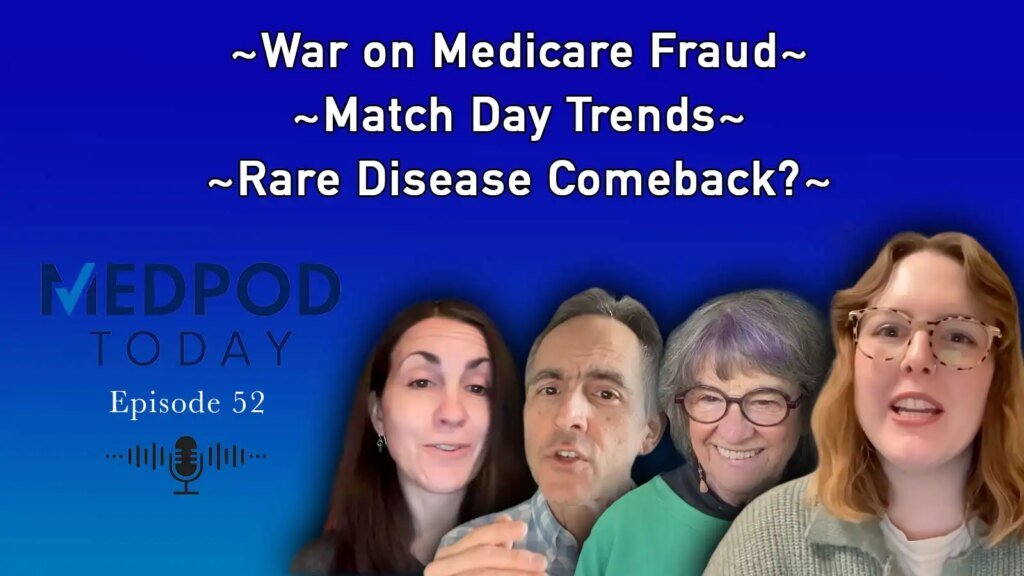
The following is a transcript of the podcast episode:
Rachael Robertson: Hey everybody, welcome to MedPod Today, the podcast series where MedPage Today reporters take a deeper look into the week’s biggest healthcare stories. I’m your host, Rachael Robertson.
First up today is Joedy McCreary with a story on how CMS Administrator Mehmet Oz, MD, MBA is handling Medicare and Medicaid fraud. Then Kristina Fiore will tell us about Match Day 2026 trends. And lastly, Cheryl Clark is in the studio with reporting on a rare disease that may be popping up tied to increasing vaccine hesitancy.
Rooting out fraud in Medicare and Medicaid has been a government priority for decades, but the current administration is taking a very different and very public approach to the fight. MedPage Today reporter Joedy McCreary has been looking into whether the substance matches the show.
So Joedy, can you tell us what’s happening there?
Joedy McCreary: Sure. So CMS Administrator Mehmet Oz has been very visible on social media about this. There are viral clips of him in a “war room” with analysts, or rolling through California neighborhoods pointing out what he calls fraud hot spots, or clips that talk about Miami Vice. At the very least, I’d call it cinematic. But experts I spoke to say the underlying work — we’re talking investigations, recoveries, enforcement — has actually been happening at scale for years.
In the last fiscal year, the Department of Justice reported a record amount of settlements under the False Claims Act, nearly $7 billion worth. In just the 6 months ending last September, the inspector general’s office at HHS generated an impact of about two and a half billion dollars. Now that’s before most of Oz’s public campaign had fully taken hold. For every dollar spent, that’s $12.70 back.
So the machine was already running. But what’s new is who’s in front of the camera.
Robertson: What is actually different about how they’re going after fraud now?
McCreary: Well, the biggest change is a move away from what they’d call the pay-and-chase model. That’s where the government pays claims first and recovers money later. Now, what CMS wants to do is flag suspicious billing patterns before payment goes out. But even that idea isn’t entirely new. A law passed in 2010 under former President Barack Obama directed CMS to put in place that kind of preemptive fraud detection. It’s the same kind of algorithm that credit card companies use. CMS never fully did it because they were afraid of denying legitimate claims.
And the most concrete example of the new approach is a 6-month freeze that Oz put on new Medicare enrollments for suppliers of durable medical equipment (DME)–those are things like wheelchairs or orthotics. That’s a persistent fraud hotspot. Now, in fact, in its largest ever fraud takedown last year, the HHS inspector general’s office linked criminal organizations to more than $10 billion in DME claims it says were fraudulent.
But this administration does have one advantage over the others: AI. Advances in artificial intelligence have made it genuinely easier and faster to spot patterns in billing data that would have taken investigators much longer to find manually.
Robertson: Is it working? And is any of this politically motivated?
McCreary: At this point it’s too soon to say. The record DOJ numbers are real, but experts caution that a lot of the work started before Oz took over, and it’s hard to say what success will look like in the future.
Now, on the political question, the administration has frozen more than $200 million in Medicaid funding to Minnesota and is cracking down on programs in New York. Those are both Democratic-led states. Now, Democrats say it’s targeted, but I spoke to an expert who says the administration is making it somewhat political, but those issues could exist in any state and they should be investigated.
The other open question has to do with continuity. President Donald Trump removed the previous HHS inspector general early in his term. Now the new one is a Republican attorney, and whether the anti-fraud measures hold up under new leadership is something we’re going to be watching.
Robertson: Thank you so much, Joedy.
McCreary: Thanks, Rachael.
Robertson: Match Day 2026 has come and gone, and it proved challenging for some groups more than others. That includes family medicine and international medical graduates, or IMGs. Kristina Fiore is here to tell us more about the data that was released last Friday.
Kristina, let’s start with IMGs. What happened this year?
Kristina Fiore: Yeah. So as you know, Rachael, there have been a lot of changes to U.S. immigration policy in the past year, and that includes a $100,000 application fee for an H-1B visa, which is the main visa used by medical residents coming in from other countries. Now, while the number of noncitizen IMG applications was actually up this year, their match rate fell to 56.4% which is the lowest it’s been in 5 years. This was especially low for those who required visa sponsorship. They had a PGY-1 match rate of 54.4% compared to 67.9% for those who didn’t require a visa sponsorship.
Brian Carmody, MD, MPH, who reports extensively on the Match and medical education through his blog, Sheriff of Sodium — he’s a pediatric nephrologist, that’s where the sodium part comes in — he had this to say about the low match rates among noncitizen IMGs: “I think it shows you that program directors are a little bit risk avoidant for those issues. Residency works on a fixed timeline, and programs need their applicants to be physically present and oriented and credentialed so that they can get to work on July 1.”
Now, there is an exemption in the works in Congress to get out of that $100,000 fee for healthcare workers. Our colleague Jennifer Henderson reported on this last week, and if that passes, that may change things for noncitizen IMGs in next year’s Match.
Robertson: What about family medicine?
Fiore: Family medicine had 899 positions go unfilled this year. That’s 16% of the 5,491 available positions. Apparently, the rate of unfilled spots has been increasing over the past few years in family medicine, so there’s some concern about what’s happening to the specialty.
Carmody said that what can happen usually is that one year, you’ll see a big percentage of positions go unfilled in the specialty, but then there will be a correction in the years following. He gave the example of emergency medicine, which had 18% of positions unfilled in 2023 but that number has rebounded since then — I think it was about 4% this year. That’s not what’s happening with family medicine. So the National Resident Matching Program (NRMP) itself said that it’s creating a “blue ribbon panel” of family medicine leaders to better understand what’s going on.
After the story, I spoke with Shawn Martin, who’s the CEO of the American Academy of Family Physicians, and he said that family medicine has received government funding to expand positions over the past several years. They’ve done that, and they’ve actually, over time, increased the family medicine workforce. He told me it’s grown about 50% over the last decade or so. But Carmody thinks the interest just hasn’t kept up. Nonetheless, all of these open spots in family medicine will likely fill in the SOAP. So we’ll have to come back again in a few months when the final numbers are in to see how that’s going.
Robertson: What are some of the other highlights from Match Day 2026?
Fiore: Aside from family medicine, other primary care programs showed strength, including internal medicine and pediatrics. About 95% of internal medicine and 94% of pediatrics positions filled. Psychiatry had a very strong showing, with more than 97% of its positions filled. It appears that more and more DOs are choosing psychiatry.
And the overall numbers are always interesting. So about 48,000 candidates submitted a rank order list. They were competing for about 44,000 open positions, and ultimately a total of about 41,500 PGY-1 and PGY-2 positions were filled.
Both MD and DO seniors had a match rate of about 93%, which is very good. And finally, there are almost 2,600 positions offered in the Supplemental Offer and Acceptance Program, or SOAP, which I mentioned earlier. Most of those usually fill up, and we will get to see all final numbers in just a few months.
Robertson: Thanks for this update, Kristina.
Fiore: Thanks, Rachael.
Robertson: This week, we heard about yet another very rare disease, this one in children, that may be popping up more around the country because parents are increasingly mistrusting vaccines. Cheryl Clark is here to tell us more.
Cheryl, what new disease are we talking about here?
Cheryl Clark: Well, Rachael, it’s not really a new disease, which is the saddest part of this story, because we know how to prevent it. It’s a contagious bacterial infection that used to affect 20,000 young children a year, killing 1,000 of them. Physicians told me that it was quite common to be doing two or three spinal taps a day in the emergency room when children came in with suspected meningitis caused by this bacteria. And there are a variety of other symptoms that physicians knew to be associated with this and they could rapidly work to treat it.
Now, the bug, if you will, is Haemophilus influenzae type b, or Hib. In 1987 a vaccine targeting Hib became available, and physicians began vaccinating children. It’s a three- or four-course vaccine. Rapidly, cases dropped to around 50 a year. But fast forward to today. There’s a nervous concern among a lot of pediatricians that we’re about to be slammed with more cases, still in small numbers, but younger clinicians might not recognize this and won’t know how to treat it.
Robertson: How do we know that Hib is really coming back and that this isn’t just anecdotal stories?
Clark: Well, I don’t think anybody is really sure. But here’s the thing — in a small community of Panama City, Florida, there were two serious cases in children within the last 6 months, both unvaccinated. One died, and one apparently was near death. Now, Paul Offit, MD, a renowned pediatrician and vaccine expert, coincidentally was giving a talk to a group of Florida doctors this month, and one of them mentioned the two cases. So he’s thinking, we’re supposed to get two deaths a year and 50 cases, and here we have two cases in one town in 6 months. What is going on?
So he wrote a column about all of this in his Substack. In response, other doctors started reporting cases. We’ve since heard of severe cases in Tennessee, New York City, and in California. I asked the California Department of Public Health, and they sent me about a dozen cases, and at least one child has died. Now that’s about a dozen cases over several years, but still.
Robertson: What else did Dr. Offit say?
Clark: He and several other pediatricians I’ve talked with told me they fear that the CDC — which should be sending out alerts about this if it’s real — is just not paying attention, or maybe clinicians just aren’t recognizing what this is because they’ve never seen it before. And we know the CDC has cut way back on surveillance and statements from HHS Secretary Robert F. Kennedy Jr. have cast doubt on vaccine efficacy. We know some parents are increasingly refusing to vaccinate their children in the incorrect belief the vaccines could cause harm. By the way, I did ask the CDC, you know, have you seen a surge in cases? And the answer came back, no, still about 50 a year.
But Dr. Offit isn’t convinced. He’s especially concerned that emergency responders won’t recognize this illness either. It can cause swelling of the epiglottis, and if that happens, putting the child in an ambulance, allowing them to have stress could cause them to suffocate.
The other thing is that family members or others exposed, once you know that they are exposed, should be given antibiotic prophylaxis. I spoke with Eehab Kenawy, MD. He’s the pediatrician in Panama City who practices in the hospital where these two children were treated. And I’ll leave you with this chilling quote from him:
“Now I have to worry about Hib, treating patients from out of town who aren’t vaccinated … and worry about all sorts of things you don’t know until the blood culture or spinal tap results come back or God forbid, the child dies.”
Robertson: Thank you, Cheryl.
Clark: Thank you, Rachael.
Robertson: And now for our measles update. There were 85 cases last week and 121 the week prior. Utah is the state to watch right now, with 45 new cases last week and 47 the week before – a total of 464 cases overall. The state is still reeling from transmission tied to the Utah State High School Wrestling Championship back in February. If you want a deeper look at the data, check out our map linked here.
That is it for today. If you like what you heard, leave us a review wherever you listen to podcasts and hit subscribe if you haven’t already, I’ll see you again soon.
This episode was hosted and produced by me, Rachael Robertson. Sound engineering by Greg Laub. Theme music by Palomar. Our guests were MedPage Today reporters Joedy McCreary, Kristina Fiore, and Cheryl Clark. Links to their stories are in the show notes.
MedPod Today is a production of MedPage Today. For more information about the show, check out medpagetoday.com/podcasts.
Please enable JavaScript to view the comments powered by Disqus.
Source link : https://www.medpagetoday.com/podcasts/anamnesis/120517
Author :
Publish date : 2026-03-27 13:17:00
Copyright for syndicated content belongs to the linked Source.