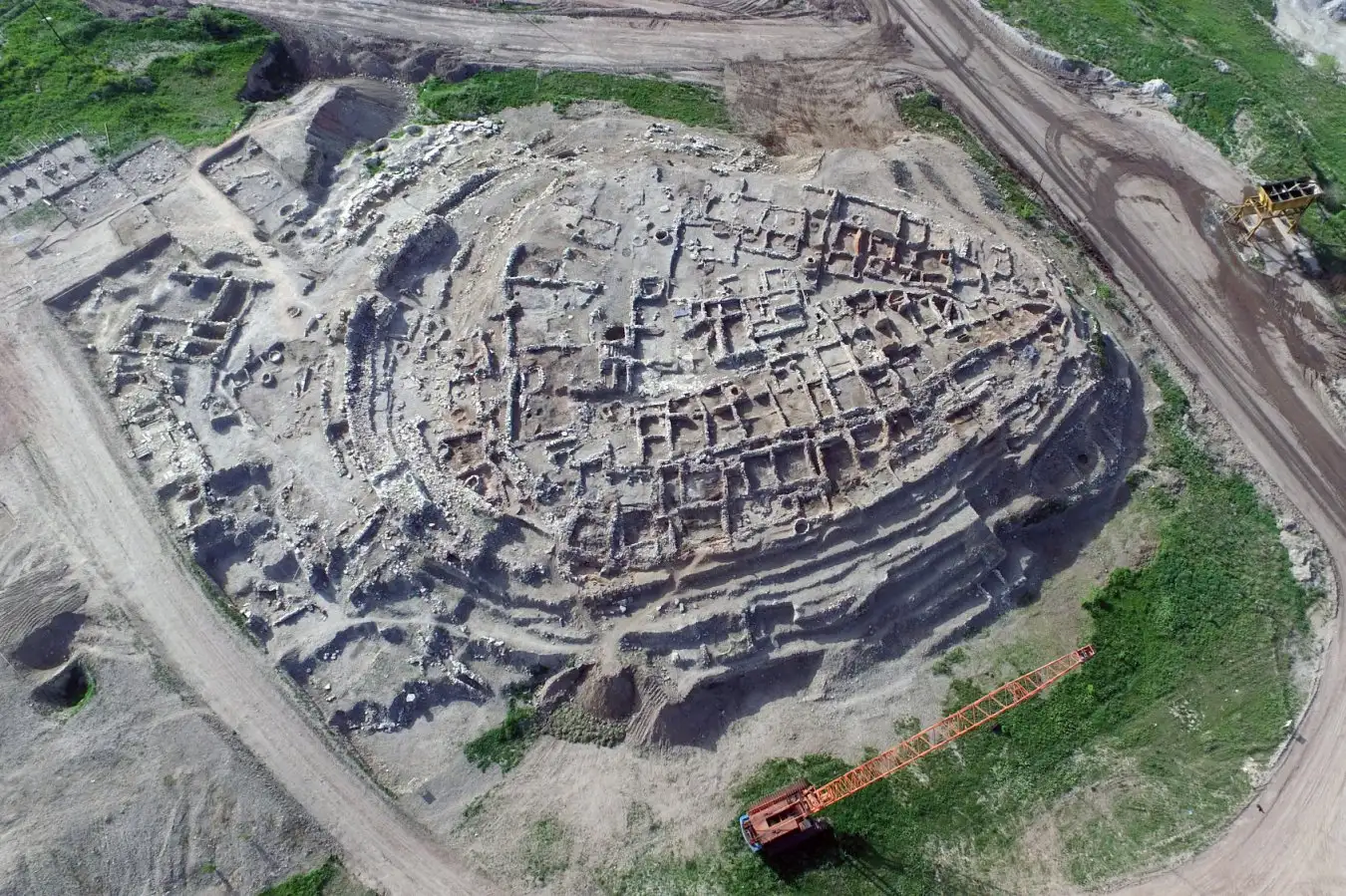
The archaeological site of Seyitömer Höyük in western Turkey represents a typical Luwian settlement
Turkish Ministry of Culture and Tourism, General Directorate of Cultural Heritage and Museums, Department of Excavations and Research; Luwian Studies #0255
A survey of archaeological sites in western Turkey has identified hundreds of large towns that thrived there during the Bronze Age – potentially supporting the controversial idea that the area was home to a major political power that destabilised the eastern Mediterranean about 3200 years ago.
Traditionally, researchers have identified several major Bronze Age civilisations that coexisted in the eastern Mediterranean between about 2000 and 1200 BC. These included the Ancient Egyptians, the Mycenaean Greeks and – in what is now central Turkey – the Hittites.
But Eberhard Zangger, president of Luwian Studies, an international non-profit foundation, has long suspected that researchers have missed something. He thinks there were a number of powerful states in western Turkey too, sandwiched between the Hittites to the east and the Mycenaeans to the west.
A decade ago, Zangger presented evidence from satellite images confirming that there are plenty of archaeological sites in western Turkey that could fit with his hypothesis. But it wasn’t clear from the images exactly when those sites were occupied.
For the past 10 years, Zangger and his colleagues have been reading through Turkish language excavation reports from some of the sites, and visiting many of them in person, to get a better sense of their occupational history.
They focused on large sites – those with a diameter of at least 100 metres – at which archaeologists have found Bronze Age pottery. A database published today provides details of 483 sites scattered across western Turkey that meet both criteria. “We are looking at settlements each with several hundred people who lived there for many centuries,” says Zangger.
He suspects that the settlements were organised into a series of small states, which he collectively refers to as the Luwian states. This invites comparisons with the Mycenaean civilisation, which also appears to have been organised into a series of small states, each with its own palace and its own king. These states have largely gone unrecognised, says Zangger, because Turkish excavators tended to focus on understanding individual sites rather than exploring their regional context.
The idea that there were small but important states in the region isn’t completely incompatible with existing evidence. “There was a major kingdom called Arzawa in western Anatolia,” says Guy Middleton at Newcastle University, UK, who wasn’t involved in the research. “The king of Arzawa corresponded with Pharaoh [Amenhotep III] and was referred to as a ‘Great King’ – one of the gang – at a time when the neighbouring Hittites were in a slump.”
But we are still lacking much archaeological evidence from Arzawa and other Luwian states, says Zangger. He thinks this is partly because many of the sites associated with these states continued to be occupied long after the Bronze Age, so the Luwian levels are buried beneath plenty of younger archaeology. “It takes you years, even decades of excavation before you get to the Bronze Age levels,” he says.
Ian Rutherford at the University of Reading, UK, points out that “Luwian” was the term the Hittites used to describe people in western Anatolia – but whether all of the people living there were Luwian or whether there were non-Luwian cultures there too, we can’t say without more evidence. “I’m sceptical,” he says.
Most controversially of all, Zangger suggests the Luwian states occasionally formed a grand political coalition powerful enough to fight against the eastern Mediterranean’s more familiar Bronze Age civilisations. He even suspects that a Luwian coalition led to the collapse of the Hittite civilisation about 3200 years ago – and an attack on Ancient Egypt at roughly the same time. A mysterious group dubbed the Sea Peoples is often implicated in these events, and Zangger thinks they were Luwians. Many other researchers, including Middleton, argue that the story of the Sea Peoples and the collapse of Bronze Age civilisations is more tangled and complicated.
However, Zangger thinks there is support for his idea in an unlikely place: the ancient Greek legend of the Trojan war, which is set in the Late Bronze Age. In that story, tens of thousands of Mycenaean Greeks are said to have fought a decade-long war at Troy – a site in one of the Zangger’s proposed Luwian states.
He points out that the story reads oddly if we assume that the large Greek army needed 10 years to overcome one relatively small city. He thinks the story spread in the centuries immediately following the Bronze Age because audiences at the time were aware that it referred to a larger battle between the Greeks and a powerful coalition of soldiers drawn from several Luwian states. “Fiction has to make sense,” says Zangger.
Scientific pioneers of the ancient world, Cairo and Alexandria: Egypt
Embark on an unforgettable journey through Egypt’s two most iconic cities, Cairo and Alexandria, where ancient history meets modern charm.
Topics:
Source link : https://www.newscientist.com/article/2506343-was-a-little-known-culture-in-bronze-age-turkey-a-major-power/?utm_campaign=RSS%7CNSNS&utm_source=NSNS&utm_medium=RSS&utm_content=home
Author :
Publish date : 2025-12-01 10:00:00
Copyright for syndicated content belongs to the linked Source.