Mysterious radiation from the outer part of the Milky Way could be a sign of dark matter
Triff/Shutterstock
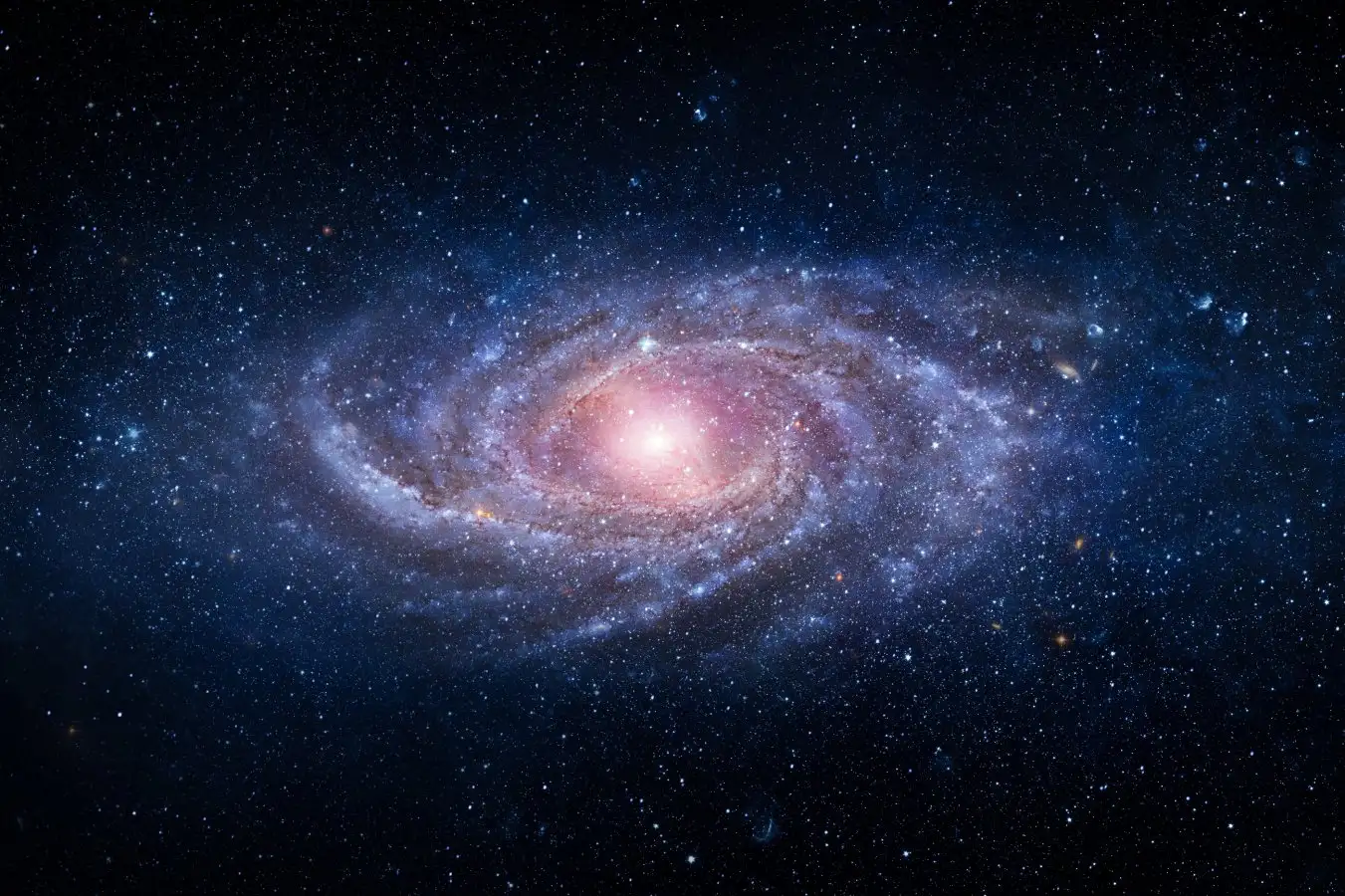
An unexplained glow that appears to emanate throughout the Milky Way’s outer regions could be our first hint of what dark matter is made of, but astronomers say it is too early to know for sure.
Dark matter is thought to make up 85 per cent of all mass in the universe, but physicists have never been able to detect the particles that constitute it.
One leading candidate for dark matter is a ghostly object called a weakly interacting massive particle (WIMP). These hypothetical particles are fiendishly difficult to detect because they interact so rarely with regular matter, but theorists predict that they should occasionally self-annihilate, disappearing and producing a flash of high-energy radiation in the form of gamma rays.
If dark matter is distributed throughout our galaxy, as its gravitational pull suggests, and it is also made up of WIMPs, then we should see a glow from the WIMPs self-annihilating. Astronomers have argued for more than a decade over whether a strange excess of gamma ray radiation from the centre of our galaxy could be this signal, but the evidence is still inconclusive.
Now, Tomonori Totani at the University of Tokyo claims he may have detected such a signal coming from the outer part of the Milky Way, known as its halo, using 15 years of observations from NASA’s Fermi Gamma-ray Space Telescope.
Totani first produced a model of how much gamma ray radiation there should be in this region based on known sources, such as stars, cosmic rays and large bubbles of radiation seen above and below the Milky Way. Then, he subtracted this radiation from the amount seen by the Fermi telescope, finding there was a leftover gamma ray glow with an energy of around 20 gigaelectron volts.
A gamma ray signal with this energy fits what could come from a particle self-annihilating in the energy range that WIMPs are predicted to have, says Totani. While he admits that it is too early to definitively conclude that the gamma ray spike is coming from dark matter, he says that the signal is “the most promising candidate radiation from dark matter known to date”.
“Even though the research began with the aim of detecting dark matter signals, I thought it was like playing the lottery. So when I first spotted what seemed like a signal, I was sceptical,” says Totoni. “But when I took the time to check it meticulously and felt confident it was correct, I got goosebumps.”
“It’s a result that certainly deserves further study, but drawing firm conclusions now would be premature,” says Francesca Calore at the French National Centre for Scientific Research in Annecy. It is difficult to accurately make a model of all gamma ray sources in the Milky Way other than dark matter, she says, and Totoni didn’t thoroughly stress test the models.
Silvia Manconi at Sorbonne University in France agrees that the results haven’t been exhaustively tested and we would need more sophisticated models to truly say whether the signal is real. Also, we haven’t seen such gamma ray signals from other sources where we should have, such as dwarf galaxies, she says, so that discrepancy would need to be explained.
We would need to look at many other radiation sources, such as radio waves and neutrinos, to be sure that the gamma rays aren’t coming from something else, says Anthony Brown at the University of Durham, UK. “It is only looking from one angle,” he says. “Dark matter really needs as much high-quality data as you can get.”

CERN and Mont Blanc, dark and frozen matter: Switzerland and France
Prepare to have your mind blown by CERN, Europe’s particle physics centre, where researchers operate the famous Large Hadron Collider, nestled near the charming Swiss lakeside city of Geneva.
Topics:
Source link : https://www.newscientist.com/article/2505811-we-might-have-just-seen-the-first-hints-of-dark-matter/?utm_campaign=RSS%7CNSNS&utm_source=NSNS&utm_medium=RSS&utm_content=home
Author :
Publish date : 2025-11-25 23:00:00
Copyright for syndicated content belongs to the linked Source.