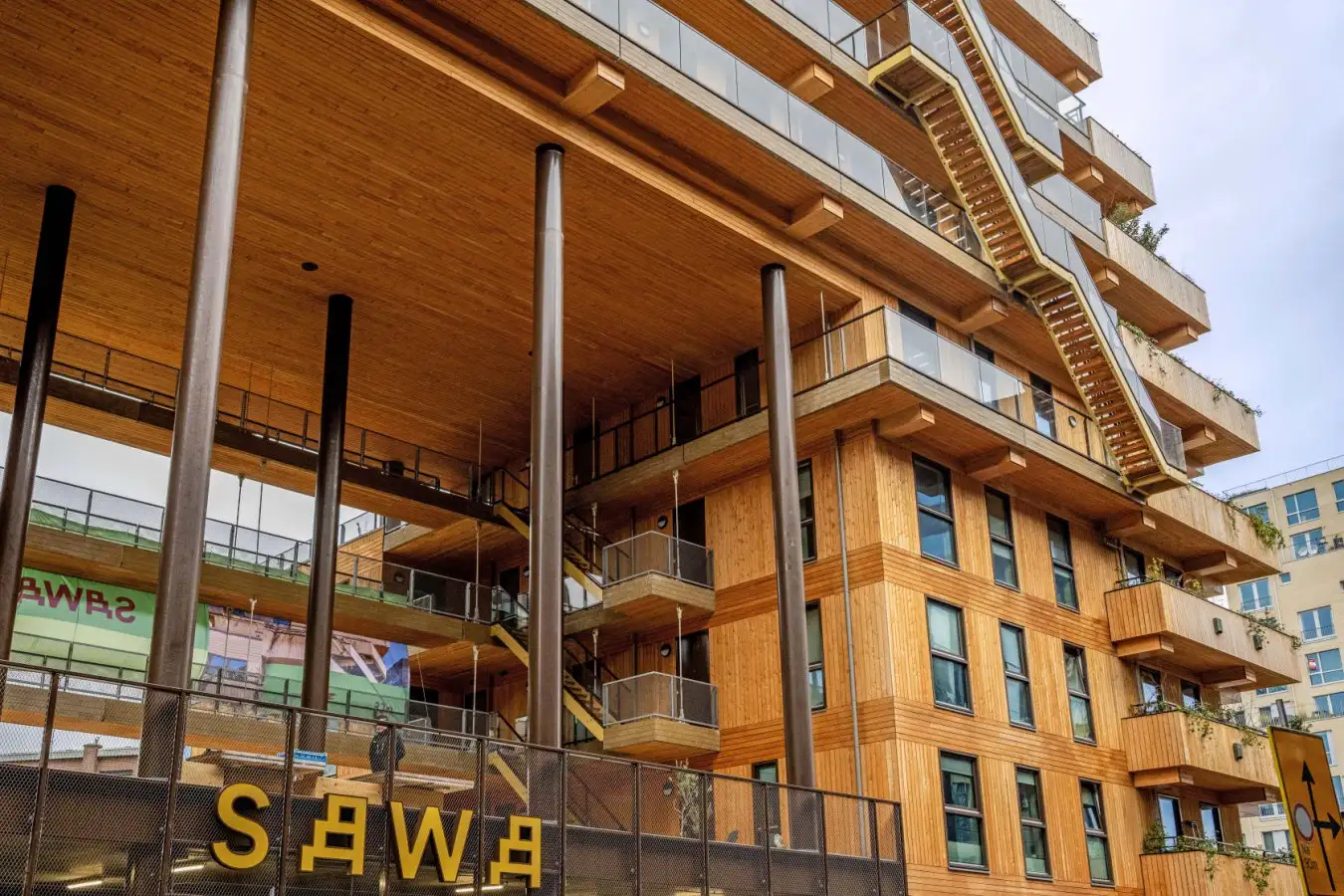
The Sawa residential building in Rotterdam, the Netherlands, is made from wood
Hollandse Hoogte/Shutterstock
Cities must reduce greenhouse gas emissions from the construction of buildings and infrastructure by more than 90 per cent in the next two to four decades if the world is to avoid warming of more than 2°C. That means radical changes are needed in the design of buildings, or what they are built from, or both.
“Canada wants to triple its rate of housing construction. The US has a housing deficit, Australia has a housing deficit, [and so does] basically every country you go to right now,” says Shoshanna Saxe at the University of Toronto, Canada. “How do we build so much more while also demanding that we pollute so much less?”
Yet this is achievable, Saxe thinks. “We’re already building buildings that meet these targets; we just have to build more of the good and less of the bad,” she says. “We’ve had these skills and this knowledge for decades; we just have to use it.”
Globally, construction generates between 10 and 20 per cent of all greenhouse gas emissions, with much of that due to the production of cement. To get these emissions down, countries and cities need to know their current construction emissions and then plan how to reduce them in line with global targets.
But when Saxe’s team was asked to do this for the city of Toronto, the researchers were surprised to find that very few studies have attempted to estimate construction emissions on a city level.
“So we decided to come up with a way of getting a rough estimate of how much cities are emitting when they build buildings and infrastructure, and then also how much they could emit in the future to stay within climate limits,” says team member Keagan Rankin, also at the University of Toronto.
Rankin did this for 1033 cities by combining an existing model used to estimate the environmental impact of products over their lifetime – known as EXIOBASE – with data on the population and growth of cities, construction investment and employment, and so on. “This is all available datasets, but he put them together in new ways that we haven’t seen anybody do,” says Saxe.
Finally, the team estimated how fast each city would need to cut construction emissions to stay in line with the remaining global carbon budget for 2°C. These numbers are crucial for planning, Saxe says, “You need to know what the budget per sector is.”
Cities will bust these budgets if they meet housing demand by building single-family homes, the analysis suggests. They need to focus on more efficient multi-unit housing.
Using different materials such as wood or recycled concrete can also help reduce emissions, but better design is even more important, says Saxe.
“It’s very popular to say we’ll just build wood buildings and that solves it,” she says. “But wood also has greenhouse gas emissions. It is only zero emissions if you make all kinds of really optimistic assumptions, including the rate of forestry growth.”
“It’s actually much more effective to design your buildings well so there’s not a lot of wasted space, and wasted structure,” says Saxe.
Rankin says that cities are well positioned to take action. “Cities are very willing to implement climate action, and when it comes to construction, they have a lot of control,” he says. “It’s just, like we found with Toronto, a lot of cities don’t have the resources to go and determine a budget.”
“Without reducing emissions from the construction sector, we cannot meet the Paris Agreement, even if we reduce other emissions to zero,” says Prajal Pradhan at the University of Groningen in the Netherlands. “In my view, it is helpful to view emissions from a city budget perspective.”
It is also important to design buildings to be low-emission over their entire lifetime, not just during construction, says Susan Roaf at Heriot Watt University in the UK, such as by allowing natural ventilation. “We cannot go on developing cities as they have been growing, riddled with super-polluting ‘zombie buildings’,” she says.
Cutting construction emissions also involves prioritising what is built, Saxe says. For instance, Canada is still constructing a huge amount of oil and gas infrastructure. “We could build new housing for 10 million people [without increasing emissions] if we dialled back how much construction we were putting into oil and gas,” she says.
Topics:
- climate change/
- sustainability
Source link : https://www.newscientist.com/article/2511350-we-must-completely-change-the-way-we-build-homes-to-stay-below-2c/?utm_campaign=RSS%7CNSNS&utm_source=NSNS&utm_medium=RSS&utm_content=home
Author :
Publish date : 2026-01-14 10:00:00
Copyright for syndicated content belongs to the linked Source.