
Lyndon Stratford / Alamy Stock P
In a grey-walled room in the Dutch city of Nijmegen, a strange activity is underfoot. Wearing a cap covered in sensors and positioning themselves into a chair, a person places their bare feet over two holes in a platform. Beneath this lies a robot, which uses a metal probe to begin to tickle their soles. Soon, shrieking, yelps and pained laughter ring around the space. Here, at Radboud University’s Touch and Tickle lab, volunteers are being mercilessly tickled in the name of science.
“We can manipulate how strong the stimulation is, how fast and where it is going to be applied on your foot,” says Konstantina Kilteni, who runs the lab, of the robot tickling experiment. Meanwhile, the researchers record participants’ brain activity and physiological parameters such as their heart rate, breathing and sweating. With the help of neural and physiological recordings, the researchers have one goal in mind: to finally crack questions that have troubled thinkers from Socrates to René Descartes. Why are we ticklish, what does it tell us about the line between pleasure and pain, and is there any real function to this weird behaviour? The answers could shed light on neural development in infants, clinical conditions such as schizophrenia and how our brains construct our conscious experience.
The researchers haven’t yet published their results, but Kilteni can reveal some of what they have found. “The touch has to be strong and very fast to be perceived as ticklish,” says Kilteni, when it comes to what constitutes tickling. The preliminary analysis also shows that electroencephalography (EEG) recordings pick up different patterns of brain activity when someone experiences ticklish sensations. The researchers plan to investigate further, using functional MRI to home in on which areas of the brain process tickling sensations, though the robot must be adapted so it doesn’t interfere with the scanner. The lab’s scientists have also begun to explore the slippery question of whether people actually like to be tickled.
“We see a little bit of everything, so both people that find it pleasant and people that find it unpleasant,” says Kilteni. People might smile or laugh, but this doesn’t always go in line with whether they report that they enjoyed it or not. Plus, impressions can change over time. “Some people anecdotally report to us that, in the beginning, it might be funny, but when it is applied to your body for a lot of time, it starts to become unpleasant, and even painful,” she says.
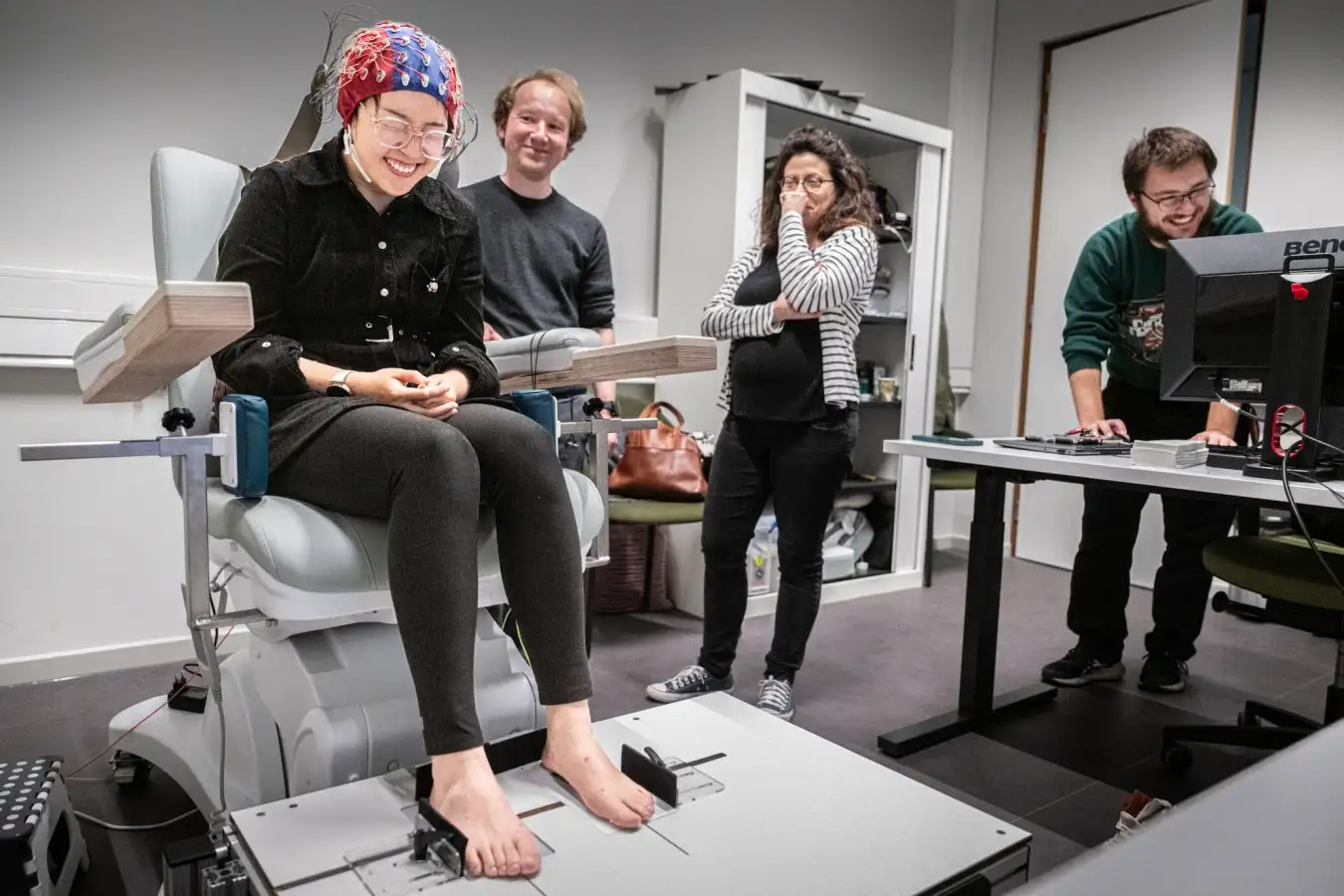
The tickle lab at Radboud University in Nijmegen, the Netherlands
Koen Verheijden
One long-standing tickling mystery that Kilteni is keen to understand is why it is impossible to tickle yourself. This fact seems to suggest that the unpredictability of the stimulus is important, something that has been borne out by contemporary research. Numerous studies have shown that our brain predicts the sensations generated by its own actions and suppresses them, so we generally perceive our own touches as being less intense than those of others. This seems to be disrupted in some psychiatric conditions: research has found that people with auditory hallucinations and a sense of being controlled by an outside force find their own touches more ticklish. “It tells us that this mechanism that the brain has to predict how we are going to feel based on our movements seems to have some deficits,” says Kilteni. “This is also something that we would like to test in clinical populations with schizophrenia.”
Why are we ticklish?
Perhaps the biggest unanswered question is why we are ticklish at all. Only humans and our close relatives are known to engage in tickling behaviour, suggesting that it may have evolved in one of our great ape ancestors. Take chimpanzees and bonobos, who often tickle each other while playing. In a study published earlier this year, Elisa Demuru at the University of Lyon, France, and her colleagues spent three months observing a group of bonobos at La Vallée des Singes in France. They discovered a strong correlation between tickling and age, with older bonobos more likely to be the tickler and younger ones more likely to be the ones tickled.
“This is interesting, because it is quite the same thing as humans, and it means that it is mainly an infant-directed behaviour,” says Demuru. “What we observed is that social bonding has a very strong influence. So those [pairs] that are mostly involved in tickling sessions are also those [pairs] that share a very strong affiliative bond.”
For Demuru, this is a strong indication that tickling evolved as a pro-social behaviour that strengthens connections between youngsters and other members of their group. It is closely linked with play-fighting, she explains: actions that would seem aggressive or unpleasant if carried out by a stranger can be enjoyed when they are done by close relations or friends. Demuru has also been studying bonobos at the Lola ya Bonobo sanctuary in the Democratic Republic of the Congo, observing how orphaned infants react to being tickled by their human surrogate parents and testing the importance of familiarity. “It’s a very special behaviour, and it’s always nice because they laugh, and it’s so cute!” she says.
Even unwanted tickling can elicit laughter, regardless of one’s state of mind and relationship to the person – or machine – doing the tickling. Some researchers argue that this shows ticklishness is a physiological reflex, although this doesn’t rule out the idea that tickling evolved to serve a social function. A third hypothesis supposes that it helps youngsters learn to defend themselves in combat by protecting vulnerable areas of their body. “The reality is that there are arguments against all these theories, so we really don’t know,” says Kilteni.
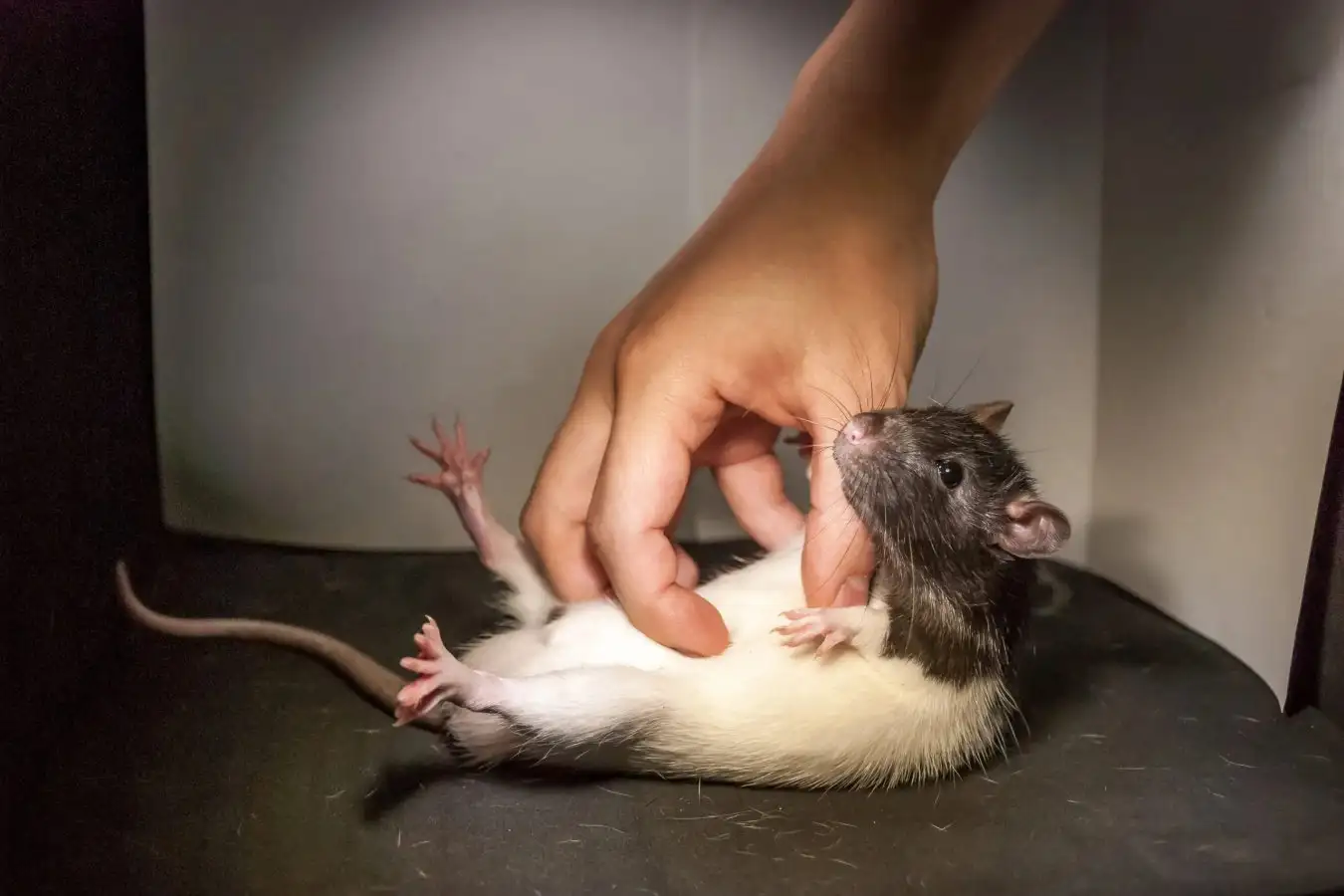
Rats “laugh” when they are tickled
Shimpei Ishiyama and Michael Brecht
However, focusing exclusively on tickling behaviour in great apes might overlook an important part of the puzzle. Although they aren’t known to tickle each other, rodents seem to enjoy being tickled by humans. Mice weren’t previously thought to be ticklish. But Marlies Oostland at the University of Amsterdam in the Netherlands has found that, as long as mice are comfortable, they can enjoy a good tickle. “If you flip them over and they stay in a relaxed state, then you can start tickling them, and that’s when we hear the laughter-like vocalisations,” she says.
These vocalisations are too high-pitched for humans to hear. Curiously, mice may not be able to hear them either, which makes it something of a mystery why the mice laugh at all. Oostland’s research hasn’t been published yet, but it is clear that the rodents like to be tickled. “If we let the mice choose between a hut from their home cage, which is completely safe and has their own smell, or tickling by an experimenter, then the animals will choose tickling over hiding in their hut,” she says.
Oostland has her own idea about why animals, including humans, have this reaction to being tickled. Our brains are constantly creating predictions about the world around us, making decisions about what might be a threat and what we need to do to survive. Tickling, she says, involves being stimulated in a way that violates our predictions. If we feel safe though, that surprise can be invigorating. “This is a hypothesis that I don’t think has been [proved] yet, but I see tickling as something that helps animals, specifically younger animals, to prepare for an ever-changing environment,” she says. Like it or loathe it, perhaps this bizarre behaviour is an evolutionary quirk we should be grateful for.
Topics:
Source link : https://www.newscientist.com/article/2502335-what-the-evolution-of-tickling-tells-us-about-being-human/?utm_campaign=RSS%7CNSNS&utm_source=NSNS&utm_medium=RSS&utm_content=home
Author :
Publish date : 2025-12-10 13:00:00
Copyright for syndicated content belongs to the linked Source.