


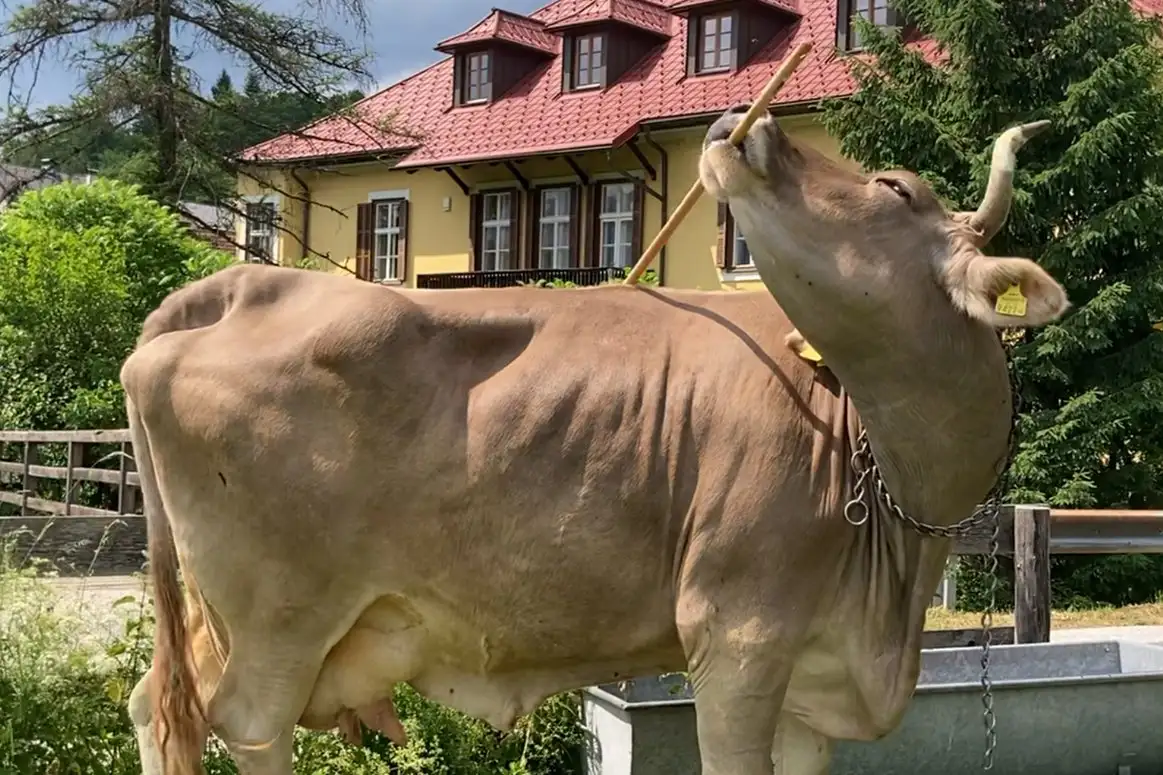
Veronika the cow is the first recorded non-primate mammal to demonstrate flexible, multi-purpose tool use
Antonio J. Osuna Mascaró
A few years ago, during a taxi ride, the driver described to me how a pig had transformed his life. A childhood with dogs taught him what to expect from animals, yet he was unprepared for the pig he had taken in as a favour.
The man told me how he had rigged a string-and-bell system by the door so the animals could signal when they wanted to go outside. Both the dogs and pig learned to do this, but the pig took it a step further: she began ringing the bell to alert the man when a dog was outside waiting to get back in. He had many examples like this, told with pride and affection. At the end of our conversation, I asked whether these experiences had changed his food preferences. They had: he no longer eats pork.
The taxi driver’s experience mirrors a growing trend in how we study the mental lives of other species. For a long time, when scientists looked for cognitive traits comparable to our own, they focused almost exclusively on non-human primates or the “feathered apes” – clever birds such as parrots and crows. More recently, researchers have expanded their focus to include a much more diverse array of species, such as bees, octopuses and crocodiles.
In line with this trend, a new study by Antonio Osuna-Mascaró and Alice Auersperg, both at the University of Veterinary Medicine Vienna in Austria, examines the cognitive capacities of an animal we often overlook: the cow. Veronika, a pet cow (Bos taurus), expertly wields a broom to scratch herself. She uses the bristled end to scratch her back but then flips the tool to use the smoother stick end for her more sensitive underside.
The researchers describe this as the first recorded instance of flexible, multi-purpose tool use in a non-primate mammal. What does this tool use reveal about the minds of cows, and will it change how we treat them?
Broadly defined, tool use is the act of manipulating an object so that its motion directly achieves a goal. This definition excludes behaviours such as nest building or seeking cover underground; while materials are moved to construct a nest, the objects function as a static structure once in place. In tool use, the movement itself is the mechanism of success – whether this involves using a rock to crack a nut or wiggling a twig to fish termites from a mound.
Scholars once thought tool use was a uniquely human trait. Jane Goodall changed this in the 1960s when she first observed a chimpanzee she had named David Greybeard fashioning and using a tool for termite fishing. Decades later, tool use has been discovered in unexpected corners of the animal kingdom.
Doodlebugs, the larvae of antlions, throw sand at prey, while certain digger wasps use pebbles to tamp down their burrows. However, these are highly specialised behaviours that emerged through millions of years of evolution. The cognition underlying these stereotyped actions is different from the flexible tool use that emerges spontaneously in some animals to solve a problem. Veronika’s use of the broom falls into this latter category.

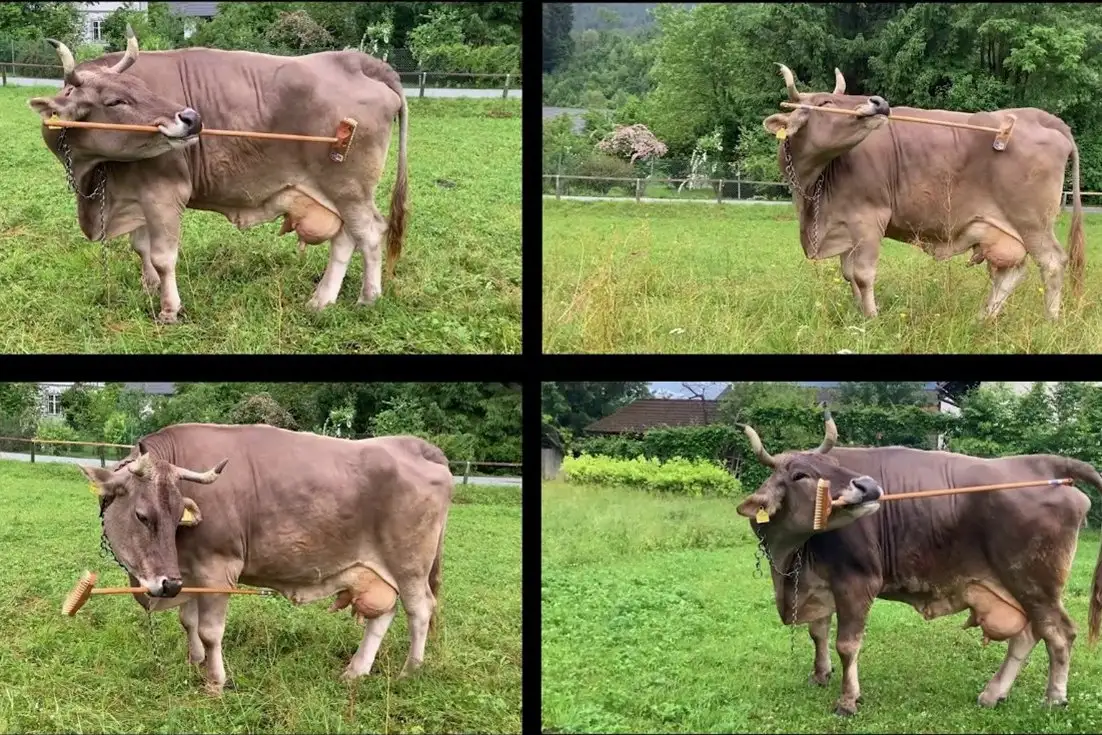
Veronika uses different ends of the broom to scratch different parts of her body
Antonio J. Osuna Mascaró
Veronika was never taught to use tools. This behaviour emerged spontaneously, starting with the use of small twigs when she was young and progressing to the flexible deployment of a multi-purpose broom.
Her behaviour suggests that she has what the psychologist Josep Call identifies as the three ingredients of a creative tool user. First, she gathers information by learning the physical properties of objects. Second, she combines this knowledge to solve problems, recognising that a rigid object can reach an itch that is otherwise inaccessible. Finally, she has a propensity to manipulate objects. This trait is important because physical capacity alone is not enough. While squirrel monkeys and capuchin monkeys have similar hands, only the latter is disposed to manipulate objects.
Will learning more about the minds of cows and other livestock change how we treat them? Research by psychologists suggests that it could. In one study, when asked to rate the mental capacities and edibility of various animals, participants tended to rate those with less of a mind as more edible and those with more of a mind as less edible. In another study, participants were introduced to a species called Bennett’s tree kangaroo. Those who were told the animal was a food source viewed it as being less capable of suffering and less worthy of moral concern than those who were told the animal lived in the wild.
The way we treat animals is strongly correlated to the minds we believe they possess. Veronika’s story is likely the first of many to challenge our perception of “simple-minded” livestock. Yet, for this knowledge to be transformative, we must address our own cognitive dissonance. Denying that animals have minds protects us from the reality of how we treat them. It’s easier to ignore a mind than it is to respect one.
Marta Halina is a professor of philosophy of science at the University of Cambridge
Topics:
Source link : https://www.newscientist.com/article/2511920-why-a-tool-using-cow-could-change-how-we-see-farm-animals/?utm_campaign=RSS%7CNSNS&utm_source=NSNS&utm_medium=RSS&utm_content=home
Author :
Publish date : 2026-01-19 16:00:00
Copyright for syndicated content belongs to the linked Source.