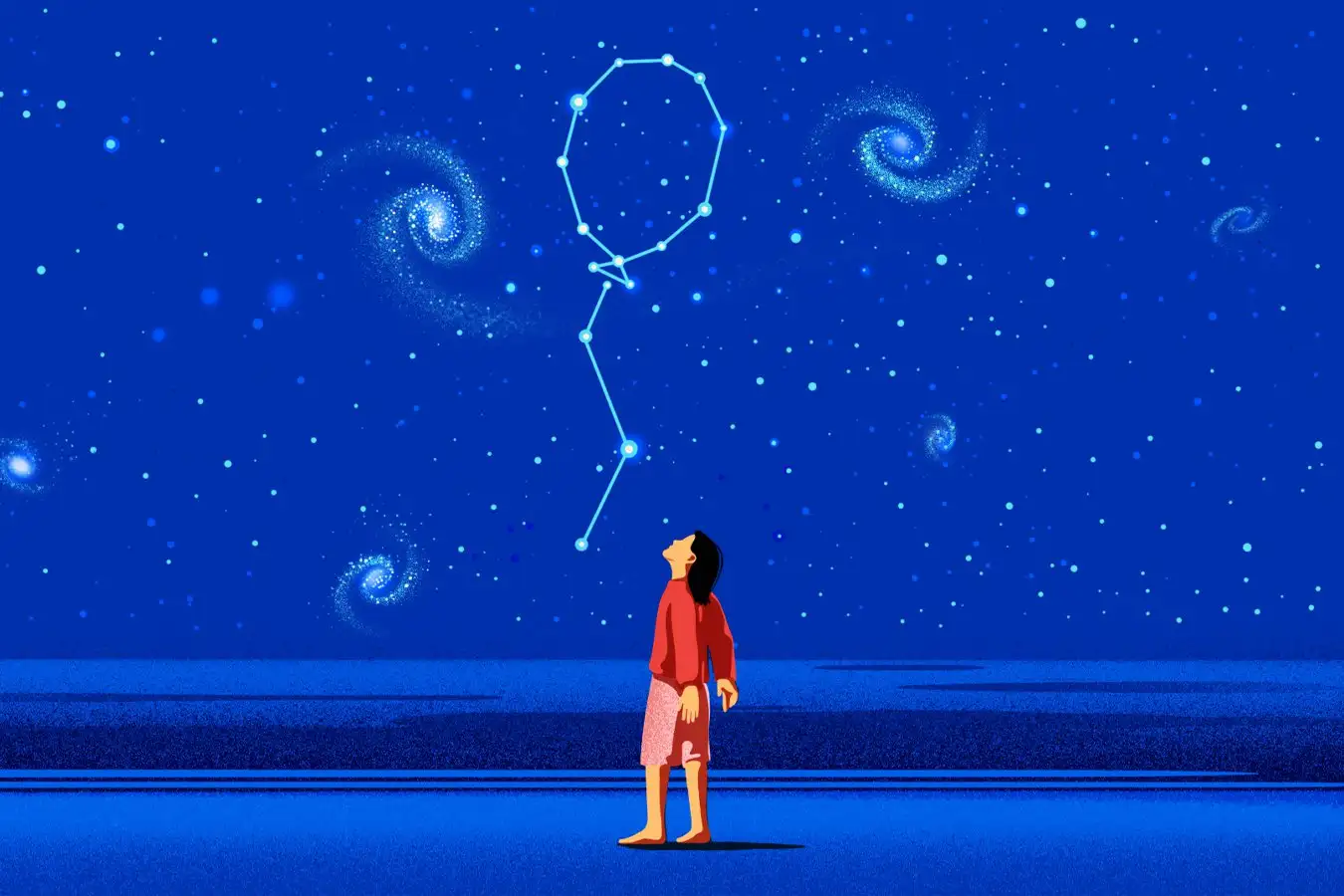
For me, this year is going to be all about self-care via the stars.
It has been 20 years since I first felt palpable envy at someone being able to navigate the night sky. In 2006, I was at a conference in La Jolla, California, reporting for New Scientist. Among the delegates was astrophysicist Neil de Grasse Tyson. One evening, as we were all having an al fresco dinner, he took out a laser pointer and gave us a tour of the visible constellations. I was mesmerised, and impressed by the ease with which Tyson wandered through the heavens. I made myself a promise: when I got home, I was going to become a stargazer.
It didn’t happen. I still haven’t learned to spot much beyond Orion and the Plough, or Big Dipper. Maybe I can blame the streetlit skies of my neighbourhood, but I can also blame the fact that, even then, I was older than is ideal. A love for the night sky is best developed in childhood. Those who start young, guided by a parent or family friend, tend to have a lifelong affinity with the heavens. And, crucially, they also tend to have better mental health.
Connecting with the cosmos is good for us. Research shows it is associated with various positive aspects of mental health, as well as improved general happiness. It even makes us more generous.
The love for looking up on a dark night is known as noctcaelador, from the Latin for “night”, “sky” and “adore”. The phrase was coined in 2003 by William Kelly, a professor at George Fox University in Portland, Oregon, in a paper investigating attitudes towards stargazing. Participants reported that they “strongly enjoyed watching the night-sky” and that they experienced an “improved mood from watching the night-sky”.
Last year, Kelly published further research showing that noctcaelador is related to a personality trait known as openness to experience, which is especially achievable in childhood.
That fits with research into the experiences of Generation Z lovers of the night sky. Members of Gen Z were born between the mid-1990s and the early 2010s, and are the first “digital natives”. Holly Brenna McNiven published an exploration of noctcaelador in Gen Z last year as part of her master’s degree project at the University of Wales Trinity Saint David. She found that many of those who reported a love for the night sky – which was associated with positive well-being – can trace their noctcaelador back to childhood experiences of astronomy.
Her study involved only 29 young people, who were recruited via astronomy clubs, so it is hard to say how representative they were of their generation. What we can say is that sharing a love of the stars with younger people can ensure that the love goes on. McNiven reports developing an affinity for the night sky through stargazing with her parents, and the majority of her participants also “noted memories linked to learning and socialising with neighbours, teachers, friends and family members”.
I’m a little sad that I didn’t get that star-love instilled in me as a child, but there’s still time. And these days, I don’t even need clear or dark nights – good news when light (and other) pollution means most of the world’s population no longer has access to a star-strewn sky. After all, who needs clear skies when there’s a growing gaggle of astronomers on TikTok (“SpaceTok”, for the initiated)?
They are mostly Gen Z, though, so I’m not sure SpaceTok is for me. Being a little older, I am thankful that, on cloudy evenings, you can still connect with the cosmos through books. I have a copy of Brian May’s new Islands in Infinity, which presents stereoscopic photographs of galaxies. And for Christmas, I got Nigel Henbest’s Stargazing 2026, a guide to this year’s sights for those who choose to look up. I just need to invest in a laser pointer and I could soon be giving Tyson a run for his money.
Michael Brooks is a science journalist and author specialising in physics
Topics:
- mental health/
- star gazing
Source link : https://www.newscientist.com/article/mg26935760-100-why-im-going-to-reap-the-mental-health-benefits-of-stargazing-in-2026/?utm_campaign=RSS%7CNSNS&utm_source=NSNS&utm_medium=RSS&utm_content=home
Author :
Publish date : 2025-12-30 18:00:00
Copyright for syndicated content belongs to the linked Source.