
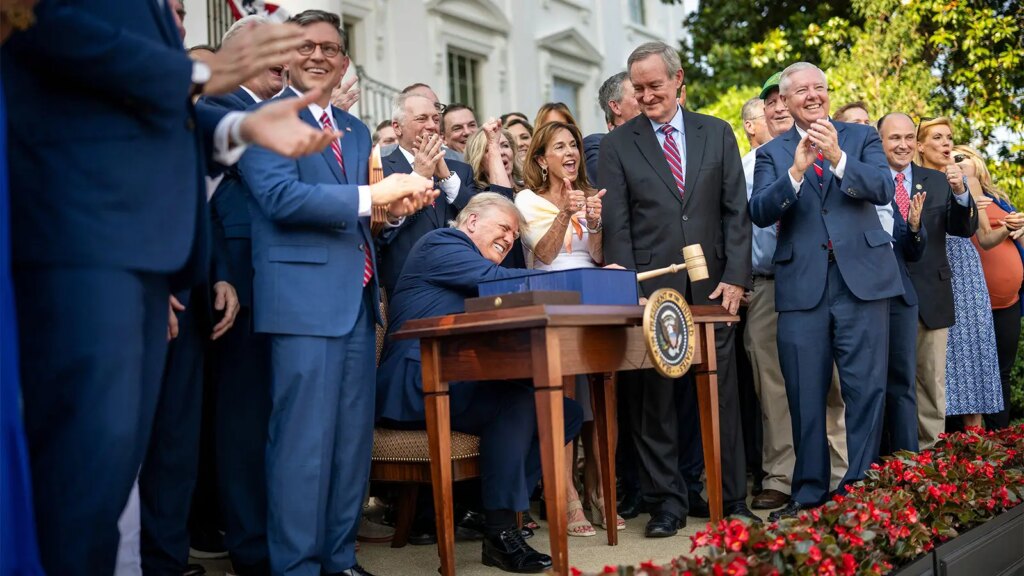
- The One Big Beautiful Bill Act may impose the largest health insurance coverage losses in U.S. history.
- Studies of four previous coverage contractions found that enrollees who were dropped from Medicaid experienced worsened access to care and poorer health outcomes.
- The new law may not spare “truly needy” enrollees from negative impacts of coverage losses.
Based on prior history, cuts to federal healthcare programs as part of the One Big Beautiful Bill Act (OBBBA) and the expiration of Affordable Care Act (ACA) enhanced premium subsidies will result in big drops in public coverage that will worsen existing problems in the health insurance marketplace, authors of a study found.
“The experience of these prior coverage contractions … [predicts] that widespread insurance loss will lead to a reduction in care utilization, an increase in household financial strain, and worsened physical and mental health for low-income individuals,” Adam Gaffney, MD, of Harvard Medical School in Boston, and colleagues wrote in the Milbank Quarterly. “These coverage contractions additionally suggest that most who lose Medicaid coverage will not find alternative coverage; that work requirements will impose burdensome administrative costs on states; that states are unlikely to offset reductions in federal Medicaid funding with internal funds; and that the second-order effects of coverage losses may, in some instances, be greater (in magnitude) than the benefits seen after coverage expansions.”
The coming decade will usher in the largest healthcare coverage contractions in history, the authors noted in their introduction. This includes 10 million who will become uninsured by 2034 due to the Medicaid funding cuts under the OBBBA and another 4 million more who are projected to lose coverage due to the expiration of the ACA subsidies.
Supporters of the cuts, including the Trump administration and congressional Republicans, say that the cuts will not affect the “truly needy.”
“This rhetoric echoes previous defenses of Medicaid cuts,” the authors wrote. “‘Our spending cuts will not be at the expense of the truly needy,’ President Ronald Reagan stated in a February 1981 address, shortly before signing the Omnibus Budget Reconciliation Act (OBRA), which delivered historic Medicaid cuts.”
Four Coverage Contractions Examined
But did that turn out to be true? To answer that question, the investigators examined the experience of four major previous coverage contractions:
- President Reagan’s 1981 OBRA cuts
- A large state-level Medicaid contraction in Tennessee in 2005
- The 2018 Medicaid contraction in Arkansas due to the imposition of work requirements
- The “Medicaid Unwinding” of the 2020s due to the expiration of the pandemic-era rule prohibiting states from disenrolling people from Medicaid
The 1981 OBRA cuts reduced eligibility for welfare — “and hence Medicaid” — at the same time it cut certain states’ matching Medicaid funds. While this was occurring, a recession was happening — interest rates were spiking, unemployment was rising, and poverty was increasing. All these latter factors should have increased Medicaid enrollment, and yet it stayed flat, the investigators said. “This demonstrates that failure of Medicaid enrollment to rise during a recession — rather than an absolute decline in enrollment — can be a manifestation of a Medicaid cut,” they wrote.
The contraction of TennCare, Tennessee’s medicaid program, occurred during the decade after the program was launched in 1994. The state expanded eligibility to include the uninsured and the “uninsurable,” and within 10 years, nearly one-fourth of the state’s population was on Medicaid, and it took up about a third of the state budget.
The fiscal strains led the state to cut off Medicaid coverage for 170,000 nonelderly adult enrollees in 2005. That cut was tied to several adverse health effects, studies found, including worse self-reported health and reduced doctor visits, hospital use, mammograms, and clinical breast exams. It also was linked to increased medical debt and lowered credit scores as well as increased evictions. “One analysis found that the TennCare disenrollment led to a rise in uncompensated care at hospitals,” they added.
Cuts From Red Tape in Arkansas
In the case of Arkansas, the authors looked at what happened after the state imposed work requirements in mid-2018. The program required adults up to age 49 in the ACA expansion population to set up an online account followed by an ongoing, multi-step process of reporting exemptions and/or work activities. The program’s startup led to the rapid disenrollment of 18,000 persons from Medicaid. The program was eventually terminated when a federal judge ruled that its requirements were illegal.
One study analyzing Medicaid enrollment in the state from 2016 — before the program started — to 2018 (after implementation) found a 13.2-percentage-point drop in the number of people with Medicaid coverage and a 7.1-percentage-point increase in the share of Arkansas residents who were uninsured. Many enrollees also appeared to be confused about the rules, and the same study found that 95% met criteria for either work or qualifying exemptions “suggesting that most of those disenrolled remained eligible for Medicaid but fell through administrative cracks because they were unable to comply with the reporting requirements,” the authors wrote. “Notably, individuals who lost Medicaid during the year that work requirements went into effect reported high rates of deferred care due to cost (56% of respondents) and medical debt problems (50%).”
Results of Medicaid ‘Unwinding’
The Medicaid “unwinding” that occurred beginning in April 2023 resulted in a nationwide drop in Medicaid coverage from 98 million to 78 million 2 years later. However, the uninsured rate rose only slightly, which the authors attribute to two factors: low unemployment and a big increase in ACA premium subsidies, which allowed more people to enroll in ACA marketplace coverage.
Despite assurances that those who were really needy would be spared from harm, “many individuals clearly suffered adverse consequences due to coverage loss,” according to the investigators. “Disenrollment during the unwinding was associated with going without a checkup (57% of those disenrolled), delays in care due to cost (51%), and foregone medications due to cost (45%).” In addition, “Medicaid disenrollments were associated with a fall in buprenorphine prescribing, and in asthma treatment among children.”
“Overall, the evidence predicts that the OBBBA will produce sharp contractions in public coverage; that relatively few of those who lose public coverage will find alternative coverage; that such contractions could be exacerbated if the economy sours … and that coverage losses will increase financial strain, reduce use of care, endanger health, and result in medically-preventable deaths,” the authors concluded. “Together, this evidence contradicts the notion that Medicaid cuts — even those directed at working-age adults — spare the ‘truly needy.'”
Please enable JavaScript to view the comments powered by Disqus.
Source link : https://www.medpagetoday.com/publichealthpolicy/medicaid/121110
Author :
Publish date : 2026-05-04 21:29:00
Copyright for syndicated content belongs to the linked Source.